Showing posts with label cleric. Show all posts

Monday, April 14, 2025

Saga of the Ortegids: Other Pantheons

The Nine Gods comprise the main pantheon of The Saga of the Ortegids. These are the gods you can expect to be worshiped in any temple in respectable society, no matter where in the world(s) you go. However, these are not the only gods that exist in this universe. Other cults to other powers might not be as large, widespread, powerful, or accepted, but they do exist. Here are some other gods worshiped in the world of the Ortegids, and the roles they play in the setting.

The Beast Gods

A number of gods exist that are always depicted in animal form. These are believed to be older, primeval spirits, their cults predating the formation of those of the Nine Gods - according to some theologists, the Beast Gods existed long before the Nine Gods ever came to this world. In most of the world, worship of the Beast Gods has been supplanted by that of the Nine Gods, though they still have a following, especially among so-called barbarian societies such as Aliahan, Suland, and the hill tribes scattered throughout wild areas of the world. They are also commonly worshiped by beastmen, and some elven kingdoms. Worship of the Beast Gods is tolerated, as their followers can comfortably coexist with civilized society, but tends to be considered backward and the domain of heathens in the countryside among more advanced realms.

Ramia
, the God-Bird, is celebrated as the great phoenix, and a bringer of hope and life to the world. Her shrine sits on the frozen island of Liamland, where it is said that once an Age she emerges from a pit of fire tirelessly watched over by two sacred virgins, then flies around the world, chooses one who is destined to be a great leader of men, and then burns herself upon her own pyre so the cycle can continue again. She is also associated with the ideals of freedom and exploration, owing to her power of flight, which makes her popular among adventurers. Although one of the Beast Gods, Ramia is invoked in the courts of many kings due to her powers of prophecy and association with divine right, and her holy symbol can be found on many coats of arms, including that of the Ortegid Dynasty - Erdrick the Aliahanian was a follower of Ramia, and was said to have ridden her into battle.
  • Ramia appears as a massive bird with iridescent plumage. Her holy symbol is a stylized depiction of a phoenix in flight.
  • Alignment: Chaotic Good
  • Domains: Life, Light, Nature, Tempest
  • Oaths: Conquest, Glory, Vengeance
Nim-Tso
, the Serpent God, is the god of poisons, thieves, murderers, and other criminals. He is associated with trickery and betrayal, and for this reason, cults devoted to him are not openly tolerated. However, there are many guilds of thieves and assassins that pay homage to him. For some, this is treated as more of a metaphorical bond, associating their clandestine operations with that of the sinister serpent god, but other, darker organizations conduct their grim business in Nim-Tso's name, and some are rumored to offer dark rituals, offering human sacrifices to their dark god. No matter how many times the authorities try to stamp out these illicit snake cults, it seems that a new one always springs up not long after. Aside from his patronage over criminals, Nim-Tso is also revered by the lizardmen, who consider him their honored forefather.
  • Nim-Tso takes the form of a massive serpent. His holy symbol is two snakes coming together, facing each other, but they're one.
  • Alignment: Neutral Evil
  • Domains: Nature, Trickery
  • Oaths: Treachery

The Forbidden Gods

These are the gods toward whom worship is not tolerated by most societies, as their portfolios are considered incapable with civil life - the gods that govern such things as death, destruction, and cruelty. Worshiping them usually entails partaking in overtly destructive behavior, and thus their cults are forced to operate in the shadows - there are some exceptions, however, when these cults grow powerful enough to challenge civilized rule, as happened with the Children of Hargon, a Malrothite cult that managed to usurp the rulership of Rhone during the War of the Three Kingdoms. Although these gods are not counted among the Nine Gods due to matters of good taste, they are nonetheless agreed to be beings of the same order, and just as powerful and immortal. They are not to be confused with demons, which do not as a rule seek followers, and even the most powerful demons are less powerful than gods. Generally, however, demons do worship the Forbidden Gods, as their interests tend to overlap, and cultists of the Forbidden Gods often summon demons to do their bidding. To shamelessly rip off Knight at the Opera, demons of the Lunar Lands are classical; demons in Saga of the Ortegids are heavy metal. The Forbidden Gods are also worshiped by the more savage tribes of beastmen.

Art by noba
Zoma
, the Three-Eyed God of the Winter Wind, is the god of death, decay, and stagnation - he who sees to the end of all things. He is associated with ice, cold, snow, and winter, due to how frost kills crops and brings an end to the harvest season. Traditionally, he is held as the twin brother of Rubiss, and her equal and opposite in all respects. Long before the first humans drew breath, Zoma rebelled against his brethren in the God-War, feeling spurned for his macabre character, and attempted to get revenge on the other gods by bringing death to their creations, but was exiled to the Black Pits of Hades. To this day, however, he plots his vengeance, and seeks mortals to further his goals. He taught necromancy to mortals through the manipulation of life and death - unlike Melisine, he's just tasked with making things die, not what happens to them afterward, and he can't really care less about that.
  • Zoma's preferred form is that of a horned three-eyed giant with sickly blue skin, and he may manifest in this form if the proper ritual is performed, but most of the time can only project enough power over the mortal realm to appear as a gigantic eye spanning the sky. His holy symbol, likewise, is that of an eye.
  • Alignment: Neutral Evil
  • Domains: Death, or use a School of Necromancy Wizard to represent a pilgrim of Zoma.
  • Oaths: Oathbreaker
Malroth
, the Many-Fanged God of the Black Pits, is the god of chaos and destruction. If Zoma represents the silent, slow deterioration of entropy, then Malroth is the loud, fiery, violent cataclysm that destroys indiscriminately; the beast that will one day devour the universe and brings about natural disasters to sate his lust for wanton ruin. He is perhaps the oldest of the gods, ruling over the Black Pits since the dawn of existence, and will bring about the end of all things when the apocalypse comes. While most mortals view him with horror and disgust, for obvious reasons, he is considered the father of all demons, and many monstrous beings are said to have spawned from his flesh. His cults, however scarce, are some of the most terrifying. Some fear him, offering sacrifices to placate his hunger so that the end times might be delayed...others, worse yet, seek to summon him in order to accelerate the end of the world.
  • Malroth appears as a hideous creature with six clawed arms, bat-like wings, and a grinning mouth full of fangs. His symbol is a fanged maw flanked by wings.
  • Alignment: Chaotic Evil
  • Domains: Death, War
  • Oaths: Conquest, Oathbreaker

Thursday, April 3, 2025

Saga of the Ortegids: The Nine Gods, Part 2

Here's the other half of the main pantheon of The Saga of the Ortegids. See here for part 1.

Gaius
, the Forgemaster, is the god of the sun, fire, and the forge. He is the patron god of the dragons (and Dragovians), who - as beasts of fire - regard him as their forefather, but he is also a patron to the dwarves thanks to his association with the forge. Legend has it that he taught the secrets of fire and metalworking to mortals. His temples tend to be placed in areas of volcanic activity, as volcanoes are revered as the chimneys of his workshop buried deep within the earth; when a volcano erupts, it is because he is drawing on its heat to forge fantastic treasures. Gaius has created many magical artifacts, but the most celebrated of all is the Sphere of Light, a ball of congealed radiance and the most sacred treasure known to dragonkind. He originally created it as a gift to the dragons of Erdland, but it has since passed into the hands of the Kingdom of Alefgard, who use it to control the Inner Sun of Torland.
  • Gaius's appearance varies depending on who he appears to. He tends to appear as a stout bearded man or a dwarf when dealing with humanoids, and as a dragon with scales that flicker in the colors of fire when dealing with dragons and their kin. Depictions of the god in artwork likewise reflect the culture of their origin.
  • Alignment: Lawful Neutral
  • Domains: Forge, Light, Nature
  • Oaths: Crown
Astrella
, the Eternal Muse, is the goddess of love, beauty, music, and the arts. She taught mortals the secrets of music, and delights in striking them with the inspiration to compose great works. Her temples often exhibit paintings, sculptures, and tapestries donated by the faithful, and her prayers are always sung, some of them incorporating instruments. She also has power over romantic attraction, and presides over all marriages and oaths of love - though legends say that she is not afraid to compel people to fall madly in love with animals or inanimate objects simply because the act amused her. As befitting of a goddess of such passion, she is not afraid to encourage roguish tendencies in her worshipers, and her creed urges that one must follow their heart's true desire, regardless of ethics or the law of the land. This has made her cult popular among thieves and criminals, and a controversial one among many authorities.
  • Astrella appears as a striking woman - it is said that everyone who beholds her sees their ideal of beauty. Other legends say that this is only a guise, as beholding her in her true radiance would cause a mortal to go blind.
  • Alignment: Chaotic Neutral
  • Domains: Trickery, Unity, Zeal
  • Oaths: Devotion, Treachery
Wyrdpater
, the Father of Fate, is the god of fate, prophecy, and magic. He alone knows the ultimate fate of all beings, and sees to it that they play their part in the grand scheme of reality. He keeps the secrets of fate closely guarded from mortals, fearing that if they know of their destiny they will seek to work against it; to that end, he is known to place curses upon those who know too much, and sends his agents to bring them into line. He has, however, entrusted certain mortals with the ability to see into the future, or even manipulate reality itself - this is in itself a means to further the plan in mysterious ways that only he truly understands. Through this he imparted mortals with the secrets of magic, though his teachings have spread far beyond his original selection, and magicians conducting their own research have discovered further secrets independent of his guidance. Some say there are some spells even Wyrdpater refused to teach to mortal man, such as the pursuit of eternal life. To pursue these forbidden magics is a dangerous pursuit, but one considered the ultimate goal of sorcery among some circles.
  • Wyrdpater is depicted as a wizened old man with a long beard, dressed in the garb of a wizard. He is usually shown carrying a scroll, upon which is written the fates of all mortals.
  • Alignment: True Neutral
  • Domains: Arcana, Fate, Knowledge, or use a Diviner to represent a pilgrim of Wyrdpater.
  • Oaths: Ancients, Watchers
Verina
, the Beastmatron, is the goddess of animals and nature. She is the mother and mistress of all beasts, and her priests are gifted with the ability to commune with them. The forest is her domain, and her ceremonies are often held in the open air at sacred springs or groves, many of which are said to be the dwellings of her nymph daughters. In part, this is because she opposes any intrusions on the balance of nature, considering artificiality and construction to defile the sanctity of the natural world. Her worshipers will fiercely guard her sacred places from outsiders, and she will rally wild beasts to fight alongside them in their defense. According to legend, she does not dwell with her divine brethren; instead, she prefers to wander the world to witness the beauty of nature up close, though only select mortals can see her. Unexplained breezes are attributed to her running by.
  • Verina is often shown as a young woman barefoot and dressed in simple animal hides, with branches tangled in her hair, or a crown of leaves. She is sometimes depicted as a beastman (especially among beastmen).
  • Alignment: True Neutral
  • Domains: Nature
  • Oaths: Ancients, Watchers
Hesper,
 the Hearth Mother, is the goddess of hearth and home. She does not have any major temples - instead, she commands the faithful to worship her over the fire, during everyday tasks, and before going to sleep at night, thanking her for their good fortune during the day. Keeping the home orderly and providing for one's family is considered a worshipful act. She commands her followers to respect the sanctity of hospitality, and commands them not to take up arms unless attacked first. Despite her homebody nature, her cult has many pilgrims, as she inspires them to go forth performing acts of charity to the poor and downtrodden who have no home or family to call their own, standing in the defense of those who have no one else to care for them. Other priests run hostels for weary travelers and the poor to rest.
  • Hesper appears as a stout, matronly woman in an apron. Despite her divine nature, she does not favor the grandiose pageantry of other gods, and prefers to present herself modestly and humbly. As such, depictions of her are difficult to distinguish from those of ordinary people.
  • Alignment: Neutral Good
  • Domains: Life, Peace, Protection
  • Oaths: Redemption

Monday, March 31, 2025

Saga of the Ortegids: The Nine Gods, Part 1

Following up from last post, it's high time we began to lay out the pantheon we're working with for The Saga of the Ortegids. For the primary religion of the setting, I've arbitrarily decided on a set of nine gods, all of whom are traditionally regarded as siblings. These gods are worshipped more or less universally throughout Erdland and Torland, and any holy man will likely know a few prayers to each of them, even if they may focus on a single patron (though some are generalists). There are other gods that coexist with the Nine Gods, and may even be worshiped alongside them in some temples, but are not considered a part of the same group; these will be discussed in a later post.

The Dragon Quest games do give us some gods to work with, but most of this is me filling in the space between the broad strokes with my own creations, and striving to create something with a suitably sword-and-sorcery feel. There will inevitably be some overlap with the gods of the Lunar Lands, but I've done my best to make this pantheon feel distinct.

Rubiss,
 the Allmother, is the goddess of life, creation, and fertility. One of the most popular of the Nine Gods, idols dedicated to her can be found throughout the two worlds, and there is at least one temple devoted to her in just about every major city. Fittingly, her portfolio is broad, and she is favored by farmers, craftsmen, midwives, and healers - just about anyone who creates things or preserves life. It is said that she created all living things in the worlds, and treats them as a mother does her children - with nurturing respect, and with discipline for those who misuse the gift of life. She is one of the patrons of the legendary Ortegid Dynasty, who carry a sacred crest gifted to Erdrick the Aliahanian by Rubiss herself as a family heirloom.
  • Rubiss appears as a beautiful woman with red hair - people with red hair are regarded as having the blessings of Rubiss. Her symbol is a set of three rubies laid in an upside-down triangle, typically worked into an amulet.
  • Alignment: Neutral Good
  • Domains: Life, Peace, Protection
  • Oaths: Devotion, Redemption
Estark,
 the Eternal Swordsman, is the god of war and battle. According to legend, he dwells atop a mountain (where exactly this mountain is varies from region to region) on a throne of iron awaiting a worthy challenger, and the souls of all warriors who die in battle must face him in a duel. Though no mortal can beat him, if he is impressed with their strength, he will let them into Valhalla; if he is not, he throws them down the mountain, where they must fight their way back up against all other hopefuls to earn another chance against him. Estark is not usually called upon in battle, as it is considered a sign of weakness to rely on him; nonetheless, he does bless weapons and sword-arms, and his clerics often study martial magic.
  • Estark takes the form of a giant clad in armor, wielding a weapon in each hand and bearing two horns on his head, along with a third eye that beholds all battles in the world. His symbol is a set of brazen horns hung from a pendant, either worn or dangling from the hilt of a weapon.
  • Alignment: Chaotic Neutral
  • Domains: Strength, War
  • Oaths: Conquest, Glory, Vengeance
Melisine
, the Queen of the Night, is the goddess of night, the moon, the dead, and the underworld. She rules over all the sun does not touch, including both the night (and nocturnal creatures) and the underground (and any creatures that dwell there). She also rules over the souls of all those who do not die in battle. Note that while she is the goddess of the dead, she is not the goddess of death; she only has sway over those who have died, not the means of their death. Though her portfolio is a macabre one, and she is often worshiped by subterranean clans of beastmen, she is not regarded as one of the Forbidden Gods, and offerings made to the ancestors pass through her. She is also a patron of dwarves, hobbits, and gemcutters, as gems come from the earth.
  • Melisine is depicted as a pallid woman in dark robes and the veil of a mourner. Her symbol is a skull with gems set in the eye sockets.
  • Alignment: True Neutral
  • Domains: Grave, Twilight
  • Oaths: Ancients, Watchers
Art by Juan del Pino
Boros
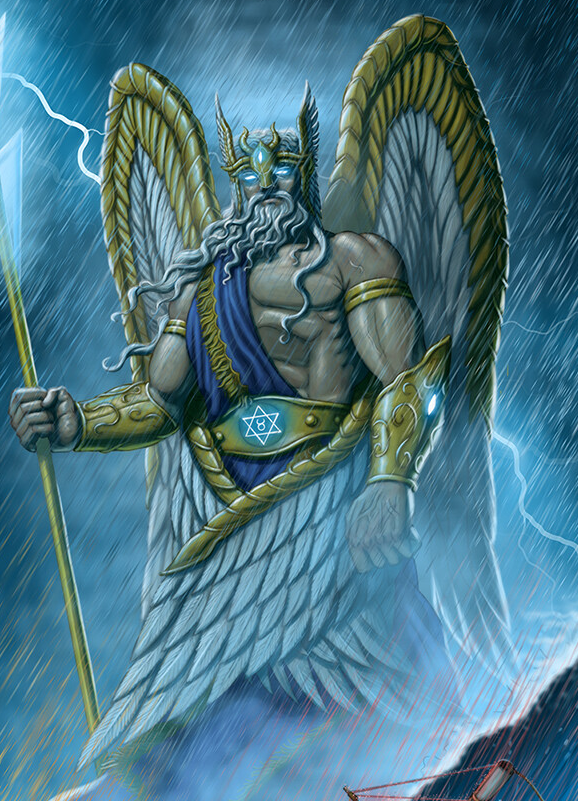
, the Tidefather, is the god of the sky, the sea, and the storms. He dwells beneath the waves, and the merfolk are of his blood, but he is also a god of thunder and lightning, calling down storms and winds for his amusement. As he is of a tempestuous and unpredictable nature, his clerics are sought out by merchants and sailors to protect their vessels, and he has a large temple in Ashalam, as well as in the Torlandic port city-state of Lianport. It is held that anything that falls into the sea belongs to him, and retrieving treasure from shipwrecks may garner his wrath. For that matter, there are many unique beasts of the sea and air that are Boros's favored children, such as the Condors of Hades, which are capable of summoning a great gust of wind from the beating of their wings that can divert the course of ships. Those these beasts are great and deadly, he will not take kindly to any of them being harmed.
  • Boros appears as a weather-beaten man with a long beard, often with either the tail of the fish or the lower legs of a bird. He always has bird-like feathers along his arms, or wings on his back. His symbol is a set of wings.
  • Alignment: Chaotic Neutral
  • Domains: Nature, Tempest
  • Oaths: Ancients, Open Sea

Tuesday, November 19, 2024

Halfling Magic

Strictly speaking, the halflings of the Green Downs are not ones for magic. Mastery of the mystic arts involves hours upon hours of careful study, hours that most halflings would rather devote to honest farm work. So too, in such an insular society, halflings are reluctant to entertain the scholarly traditions of magic from outside the Green Downs.

However, it cannot be denied that the Hinnisch folk often encounter situations in which magic is useful. They too suffer ailments and need protection against robbers and the elements. They too lose tools that no one can find, and they too may be bedeviled by spirits. To that extent, the halflings have their own traditions of spellcraft that exist within their own communities.

In the Hinnisch tongue, magic is known as braucherei, and a practitioner is dubbed a braucher (pl. braucheri). There are only a select few families in the Green Downs that practice braucherei; it is a gift passed down through generations, and most halflings do not bother to study the mystic arts unless they are born into them. The braucher families keep meticulous records of their traditions, sharing their knowledge with their children from a young age to carry on their craft. All braucherei consider themselves members of the same extended family, united by craft if not by blood; as such, they do not intermarry, though any child with at least one braucher parent may have the gift. When a child is born to a braucher family, all braucheri in the nearby villages gather to celebrate the occasion. At these meetings, a ritual is performed to confirm whether or not the child has an innate skill for magic - if they do, they are taught the craft, trained from childhood to carry on the family business.

Braucheri deal strictly in white magic - that is, protective and healing spells. They consider offensive magic and curses - black magic - to be dangerous and unholy, and fear it. In game terms, they are best represented by clerics of the Life or Peace domains. Halfling magic, like the traditions of the cunning folk in human lands, is influenced heavily by religion, and incorporates prayers and the invocation of deities and saints, but braucheri are not ordained members of the Pantheonist cults.

The braucheri collect their wisdom in grimoires - which, in halfling tradition, do not consist solely of spells; a typical Hinnisch grimoire will also contain prayers, mundane remedies, and even recipes for food and drink. These tomes can be considered a collection of all information the braucheri consider useful to have at hand, which, for halflings, includes the more victual pleasures of life. The most prized grimoires of all, however, are the missives of heaven - texts held to have been miraculously delivered from the gods themselves. These texts are magic in and of themselves, and protect anyone who carries them from harm, be it from demonic powers or the hands of men. However, in order for such protection to apply, the user must abide by a code of conduct outlined in the text. Failure to live by its tenets means the spells will be undone.

Braucheri enjoy a position of status within halfling communities, revered as healers, teachers, and religious leaders. Many villagers will turn to them for help that only they can work. However, though it is unusual for halflings in general to stray far from their burrows, and braucheri specifically even more so, there are some that may be found plying their craft in other lands, or along the roads.

Art by Caterina Capogrossi
Background: Braucher

Prerequisites: Must be a halfling. Optionally, a DM may allow PCs of other races to take this background if they have, for whatever reason, been raised among halflings, but this is rare.

Suggested Names: Pennsylvania Dutch names, or classically Tolkienian hobbit names.

Skill Proficiencies: Arcana, Religion

Tool Proficiencies: Herbalism kits, one set of artisan's tools or musical instrument of your choice.

Languages: Hinnisch, Celestial.

Equipment: A healer's kit or a herbalism kit, a grimoire, a set of common clothes, and a pouch containing 50 GP.

Feature: Hex Sign. You have been taught several apotropaic sigils, and can imbue them with power; halflings use these to decorate their barns and homes, and they are often of fine craftsmanship, featuring bold colors and artistic designs. You may spend an hour to paint a sign on a building no larger than a barn; all creatures within that building are under the effects of a protection from evil and good spell. This effect ends if the sign is damaged or the wall it is on is destroyed.

Thursday, February 8, 2024

Minor Gods of the Lunar Lands

In a previous series of posts, I described the most prominent deities in my setting. But these are merely the most prominent deities. The Lunar Lands has innumerable gods, and just about every concept has its own patron. Though there may be a select few gods with relevant enough or broad enough portfolios to be worshipped just about anywhere, that is by no means an exclusive list.

In my opinion, pantheons do much more for the worldbuilding of a setting than they do for it mechanically. Gods are - or at least they should be - much more than just things that grant certain spells to clerics. The role of gods and religion in a setting influences its culture, its politics, its stories, even its metaphysics. Even if a god doesn't seem relevant for a PC to worship, it can still be useful for them to be detailed for the purposes of developing a setting. What are there cults like? What are their philosophies and their practices? What myths are they involved in? Did they shape any events in the setting? Answering these questions makes the gods a much deeper part of the world than something only interacted with for gameplay purposes, and it gives the world itself far more depth as a result. It can even be a source of some great drama and adventure hooks, and some interesting NPCs.

Here are three of the more obscure gods of my setting, ones that might not be worshiped by most PC clerics, but ones worth throwing into the background to liven things up regardless.

Camalos is the god of chivalry and knightly virtue. It is said that he devised the chivalric code to set out the rightful conduct and values of a noble warrior, and though all knights swear fealty to their liege, so too do they also swear an oath to Camalos, as the First Knight, to uphold his tenants. Usually, he is seen as the image of a perfect knight and the personification of chivalry, acknowledged by knights and paladins as a role model regardless of their patron deity; it is rarer for him to be worshiped in its own right - though the headquarters of every knightly order holds a shrine to Camalos, and he does have a small but devoted cult of his own.

The priests of Camalos take the chivalric virtues (such as valor in battle, honesty in all regards, respect for women, and deference to one's liege) as rules to live by, and often practice martial training. Curiously, although Camalos's monks and nuns are celibate, they are allowed (arguably encouraged) to pursue trysts with secret lovers, insofar as these feelings are not consummated, and insofar as no one else learns of such affairs - after all, chivalry holds that courtly love is the purest love of all.

  • Camalos's holy symbol is a knight's helmet, sometimes displayed as a charge on a cleric's coat of arms.
  • The leader of Camalos's cult is Patriarch Turias III, who presides over an abbey in the City-State of Lynnery. This monastery is built below a great cliff face, into which Camalos himself has carved the tenants of knighthood.
  • Alignment: Lawful Neutral
  • Domains: Order
  • Oaths: Crown, Glory, Devotion
  • Sacrifices: Rewards of knightly quests (beasts slain, treasures won, lances broken in a joust, etc.)

Gwennert is the god of dogs. All dogs worship him as their king, and he is considered the master of stray dogs who do not have a master of their own. As such, many cities have cults of stray dogs that gather in alleyways to pay homage to their patron. His cult preaches the values of absolute loyalty to one's master, something more valuable than life itself; a loyal follower must obey their master regardless of if it makes sense to do so, as the dog who waits for his master even after the master has died. Although his teachings make more sense to dogs, he nevertheless has a contingent of followers among other races, who see the relationship of a dog and its master as a reflection of that of a vassal to their lord.

As legend has it, Gwennert was once a mortal hound belonging to a knight, who was tasked with guarding his newborn son. One day, Gwennert's master found the hound covered in blood, and aghast at the sight that the dog had seemingly killed his child, slew him - only to find that the baby was alive in his crib, with a dead wolf laying at its feet. Mourning his dog's loyalty, the knight constructed a shrine where he was buried, and the other gods, it is said, elevated Gwennert's soul to the heavens to watch over all canine-kind (one heresy claims that the cult was started by that knight in order to memorialize the dog. If you speak dog, never claim as much when a dog can hear you). Because of this, Gwennert is sometimes worshiped as a protector god, and prayed to for safety of children or good luck in childbirth.

  • Gwennert's holy symbol is the paw or nose of a dog, worn as an amulet.
  • Gwennert's cult is led by a hound named Nosewise I. He resides at the shrine where the dog-god's body was buried, located in Vardessy outside the village of Harlesburg, and a shrine maiden named Reika acts as his interpreter. However, followers of the cult insist on the fact that the dog is the Patriarch, not the maiden, and she only delivers his revelations to the people.
  • Alignment: Lawful Good
  • Domains: Life, Peace, Nature. Or just play a Really Good Dog.
  • Oaths: Redemption, Devotion
  • Sacrifices: Bones

Usalia is the goddess of wrestling. She oversees all contests of grappling and is said to guide champions to victory, and it is common to open a wrestling match with a prayer to her. She favors those who have honest faith in their strength and show good sportsmanship to others. Most Pantheonists on the mainland consider Usalia to be the daughter of Kord, the god of strength, and she is largely revered within his cult. However, there is a particular mystery cult in Valossa that worships Usalia directly.

According to this cult, Usalia was actually born to a mortal family in the hills of northern Valossa, where she grew to become a champion wrestler, undefeated by any opponents. However, she would die suddenly of illness. Feeling her glory was yet unfinished, Usalia challenged Morthanos himself to a wrestling match for her soul; although he ultimately won, it was an epic battle, and one where she broke the reaper's leg. In response, she was granted a seat among the gods instead of being sent to the Land of the Dead. Valossan depictions often show Morthanos as walking with a limp for this reason.

The Valossan cult of Usalia is known for their practice of ritual combat, incorporating grand theatrics into mock bouts during rituals. Members of the cult wear elaborate masks and assume anonymous identities in public, only revealing their true face if bested in a match where they have wagered their mask; to unmask a follower in any other circumstance is one of the cult's gravest sins. Though these matches are largely staged, the members of the cult train in the arts of grappling, and it would be a mistake to underestimate one in battle. In fact, one of Usalia's most celebrated saints was a silver-masked paladin who performed many heroic deeds with his bare hands, including overcoming a coven of vampiresses and forcing a ferocious blue demon to do his bidding.

  • Usalia's holy symbol is a laurel wreath, as would be given to a victorious wrestler (either an actual one or a depiction thereof). In Valossa, a wrestling mask is often used instead.
  • Usalia's Patriarch is a masked half-orc known only by the name of Tiburon, who oversees a temple in the village believed to be her home as a mortal. He is revered as the strongest wrestler in Valossa and the champion of the cult. If one was to best him in the ring, he would grant his position to them.
  • Alignment: Lawful Neutral
  • Domains: Strength, or use a Monk or a Tavern Brawler Fighter to represent a cleric of Usalia.
  • Oaths: Glory, Conquest
  • Sacrifices: A portion of the winnings of a wrestling match, or the mask of a defeated opponent (these are hung in the temple).

Friday, December 15, 2023

Friday Encounter: The Cursed Monastery

This encounter may be used on a lesser-traveled road or in the wilderness, preferably reasonably close to civilization. It is best used if the PCs are traveling and in need of shelter, perhaps as darkness creeps in, or else in adverse weather conditions.

Background

Those traveling long distances will of course need places to stay, restock, and rest their heads. Of course, there are roadside inns and villages that will house travelers, but these aren't the only option. Knights and nobles might make pleas to their peers to allow them shelter in their castles for a night, and if all else fails, there are many monasteries and convents whose doors are open to the needy free of charge, though the visitors may be expected to assist with chores or partake in the communal meals of the faithful in lieu of payment.

Mengrenath, a demon, knows that. Like many demons, he delights in leading the servants of the gods astray and creating discord, and just recently he hatched a scheme to do just that. Posing as a hermit in the woods, he encountered a foolish young initiate from a nearby monastery who was out foraging for food and offered him a bushel of mushrooms, instructing him to place them in the stewpot but cautioning him not to tell anyone what he'd done or where the ingredients came from.

The mushrooms were, of course, cursed - and when the monks consumed their dinner that night, they were all stricken with a poison that wasn't just deadly, but afflicted them all with unlife. Mengrenath was tickled to know that his plan was such a success...but, emboldened by it, he wanted to go further. Now, he schemes to claim more lives by taking advantage of the monks' vows of hospitality, directing weary travelers into the jaws of the dead!

The Encounter

The PCs should first encounter Mengrenath, still in the guise of a hermit - he appears as a tall, thin man in a long and weather-beaten cloak with the hood pulled over his brow. As he comes upon the party, he notes they look weary, and offers to lead them toward a nearby monastery where they will surely find a place to rest. He will not under any circumstances reveal his name or his true nature, simply calling himself "a stranger" and that the PCs "don't need to know," and using circuitous answers that don't lead anywhere if the PCs insist. He will lie to the party to assert that the monastery is safe, and if they seem hesitant he will state that the monastery has a hermitage he stays at occasionally before deciding, apparently on the spot, that he might as well stay there tonight, as "it feels like rain."

If the PCs agree to let the hermit lead them to the monastery, he will take them down a route that will get them there in about half an hour. He stops at the gates before telling the PCs he had something to attend to, and that he'll find his way back to the hermitage to meet them there. The next time the entire party takes their eyes off the hermit, they will find he has vanished without a trace.

Entering the monastery, the PCs will find no sign of any monks, not even if they ring the bell by the door. It is only if they push deeper into the monastery that its true nature will be revealed.

There are a total of 36 undead monks (stats as zombies) in the monastery. Use the map below as the party explores the area. Five monks are wandering monsters - every 10 minutes the party spends in the monastery, or any time they make noise, roll 1d6; on a 6, 1d4-1 of the monks, assuming they are still intact and undead, appear.

Click to enlarge

  1. Stable: There is a live horse in one of the stalls. It is noticeably thin, like it hasn't eaten for a few days. This horse belonged to Fernando Moran, a merchant who was staying at the monastery when the zombie plague struck (see cloister below). His wares, totaling 500 GP in textiles, grains, and other trade goods plus 300 GP in coinage, are kept behind a locked door that leads into a warehouse; the key is carried by one of the monks in the chapter house (see below).
  2. Chapel: There are eight zombified monks standing amongst the pews (for extra fun, make sure they have their backs turned to the PCs when they enter to make their true nature less apparent). One of the elder brothers is carrying a silver censer that in his mindless undead state he has taken to using as a flail, and deals 1d8+1 bludgeoning damage on a successful hit. The censer is worth 30 GP if sold. Also here is a golden candelabra on the altar worth 25 GP. Behind the altar is a large scroll case inlaid with silver; it is worth 200 GP, but will be difficult to transport (it weighs 100 pounds and is 6 feet tall).
  3. Cloister: There are four zombified monks lurching around the cloister and into and out of the cells. Each cell is shut by a door with a narrow window to the inside and contains a bed, desk, and chamber pot, but no valuables. One cell is barricaded from the inside, but the light of a flickering candle can be seen from the window, and the sound of knocking can be heard from within; if the PCs approach, they will hear a man calling to them from the inside. This is Fernando Moran, a merchant who was staying at the monastery when the zombie plague struck. If the PCs seem friendly, he will introduce himself and explain the situation as best as he knows - he notes that the monks began acting strange and attempted to grab him about three days ago, and he has barricaded himself in the cell ever since. He notes that he didn't feel well the day before then and stayed in the cell during the communal meal - unbeknownst to him, this saved his life. He will pay the PCs 100 GP each if they escort him to safety, and he has contacts in the nearest town that he will pass their names onto, allowing them to get more favorable prices at the shops there.
  4. Dining Hall: There are ten zombified monks gathered around the table, currently devouring an entire pig.
  5. Scriptorium: There are two zombified monks here. On one of the tables is an illuminated manuscript worth 30 GP. On another is a half-finished scroll of bless. Because of its half-finished state, attempting to cast it requires a DC 10 Intelligence save, with a failed save triggering a scroll mishap.
  6. Library: The door to this room is locked, and the key is carried by one of the monks in the chapter house (see below). The shelves contain eight rare books, each worth 1d6x10 GP, as well as two spellbooks, three scrolls of bless, two scrolls of healing word, and a scroll of branding smite.
  7. Infirmary: There are enough herbs, bandages, and other supplies here to comprise a healer's kit. In addition, there is a locked box that contains four potions of healing. The key is carried by one of the monks in the chapter house (see below).
  8. Storage: There is nothing of value in this room, but there is a zombified monk in the corner of the room furthest from the door, hiding in the shadows and behind a stack of boxes. Any creatures that rummage through the supplies will alert the monk to their presence.
  9. Chapter House: This building is home to the three eldermost brothers of the monastery, who meet in the common room downstairs to discuss the administration of the facility. The upper floor contains the living quarters for these monks, one of whom has a silver holy symbol containing the finger bone of a saint underneath his bed. When the PCs arrive at the monastery, there are two zombified monks downstairs. One monk carries a key ring on his belt with keys to all the locked doors in the monastery.
  10. Almonry: The door to this room is locked, and the key is carried by one of the monks in the chapter house (see above). This is where the monks keep wealth to be donated as alms to the poor. The room currently contains 500 GP in coins, as well as clothes, shoes, blankets, and the like. Removing any treasure from this room, however, will cause the PCs to attract the wrath of Marseah, goddess of mercy and hospitality, who will punish them with rainstorms and cause their rations to spoil until appeased by an act of penance.
  11. Kitchen: This is a separate building to reduce the risk of fire. There are four zombified monks here, one of whom was once the initiate who brought the curse on the monastery. He carries a bag around his shoulder that contains a thick, heavy ledger. Inside, he has made records of his conversations with "the kind hermit in the woods" and has jotted down a map leading to where he found him harvesting mushrooms. He states that he should return there if the mushrooms prove tasty enough.
  12. Hermitage: This is a small cabin set aside for any visiting hermits to take up residence in. There are currently no hermits present, and no valuables.

In addition, the monastery is surrounded by a stone wall that also encloses some farmland, beehives, and animal pens, not included on the map. Nothing of value is found there.

Further Developments

If the PCs return to where they met Mengrenath, they will find no sign of him. However, a DC 15 Investigation check will reveal a trail of footprints in the shape of hooves in the earth. If the PCs follow the trail, they will come upon the mushroom patch the demon harvested his cursed mushrooms from. Alternatively, if the PCs found the initiate's map, they can follow it to the mushroom patch.

Art by Critical Meltdown
There is no sign of Mengrenath at the mushroom patch, either - but it sits beneath the boughs of a large, dead tree, from whence the ground sprouts a nest of pallid toadstools that drip a thick black slime. A close inspection will reveal the mushrooms have markings on the stalks that resemble a ghastly face.

A DC 12 Arcana check, or a DC 20 Nature check, will reveal that these mushrooms are the Fungus of Lamentation. Said to sprout from the grave of a murderer, these mushrooms carry a poison so strong, it is capable of killing those who eat it and animating their bodies as undead.

If a creature eats one of the mushrooms, it must make a DC 17 Constitution save or immediately drop to 0 HP. Any death saves made afterward are made with disadvantage, and any creatures that die as a result rise as zombies three hours past midnight 1d4-1 days later.

Saturday, November 19, 2022

More Gods of the Lunar Lands

Following on my previous post, here are some more of the important deities in my setting. Refer to that post for general details.

Olmo is the god of the sea, and all that dwells within it. In keeping with the tempermental nature of seas and storms, he is the most tempestuous of the gods, and the quickest to anger, as well as being more likely than many to seek violent retribution for perceived wrongs. Many temples offer to Olmo in the hopes of keeping him appeased in order to ensure safe journeys by sea. His children are the merfolk, who he tends to show favor to over the earthbound.

  • Olmo's symbol is that of a crashing wave, and his associated colors are blue and green.
  • The center of Olmo's cult is a fabled city beneath the waves somewhere in the Great South Sea, which has never been glimpsed by human eyes. However, the Water-Witches of the City-State of Ziggara are said to commune with Olmo's children and impart their teachings to mortal man.
  • Alignment: Chaotic Neutral
  • Domains: Tempest, Nature
  • Oaths: Open Sea, Ancients
  • Sacrifices: Gold, libations
Seidra is the goddess of magic and prophecy. It is she who guards the secrets of magic, sharing them only to her most trusted of mortal agents. Her orders tend to be quite esoteric and secretive and are hesitant to welcome outsiders, but for those who can secure entrance to their vaults, they possess some of the greatest archives of scrolls and spellbooks in the known world. Seidra's chosen are often granted the knowledge of the future, and many of these oracles have been sought out for guidance, though their advice is often imparted in riddles and vague warnings that one may misunderstand until it is too late.
  • Seidra's symbol is a pentacle, and her associated colors are green, white, and gold.
  • The center of Seidra's cult is Kveshenholm in Kvesland, and is tended to by an all-female order of mystics. It is led by Matriarch Dagny III.
  • Alignment: Chaotic Neutral
  • Domains: Arcana, Knowledge, Twilight, or use a Diviner to represent a cleric of Seidra.
  • Oaths: Ancients, Watchers
  • Sacrifices: Incense, candles, goats
Mimir is the god of knowledge - if Seidra represents knowledge over the arcane and what cannot be understood, Mimir presides over the rational world that can be understood, including history and the physical sciences. His temples often contain great libraries, and many philosophers have been trained in their halls. Those who have heard his commands describe him as being incredibly precise in his matter of speaking and using loquatious verbiage with many references to recorded facts.
  • Mimir's symbol is an equilateral triangle with an eye in the center, and his associated colors are blue and purple.
  • The center of Mimir's cult is Maltherios in Golnir. It is led by Patriarch Ourias XIV.
  • Alignment: Lawful Neutral
  • Domains: Knowledge, Order
  • Oaths: Crown, Devotion
  • Sacrifices: Gold, candles, incense
Weyland is the god of craftsmen and artisans, and all trades that produce objects. Valuing hard work, dedication, and artistry, he is revered as the greatest of all smiths, and there are many magical artifacts attributed to him or his saints. He is one of the most popular deities among the dwarven holds, and many craftsman guilds pay homage to him either officially or in their titles or coats of arms; in some guilds, an item cannot be considered a masterpiece until it has been inspected by a priest of Weyland to decide it lives up to the god's standards.
  • Weyland's symbol is a hammer upon an anvil. His associated colors are grey, black, and bronze.
  • The center of Weyland's cult is Mezurdim, the largest of the dwarven cities, located in Kvesland. It is led by Patriarch Ral VI, a dwarf who claims to be old enough to have seen emperors rise and fall.
  • Alignment: Lawful Neutral
  • Domains: Forge, Order
  • Oaths: Crown
  • Sacrifices: Coals and embers, which Weyland is said to use for his forge. Those that were used when forging a masterwork are preferred.
Nehalennia is the goddess of trade and commerce - Weyland oversees the production of goods, but Nehalennia governs how they are bought and sold, protecting merchants, dealers, and moneylenders either at sea or on the road from both thieves and dishonest traders. She is the patron of many trading guilds, including the Merchant Company of Karkossen, which includes the Patriarch on its council to bless their endeavors.
  • Nehalennia's symbol is a basket of loaves, and her associated colors are blue and white.
  • The center of Nehalennia's cult is the city-state of Karkossen. It is led by Patriarch Roeland I.
  • Alignment: True Neutral
  • Domains: Forge, Peace, Order
  • Oaths: Devotion, Open Sea
  • Sacrifices: Gold, silver, bread
Eostre is the goddess of fertility and the harvest. She makes plants grow and animals reproduce, and heralds the coming of spring and the rebirth that follows; the spring equinox is celebrated as Eostrefest with many processions, fairs, and ceremonies to mark the start of the growing season. Her monasteries often serve as working farms, where the faithful toil over the land to show their devotion to the bounties she gives them in return.
  • Eostre's symbol is a cornucopia filled with the fruits of harvest. Her associated colors are white and green, along with pastel blue and pink.
  • The center of Eostre's cult is the city of Meyhen in Vardessy. It is led by Patriarch Irnerius V.
  • Alignment: Neutral Good
  • Domains: Life, Nature, Peace
  • Oaths: Redemption, Devotion
  • Sacrifices: The first fruits of a harvest
Lady Fate is the goddess of fate and destiny. According to legend, she was once a mortal woman who, when she was supposed to die of illness at a young age, was visited by Morthanos, but the god of death was so charmed by her beauty that he refused to collect her soul. Eventually, he married her, granting her eternal life as the weaver of all things that shall happen. Her clerics interpret her warnings and advise on what must be done, but she is reckoned to be spiteful and tempestuous, and can wreak misfortune on those she scorns - often for reasons known only to her. Yes, we blame her for bad rolls.
  • Fate's symbol is a loom, strung with threads in her sacred colors of red, green, and gold.
  • The center of Fate's cult is Kobuz in Kvesland. It is led by Patriarch Daumantus II. However, there are many covens of witches, sometimes with their members sharing a single eye or tooth between them, who claim to know Fate's whims directly and can forsee the future.
  • Alignment: Chaotic Neutral
  • Domains: Knowledge, Order, Arcana, Grave
  • Oaths: Watchers, Vengeance
  • Sacrifices: Wheat, cattle, sheep
And lastly, one god unlike the others but worthy of mention all the same...

Reynard, the trickster god, is seen as a patron of jesters, bards, gamblers, and thieves. He is appealed to for luck, and represents chance where Fate represents what is predestined. Often, he is depicted with the head, legs, or tail of a fox, or as a fox wearing a jester's cap, but he is said to take many guises in the mortal world, working mischief against mortals and other gods for the sake of his own amusement.
  • Reynard has no established cult, no teachings, and no formal clergy (where's the fun in that?), though he has been prayed to by gamblers and the desperate. However, gambling dens are often euphemistically referred to as the temples of Reynard, and in many communities, the term "Patriarch (or Matriarch) of the Cult of Reynard" is used for a person who conducts business between a town and the Caravan People - or more surreptitiously, with thieves' guilds and criminal elements.

Sunday, July 3, 2022

Gods of the Lunar Lands

We've talked enough about theory in the last few posts. It's time for another setting post - and today, I'm going to be talking about the pantheon of my setting. Before we begin, a few notes about how I handle religion in my games.
  • The way religion works is generally in the Roman model. There are innumerable gods out there, representing just about every concept imaginable, but the popular cults tend to revolve around a select few with commonly applicable or useful domains. The gods are in effect personifications of the driving forces behind reality, embodying all aspects of creation.
  • Beyond the popular cults, however, there are many examples of petty gods dedicated to trivial things, local deities, deified ancestor figures taken from Old Faith traditions, saints venerated within the cults of the gods, and the like. These things are not mutually exclusive.
  • I try to portray a religion that is truly polytheistic, rather than henotheistic. There are temples and cults that are dedicated to a singular patron god, but the majority of people will venerate all of them. Even a cleric of Kerne will understand that an offering to Olmo is a good idea when preparing for a sea voyage.
  • The way religion is practiced takes influence from Roman and Germanic paganism. Sacrifices of crops and livestock are common, and most people have a small household shrine to offer to the gods watching over their families. The most common sacrifices for each god are listed below.
  • Aesthetically, I like to imagine clerics and temples taking inspiration from the Eastern Orthodox Church, if for no reason other than that it's so much lesser-used compared to Catholicism (and I say this as a Catholic). Besides, onion domes are cool.
You also can't convince me these monks don't look like fucking wizards.

  • There aren't such things as racial deities in my setting, nor are there pantheons unique to certain regions. While traditions will obviously differ from place to place, and while certain gods may be more popular in different areas than others, the prayers of the faithful are all generally going to the same beings regardless of what or where they are. Dwarves, for instance, largely worship Weyland, and orcs worship Kerne and Morthanos, but they do so with their own rituals and their own names. This is more akin to how ancient polytheists viewed religion - there are records of correspondence between two Roman theologicians arguing other whether or not the God of the Jews was Jupiter or Saturn. I feel like this is a fun concept that makes pantheons seem more cohesive, like they belong in the world, rather than being made up for a game. That's something that's important to me.
Now, keep in mind, Pantheonism is only one religion in the Lunar Lands. Other traditions exist too, most notably Elementalism (the faith of Quel'Ahma that reveres the four elements as cosmic forces), the Old Faith (a mix of animism, ancestor worship, and a few cults of ancient gods mostly practiced by elves, druids, and hillfolk), and the mystic traditions of the Covered Path and its dervishes. I will discuss those at a later date, but the subject of this post will be on some of the most widespread cults to the Divine Forces.

Game stats here are given for 5e, but the lore should be system-neutral. Note that these are simply guidelines on how to represent members of each cult in games. It is not impossible, for instance, to play as a Voltanite paladin with the Oath of Conquest, but this may be rarer than paladins of other oaths.

Voltan is the God of Kings and King of Gods - the chief deity of the pantheon, and also the god of law, honor, and governance. He is invoked in trials and ordeals, with courts often held at his temples, and it is believed that he should guide each king and noble to act in accordance with his code of just rulership, giving back to those who honor their leader in return.
  • Voltan's symbol is a crown, sometimes crossed by a sword with the balance of a scale as its crossguard. His associated color, used on the vestments of his priests and the domes of his temples, is gold.
  • The center of Voltan's cult is the Holy City of Lescatie, and it is for this reason it is considered the most important cult center of all. It is led by Matriarch Wilmarina I, whose political clout rivals that of the Emperor.
  • Alignment: Lawful Good
  • Domains: Order, Unity
  • Oaths: Crown, Heroism, Vengeance
  • Sacrifices: Gold, incense, cattle, wine
Marseah is the Goddess of Mercy, Healing, and Hospitality. The teachings of her cult stress kindness and generosity to others, and her faithful train in the arts of healing both mundane and magical. One of the most popular deities, she is the wife of Voltan.
  • Marseah's symbol is a pair of hands clasped in a gesture of prayer. Her associated color is white.
  • The center of Marseah's cult is the city of Heidenheim in Vardessy. It is led by Matriarch Hildegarde III.
  • Alignment: Neutral Good
  • Domains: Life, Peace
  • Oaths: Devotion, Redemption
  • Sacrifices: Incense, candles
Torvald is the God of Protection and Boundaries. A liminal deity, he stands in defense of the borders between this world and those beyond, and is thus associated with the banishment of evil and lifting curses, though he also is the patron of those who build walls and guard castles and cities.
  • Torvald's symbol is a key fashioned of silver, as it is believed that he blessed silver as his holy metal and imparted it with the ability to repel the unnatural. His associated color is also silver.
  • The center of Torvald's cult is the city of Torvaldshaupt in Vardessy. It is led by Patriarch Ulrich II.
  • Alignment: Lawful Neutral
  • Domains: Protection
  • Oaths: Watchers, Devotion
  • Sacrifices: Silver, sheep
Solenna is the Goddess of the Sun, worshipped for blessing the fields with life and lifting the darkness of night. She is also venerated as a goddess of hope and happiness, and her clerics joyfully honor her by facing the path of the sun with their arms spread and raised above their heads. Her husband, Mondi, is the God of the Moons, though they are doomed to always be apart, except on the rare occasion of an eclipse.
  • Solenna's symbol is that of a sun disk. Her associated colors are yellow and red.
  • The center of Solenna's cult is the capital city of Venec in Togarmah. It is led by Patriarch Otho VI.
  • Alignment: Neutral Good
  • Domains: Light
  • Oaths: Devotion, Redemption, Heroism
  • Sacrifices: Wheat, chickens, candles, cattle
Morthanos is the God of Death and the Dead. Unlike the other gods, who dwell in the Heavens, he reigns from a palace in the Land of the Dead, where he rules over the shades of the deceased. However, he rarely returns to his throne, for he is busy collecting the souls of the fallen. Though many fear him (and usually refer to him simply as Death, lest he take the invocation of his name as an invitation), he tries to comfort the dead and dying, as his role is only a natural part in the cycle of being.
  • Morthanos's symbol is a scythe crossed by a lantern, representing the two items he carries as he walks the roads of the mortal realm. His associated color is black.
  • The center of Morthanos's cult is the city of Olarra in Taldameer. It is led by Matriarch Marisela III.
  • Alignment: True Neutral
  • Domains: Death, Grave
  • Oaths: Watchers, Redemption
  • Sacrifices: Incense, coins, candles, libations
Kerne is the God of War and the Hunt, governing both the pursuit of beasts and those of man. He traditionally takes the form of a musclebound man with the head of a stag (sometimes, particularly in southern lands, a bull), clutching a weapon in both hands, and he prizes valor and courage in battle. His priests often train in the fighting arts as much as they do in prayer, and his cult produces many paladins.
  • Kerne's symbol is four weapons (swords, maces, spears, axes, etc.) placed on one another to form an eight-pointed star. His associated color is red, and he is also associated with bronze and iron.
  • The center of Kerne's cult is the town of Keldrholt in the North. It is led by Patriarch Vidar I.
  • Alignment: Chaotic Neutral
  • Domains: War, Zeal, Blood
  • Oaths: Conquest, Glory, Ancients
  • Sacrifices: Iron, weapons, the first kill of a hunt, ale, mead
This is but a few of the major gods of the Lunar Lands. More to follow in a later post!