Friday, November 7, 2025
Friday Encounter: Chamber of Tremors
Friday, August 1, 2025
Friday Encounter: Tithe Collection
Friday, May 23, 2025
Friday Encounter: Tournament at the Bridge
![]() |
| Art by Peter Jackson (Not that one) |
Background
Sir Ascanio di Tolceda and Sir Michal Klerke are two knights who have long been friendly rivals, with a long history of comparing their heroic exploits and seeking to one-up each other at every turn. Both of them believe in the virtues of knightly valor, and hold that glory in battle is one of the finest pursuits a knight can aim for. To that end, they are firm believers in the tradition of pas d'armes, and they and their followers have been engaged in many a duel before. This time, however, the two knights have arranged a contest far beyond anything they've pulled off yet.
The two knights and their retinues have come to a well-traveled bridge and determined that it shall be the site of a grand tournament. No knight may leave until everyone on each side has fought everyone else in a joust; only then will one be able to determine their men are the greater. All the knights are stoked with the fires of competition, and no one dares to disappoint their liege. They are determined to keep to the tournament and see it out to the end, and will not move from the bridge until it is over.
The problem is, both rivals have shown up with a great host of knights, and the tournament has already raged for several days, with no sign of slowing down. And there are plenty of travelers looking to cross the bridge, only to be held up by the dueling knights. The people are growing restless...
The Encounter
This encounter should be used while the PCs are traveling on a major route that gets a lot of traffic, such as an important trade or pilgrimage route. As they approach a bridge, they notice that the path is backed up with a considerable number of travelers and carts - and they look frustrated and listless. The side of the road is lined with vividly-colored pavillions, where men are polishing their armor and squires can be seen tending to horses. Up ahead on the bridge itself, two knights in full armor are charging at one another along the length of the bridge, lances drawn, while their associated retinues and companions cheer from the sidelines.
If the PCs speak to the travelers, they will relate that the knights have been jousting for the last three days, and this has slowed traffic over the bridge. Some of the travelers have been waiting for hours to cross, but every time one knight is unhorsed, another joust begins. They've tried speaking to the knights, but none of the travelers are of noble class, and the knights won't listen to them, feeling they have no understanding of the demands of chivalry. The travelers request the help of the PCs - maybe they stand a better chance of getting through to them, especially if there are fellow knights among them.
The knights insist that their tournament is a matter of great importance, and they are not willing to put it on hold for anyone, nor are they willing to leave the bridge and admit their cowardice. Besides, they've already set up an extensive camp and it would be a lot of work to move it. If the party tries to ask the knights to leave, they will only hear a PC out if they are themselves a knight or noble, and even then, they had best have a persuasive (or deceptive) enough argument. However, if presented with direct orders from a noble of higher rank (such as a count, duke, or king), they will defer to authority.
The PCs might have better luck if they try to meet the knights on their own terms. If asked, they will be led to Ascanio and Michal, who are serving as judges for the tournament and overseeing the bouts. The two knights will gladly allow the PCs to join the tournament, and will provide armor, lances, and horses for anyone who does not have any of their own, but expect them to be returned at the end of the tournament. The two knights will both encourage the PCs to join their respective team, attempting to win them over with grand accounts of their heroic deeds. Even though they are rivals, they respect each other as knights and will not dare to besmirch each others' honor. They just insist that they are clearly the superior knight to support.
To make things more interesting for the players, both knights are in the possession of a magical artifact that they are willing to surrender to anyone who can best them in a joust. Sir Ascanio has a lance that grants Advantage on all attack and damage rolls as long as the attack is made from atop a horse or other steed, while Sir Michal has a helmet that grants the effect of a set of eyes of the eagle when worn. You may also want to have one or both knights be in the service of noble houses or other factions in your campaign - siding with one or the other may impact a PC's standing with those factions.
You can potentially stretch this encounter out into an entire "tournament arc," with the PCs facing off against multiple opponents. Some of these opponents could be knights they have previously encountered in the campaign or have preexisting relationships with. Furthermore, the PCs might face off against knights in the tournament that could become recurring rivals later down the line. If you want an encounter that you can resolve quickly, though, you can simply have the PCs challenge one of the rival knights directly, and he will agree to withdraw from the bridge if he is bested in a joust. All competitors can be assumed to have the stats of a knight, and use warhorses as mounts.
Several people have written jousting rules for 5e, so feel free to use whatever system works best for your table here. I was going to list a set of my own, but in researching the subject, these rules are pretty close to what I would use anyway, so I'm just going to leave them here.
Alternatively, the PCs could try looking for an alternative route around the bridge. This route, however, may prove to be a deadly and treacherous one, and the travelers may want to come along too to scope it out. This could turn into an escort mission for the PCs.
Friday, December 6, 2024
Friday Encounter: Thieves' Holmgang
Wednesday, September 11, 2024
Golniri Fire
Note that Golniri fire is not the same as alchemist's fire. In the Lunar Lands, alchemist's fire is a catch-all term that describes all other incendiary weapons - most of them were created as an attempt to reproduce Golniri fire, to varying degrees of success.
Golniri Fire, Flask
This sticky, adhesive fluid ignites when exposed to air. As an action, you can throw this flask up to 20 feet, shattering it on impact. Make a ranged attack against a creature or object, treating the Golniri fire as an improvised weapon. On a hit, the target takes 1d6 fire damage at the start of each of its turns. A creature can end this damage by using its action to make a DC 10 Dexterity check to extinguish the flames. Dousing an affected creature in water will not put the fire out.
Weight: 1 pound.
Golniri Cheirosiphon
A cheirosiphon is a handheld version of a ship-mounted siphon used to project Golniri fire. It cannot be bought at stores and must be obtained from a quartermaster or looted from enemies. Using a cheirosiphon requires its own proficiency; characters must be trained in order to use it. With a DM's permission, a character may replace any of their starting weapon proficiencies with proficiencies in cheirosiphones. If you wish to use a cheirosiphon for a character's starting equipment, get your DM's permission in order to do so.
Damage: This weapon fires in a 10-foot cube area within a 30-foot range. Every creature in the area must succeed on a DC 12 Dexterity saving throw or take 3d6 fire damage. Additionally, on a failed save, they catch fire and take 1d6 fire damage at the start of each of their turns. A creature can end this damage by using its action to make a DC 10 Dexterity check to extinguish the flames. Dousing an affected creature in water will not put the fire out.
Weight: 10 pounds.
Properties: Ammunition (Golniri fire), Reload (3 shots), Two-Handed.
Golniri Siphon
This weapon is designed to work with the rules for ships found in Ghosts of Saltmarsh. It was, in fact, created in response to something I pointed out on the Ghosts of Saltmarsh subreddit on the lack of rules for alchemist's fire siphons. All credit to Reddit user level3kobold for this one, hope you're doing well out there.
This rotating nozzle is mounted on your ship's deck, and has room for a pressurized tank of alchemist's or Golniri fire. As an action, a creature may aim the nozzle and throw a lever, causing the tank to shoot a 60 ft long, 5 ft wide line of fire. Any creature caught in this line must make a Dexterity saving throw (DC 14) or be set on fire. Objects automatically fail their saving throw. While on fire, creatures and objects take 2d4 (for alchemist's fire) or 2d6 (for Golniri fire) fire damage at the start of each turn. A creature can extinguish themselves or a 5 foot square within their reach by spending an action to make a DC10 Dexterity check to extinguish the flames. Large objects take damage for each 5 foot square that is ignited. Golniri fire cannot be extinguished by water.
By itself, this ship-mounted nozzle costs 1,000 gold to construct and install.
Each pressurized tank for this weapon also costs 1,000 gold. In between firing, the old tank must be unloaded, requiring an action, and a new tank must be loaded, requiring another action. Empty tanks weigh 8 lbs, while full tanks weigh 32 lbs. Refilling a tank requires 1,000 gold worth of alchemist's fire or Golniri fire.
You'll notice this is an extremely expensive weapon to use. Still, it's a deadly weapon in ship-to-ship combat, as it deal massive continuous damage to ships, as well as burning low-level shiphands to a crisp.
Compared to regular alchemist's fire, it deals twice the damage and covers twelve times the potential targets (reaching our goal of 24x strength). The cost works out so that it's more expensive until you use the weapon 5 times, at which point it starts to pay off and become less expensive.
As a bonus, players might get creative and try filling the empty tanks with liquids other than alchemist's fire...
Thursday, June 20, 2024
Karnoffel
There have been attempts to make card games that might exist in a D&D world, like Three-Dragon Ante and Prophet's Gambit, but none of them have really hit the mark for me. They're clearly based off of modern principles of game design - too streamlined and too complicated at the same time, with mechanics more in keeping with Magic: the Gathering than a traditional card game. In a preindustrial society, card games shouldn't be so refined; they would usually have rules that can fit in a simple document (so rarely will single cards drastically change the rules of the game in a unique way), making them easy to transmit orally, and with enough inconsistency to make it clear that they were created by ordinary people as a diversion, not by professional game designers doing this sort of thing for a living. Karnoffel scratches that itch, and has the added benefit of being relatively simple to play - plus, you don't need any special equipment; just a standard playing card deck.
As an added bonus, Karnoffel has a long history of association with the Landsknechts, the model for the Swordbrothers of the Lunar Lands. Which means that it fits right into our ongoing tour of the Freikantons.
How to Play
You'll need a standard 52-card playing card deck, with the aces and jokers removed. For flavor purposes, cards in the Lunar Lands use the suits of the minor arcana (swords, staves, cups, and coins), but any deck will work.
Karnoffel is what's known as a trick-taking card game - that is, players take turns playing cards over a number of rounds, or tricks, with a winner for each trick. At the start of a game, a dealer deals five cards to each player, one of which is face up. Of the face-up cards, the suit of the one with the lowest number becomes the trump suit for that game; in the case of a tie, the card that was dealt first determines the trump suit. Certain cards of the trump suit have higher value than cards of other suits - see below.
Each player plays one card from their hand per trick, starting with the player to the left of the dealer and continuing clockwise. The value of the cards is as follows, in descending order:
Jack of Trump Suit: The Karnoffel.
7 of Trump Suit: The Devil. This one has some unique rules. It must be the first card played in the trick, and may not be played on the first trick of a game. In all other circumstances, it automatically loses the trick.
6 of Trump Suit: The Matriarch (in real-life Karnoffel, the Pope).
2 of Trump Suit: The Emperor.
King of Any Suit
3 of Trump Suit: The Oberstecher.
Queen of Any Suit
4 of Trump Suit: The Unterstecher or Duke.
Jack of Any Non-Trump Suit
5 of Trump Suit: The Knight.
10 of Any Suit
9 of Any Suit
8 of Any Suit
7 of Any Non-Trump Suit
6 of Any Non-Trump Suit
5 of Any Non-Trump Suit
4 of Any Non-Trump Suit
3 of Any Non-Trump Suit
2 of Any Non-Trump Suit
7 of Trump Suit when not played as the first card of the trick or when played on the first trick of a game.
From personal experience, I recommend having the list of card values on hand when playing Karnoffel, as players may struggle to keep track of them if unfamiliar with the game.
Once all players have played a card, the trick ends, and the player who played the highest-valued card wins the trick. The next trick begins with the player who won the last trick and continues clockwise. The first player (or team; see below) to win three tricks wins the game. Whoever was to the dealer's left becomes the dealer for the next game.
Note that Karnoffel was traditionally played with either two players, or with two teams of players. If teams are used, players on the same team are allowed to look at each others' cards and consult with one another on their moves. Theoretically, it could be played with more than two players or teams, but this might lead to running out of cards before a trick is won, so the number of cards in each players' hand might need to be adjusted accordingly.
An Example of Play
Two Swordbrothers - Marius and Hilmar - are playing a game of Karnoffel back at their camp. Marius is the dealer, and deals Hilmar the following cards:
6 of Cups (face-up), Jack of Cups, 4 of Coins, 8 of Cups, Jack of Swords
Whereas he deals himself the following cards:
8 of Swords (face-up), 5 of Cups, 9 of Coins, 4 of Swords, 7 of Coins
The numbers of the face-up cards are a 6 and an 8. Since 6 is lower, the trump suit for this game is Cups. Hilmar, feeling quite smug but wanting to hold onto his Karnoffel just in case, plays the 6 of Cups - the Matriarch. Marius knows none of his cards can beat it, and decides to play his 4 of Swords to get rid of it. Hilmar wins the trick.
For the next trick, Hilmar plays the Jack of Cups - the Karnoffel. No card in the deck can possibly beat it. Marius restrains the urge to gut Hilmar with his katzbalger and instead considers what card he wants to get rid of. His lowest-numbered card is the 5 of Cups, but that is the Knight, and still a trump card, so he decides to hang onto it just in case. Instead, he decides to relinquish his lowest-valued non-trump card, the 7 of Coins.
At the start of the third trick, Hilmar is in the lead by two, but is out of trump cards. He gets cocky and plays the 8 of Cups - but even though it's the trump suit, an 8 of the trump suit doesn't trump an 8 of any other suit. Marius decides to play his Knight here, and wins the trick. Even though the number is lower, the fact that it's a trump suit means it takes precedent.
For the fourth trick, each player has two cards left. Since Marius won the last trick, he goes first and plays the 9 of Coins. Hilmar, realizing that he needs to take things more seriously, plays the Jack of Swords. Even though it isn't of the trump suit, a Jack still beats a 9, so it wins. Hilmar wins the third trick, and the game.
Each player then returns their cards to the Marius, who shuffles them back into the deck and passes it to Hilmar. Now Hilmar is the dealer, as he was sitting to Marius's left, and he deals five cards to Marius and to himself.
Why "Karnoffel?"
As for why the game is called that? Well, the term "Karnoffel," in medieval German, meant either to beat someone, or an inguinal hernia. Both of these are weird things to name a card game, but apparently, the term was also used as a slang term for a Landsknecht. No clue as to which meaning was intended for the game.
Tuesday, April 16, 2024
History's Greatest Hits
I've posted a fair amount on this blog about the Dragon Quest series, and in particular Dragon Quest III, a game that I grew up with and which influenced my approach to DMing. I've always been intending to go back to the game and see how well it holds up from when I was a kid, and I've finally gotten around to doing it. It's definitely made me more interested in pursuing the rest of the series, both out of personal interest and to mine it for gameable ideas, but for now, I'm starting with the one I remember. In doing so, I noticed one thing interesting about the game and its world, and something that I've seen in quite a bit of fantasy worldbuilding.
See, the world of DQ3 is recognizably a malformed, rotated version of our Earth. The continents are largely recognizable, and there are areas based on real-world regions located where you'd expect them to be. However, while the geography matches up, the history not so much. The game plays it fast and loose in respect to historical accuracy, and it's not afraid to mix and match different eras in its inspiration. The first town you go to after leaving your homeland is noticeably based on imperial Rome, complete with colosseum. But across the sea is a region that recalls ancient Egypt, where you delve into an ancient pyramid (of course) to retrieve a magic key that allows you to access a town that corresponds to Portugal during the Age of Sail, and from there you get a ship you can take to areas reminescent of feudal Japan, medieval Scotland, and a town of settlers on the continent equivalent to North America. It's all there in the same world, at the same time, and nobody questions it - it just is.It's an approach to worldbuilding I've dubbed a History's Greatest Hits setting, and DQ3 is far from the first time I've seen it. There are plenty of settings out there that flippantly and shamelessly crib from real-world history, mashing together the fun parts of different eras into a single world. Probably the most famous literary example is Robert E. Howard's Hyborian Age, which grew out of him wanting to write historical swashbuckling adventure, but not wanting to tie himself down to accurately depicting any one era - it's a setting where Conan can fight knights in one story and Egyptians in the next without anyone batting an eye. The Known World of Mystara has also often been described this way, with its Byzantines, Mongols, Vikings, and Arabs all a stone's throw from one another, although it's perhaps not quite as drastic with how it's willing to stretch the limits of contemporaneity. Warhammer Fantasy, although its baseline is somewhere around the 1500s, still has a Renaissance-era Holy Roman Empire with a (French-speaking) Arthurian England to its west and marauding Norsemen to the north. And, yes, my own Lunar Lands is no stranger to this phenonmenon either, with regions based on Dark Ages Scotland, colonial Mexico, Renaissance Italy, the Polish-Lithuanian Commonwealth, and the Abbasid Caliphate all coexisting, to name a few.
![]() |
| Deadliest Warrior |
They're also helping in providing touch points to players and readers to understand the setting - not everyone is willing to sift through an eighty-page history of the Great War between the Zornaphian Satrapies and the Oligarchs of Runos, but if you pitch it as "it's basically ancient Greece," say, people will instantly have a good idea of what things look like, how people act, and what they can do. They're easy to handle on the writer/DM side of things too, since a lot of the worldbuilding is already filled in for you; the most you might have to do is throw in a few points of divergence to make things interesting ("It's like the Aztec Empire, but with the dueling culture of 18th century Prussia!") or to see how things can fit together ("Why would there be Landsknechts on the border with Mongols anyway?"). Plus, there's just some people who recognize that seeing a samurai and a musketeer team up to fight cavemen is just inherently kind of neat. I don't think it's any surprise that so many fantasy writers fall back on settings like these, and there's almost certainly many examples out there that I missed.
Thursday, March 7, 2024
Yo Dawg, I Heard You Like RPGs...
This is an idea that could be either a lot of fun, or incredibly stupid. It's probably both.
Recently, I was reading a very interesting article on the history of roleplaying games, one that discussed how, although RPGs as we know them - with codified mechanics for conflict resolution, character stats, randomized mechanics using dice or cards, and such - are a recent innovation, we have evidence that people engaged in structured forms of roleplaying for hundreds of years. Rather poetically, much of the surviving records of these traditions date back to medieval Europe, in which roleplaying was a popular diversion among noble courts to pass the time when there was nothing more important going on.
![]() |
| We have to go deeper! |
Many of these games involved the use of a ragman's roll - a scroll with a series of ribbons attached to it, each of which could be traced back to a particular passage. Each participant would pick one of these ribbons and follow it back to the passage it corresponded to, which would describe a character or scenario. Then, they would have to take the role of that character, talking and acting as they would do so, while interacting with other players doing the same. (Incidentally, this is where the term "rigmarole" comes from).
It's a fascinating bit of history, and one of the many, many examples of interesting medieval trivia that popular culture is woefully unaware of. But it also means something that carries a lot more potential. There is a nonzero chance that the people in your medieval fantasy RPG world play RPGs.
I think that, when approached with the right mindset and the right players, a session in which the party takes part in a game of Ragman's Roll could be a lot of fun. For the session, the PCs would be tasked with stepping into new roles and personas, acting as they would interpret the roles from within the context of their character traits. Essentially, the players would end up playing characters who are themselves playing characters. Instead of making decisions that they feel their characters would, they would have to make decisions they feel that their characters would feel their characters would.
There's a number of different ways to do it, too. It could simply be used as a framing device for a one-shot session in the middle of an existing campaign, such as if one of the players can't make it to the table - the players would be using new PCs in a self-contained story, but that story could also exist within the context of the greater campaign as a scenario played out by the original PCs. It could be an opportunity for players to experiment with new PC ideas they've been developing, or to reuse a PC from a previous game, perhaps with some tweaks due to being filtered through the PC taking their role. Such a one-shot wouldn't even need to use the same system, and it could be a way to try out a different game without committing to a full campaign.
![]() |
| It's not like we don't enjoy playing old games anyway |
Obviously, a scenario like this wouldn't be for everyone. Roleplaying as someone roleplaying as someone else would no doubt be a challenging task, and it could easily get confusing for some players to keep track of balancing both how their character would behave and how their character's character would behave, to say nothing of the code-switching between three different roles. It can already be difficult to distinguish in-character from out-of-character talk at the table; now there's another layer beyond that. All these challenges would be present even if Ragman's Roll is used as a low-stakes diversion - if the PCs are actually trying to gain something through the game, that could make things even trickier. Some people might find the whole exercise a bit meta, too, but that's where you can bust out that this is all historically accurate.
But I do think, when approached with the right mindset, it could make for a very memorable and enjoyable session. A lot of roleplayers might enjoy the challenge of roleplaying someone roleplaying, and such an opportunity to get deeper into their characters' heads (or maybe that's just my theater kid self talking). At the very least, it'd probably create some amusing chaos if combined with alcohol, which I'm sure was what medieval people got out of it anyway.
Tuesday, February 6, 2024
Freeport By Way of Mexico City
As some of you may have recognized, Valossa and its capital Porto Libre are adapted from Green Ronin's excellent Freeport: City of Adventure line. When locking down details of my setting, the idea of a setting-neutral city with plenty of locations, NPCs, and adventure hooks to drop down into an existing campaign world appealed to me, and it was something I decided was worth tracking down. I'm pretty happy with the results. There's easily enough in the Pirate's Guide to Freeport alone to fill multiple campaigns, and that's not even the most recent version of the book; it's just the one I have.
There's one problem, though.
See that? That is Freeport, Maine. My home town.
It's not like it's a particularly obscure place as far as Maine goes, even. We get tons of tourists every summer. It's where LL Bean was founded, and I spent an embarrassing amount of time just hanging out at their flagship store in my youth (they have a fish tank). The point is, the images evoked by the name "Freeport" in my mind are hilariously mundane, and not at all what the fine folks at Green Ronin were going for.
Also, there's not really an English-influenced culture in my setting anyway, so I don't use direct English names often.
So obviously, if I was going to use it, the name had to go. And my first thought was to translate it into another language. I started thinking about other places that produced a lot of pirates, and my mind went to the Spanish Main. Porto Libre it was, then. Less Caribbean, more Gulf. Less rain-soaked streets and powdered wigs, more tiled roofs and sunny balconies.
An aside: Yes, before anyone asks, I know it should be Puerto Libre. I didn't catch that mistake until it was too late, and it stuck.
Naturally, this led me to place the city and its island environs off the coast of Taldameer, the resident Spain stand-in in my world. I still wanted Porto Libre to feel distinct from the mainland without losing its Spanish character, though. For a while, I was leaning toward drawing inspiration from the Balearic Islands (and I still do a little of that); conveniently, they themselves have a long traditon of piracy. But then I got an idea just stupid enough to work.
Porto Libre, I decided, would be the Lunar Lands' equivalent of colonial-era Mexico.
This period in history is a fascinating one, and one that gets little attention in the Anglosphere. You can see the last vestiges of feudalism in the noble estates and their industries, making it fit surprisingly well into a medieval framework. And the collision of indigenous mythologies with Catholicism gave rise to a rich folkloric tradition that continues to this day, even beyond the stuff everyone knows about like the Day of the Dead. That gives me plenty of material to work with already.
As I gave Porto Libre a facelift, I soon realized that the material given the Freeport books wasn't going to contain everything I wanted to explore. Lifting a name from the background, I expanded the Serpents' Teeth into the larger island of Valossa. I could still have sweltering jungles, but there would also be room for all the desert bandits, lonely cattle ranchers, isolated mission houses, and dashing swashbucklers one could ask for. If I run a campaign in Valossa there will be at least one NPC played by Danny Trejo and you are going to like it dammit.
Yes, it's a bit anachronistic. I know it's outside the late-medieval-Europe scope of the majority of my setting, and even more separated by space than it is by time. Yes, I know that I try to be relatively non-Flinstonist in my approach to worldbuilding, and the presence of Mexico within a couple days of Greece is going to raise a few eyebrows. But who cares? This is a fantasy setting - one heavily inspired by history and folklore, yes, but even though there's an attention to authenticity, it's not meant to be shackled to it. I've already mashed together parts of different time periods, if the fact I have a Polish-Lithuanian Commonwealth and an Abbasid Caliphate is any indication. A Mexico on top of that doesn't feel that weird.
It isn't like this is particularly new, either. Robert E. Howard, the man who pioneered fantasy worldbuilding because he liked writing historical fiction but took the "historical" part of that as a suggestion more than anything else, wasn't afraid to throw aspects of the colonial era and even later into the Hyborian Age - Pictland might be named for an ancient Scottish tribe, but it draws more influence from the frontier settlements found in Westerns. He himself might have based Zamora off of Mexico, as this article theorizes - and my discovery of that article was a big influence on deciding to go this route with Valossa.
In short - don't be afraid to think outside the box with your worldbuilding. Even if the majority of your setting is based on a particular region or era, there's no reason you can't incorporate pieces of another. In fact, it might help set your setting apart. A lot of people have expressed a desire to do something different from standard medieval European fantasy for their games, but many players find a complete departure from the norm jarring and difficult to adjust to. But if you decide to go halfway, and dump 17th century New Spain off the coast of 15th century Europe, suddenly you have something that feels different, but with all the comfortable touchpoints within reach.
From here on out, the Year of the Gazetteer's Valossa entries will largely focus on the parts of the Republic beyond Porto Libre itself. For information on the capital, I would recommend you go to The Pirate's Guide to Freeport, and just mentally replace everyone's names with the closest Spanish equivalent and all entries of "Sea Lord" with "Doge" (I prefer my silly one-off titles historically accurate, thank you). But there's far more to Valossa than just Porto Libre, and I hope you're ready to exploring it with me!
Friday, February 2, 2024
Friday Encounter: The Charcoal Burners
Here's an encounter you can use to add some life to your game world, and explore some of the lesser-seen parts of your setting.
In my opinion, there's something to be said for mundane encounters. They serve as a reminder that there is more to the world than monsters and magic - that outside of the adventures of the PCs, there are still ordinary people living ordinary lives. They ground the setting and the character, which makes the fantastic seem all the more special when it's juxtaposed against a backdrop of mundanity - something I feel that a lot of officially published D&D material has gotten too far away from. If you depict certain professions in your games, then you've established that your setting has certain industries in it, which goes a long way toward making it feel more alive. Particularly when those industries delve into aspects of life we often see overlooked in stories.
One of these industries is that of the charcoal burner. Charcoal burning - that is, the practice of gathering wood and carbonizing it in a kiln to serve as fuel for other industries, like smithing and glassmaking - is one of the oldest professions in human history. It's quite an interesting one, too. Because charcoal burning in the pre-industrial era takes a long time, and because the temperature of the fire must be carefully controlled during that period, medieval charcoal burners would often live in huts in the woods where they could observe the process, and this led to them being perceived of as people on the fringes of society, viewed with suspicion. This provides plenty of fodder for fun interactions with NPCs, and could tie into worldbuilding if charcoal burning in your setting is associated with races, cultures, or castes viewed as outsiders. The reclusive and antisocial lives of charcoal burners often led to them being suspected of witchcraft - in a fantasy setting, that could even be true!Despite all this, I can't think of any time charcoal burning has come up in fiction, let alone TRPGs. Most writers seem to think that everyone in the Middle Ages (either in real life or in a medieval fantasy world) was either a noble or a farmer, and that's doing a disservice to just how interesting the period was.
Let's change that.
The Charcoal Burners
This encounter should take place in a forested area on the outskirts of civilization. While traveling, the PCs should come across Lolor and Eral Zocikvaz, two dwarven brothers who make a living as charcoal burners. Perhaps they run into the brothers while they are out gathering wood for their kiln, or they might come across their camp.
Either way, the brothers are happy to run into unexpected company this far out in the woods. They introduce themselves to the PCs and explain their profession, noting that due to the isolation their job involves and the notion of dwarves as outsiders in human society, they don't often get the opportunity to speak to others. They have grown lonely and would be happy to have someone to talk to. Seeing that the PCs look like weary travelers, they invite them back to their camp to stay a while and warm themselves by the kiln, and perhaps even share a drink or two (they are dwarves).
If the PCs decide to follow the brothers to the camp, they will gather around the fire and share bowls of mushroom stew, eager to hear stories of the party's exploits; they are particularly curious about any fabulous treasures they might have won by their heroic deeds, particularly those they might have obtained recently - if they can see them, Eral notes, that's even better. For their own part, they will note sightings of troll tracks in the woods along the path the party is headed and advise them to be careful.
As the sky grows dark, Lolor produces a keg of dwarven ale - "a treasure of his ancestral lands," he calls it, despite the fact that the brothers have lived near a human village their whole lives and only obtained the ale from a passing trader, as Eral is quick to note. The ale is particularly strong, especially for those not used to it, and the brothers will insist on sharing it liberally, pressuring those who refuse by appealing to the virtue of hospitality. Anyone who consumes the ale must make a DC 12 Constitution save; if they fail, they will pass out as soon as they settle in to bed. Dwarves have Advantage on this save.
After the meal, Lolor invites the PCs to spend the night at the camp, noting that it is a safe place to rest, and that night is swiftly approaching. However, this is a part of their scheme. The Zocikvazes aren't just starved for company. Looking to add some extra revenue with which to buy trade goods from merchants, they hope to get the PCs drunk and then rob them in their sleep, hoping they won't notice their valuables missing until it's too late.
During the night, each PC must make a DC 20 Perception check. PCs who have passed out drunk automatically fail this check. Any PCs who pass the check will be able to feel the brothers rummaging through their belongings during the night and are woken up by the disturbance. The brothers won't attempt to rob the party if at least one member stays awake to take watch, though they'll insist such precautions aren't necessary.
If they aren't detected, the brothers will check each PC's inventory, taking anything small enough to not be immediately noticed as missing but that looks of value. They will favor magic items if any fit this description. Failing that, they will look to take one item worth 100 GP or more from each PC, or enough items to make up this value if there is no one item that fits. They will bid the PCs off on their way the next morning, wishing them good luck and not letting on about their plot.
If the brothers are caught in the act, they will plead mercy from the PCs, explaining their motives and stating they didn't think they'd be caught. Eral will offer his most valuable possession - a Wolf Sage's Signet (from The Book of Many Things - when attuned by a spellcaster, it allows the wearer to cast Augury, Freedom of Movement, and Pass Without Trace using Intelligence as a spellcasting ability once per day). He doesn't know its properties and believes it to simply be fine jewelry.
Monday, November 28, 2022
The Brotherhood of Blackheads
If there's any trope in fantasy gaming I have little love for, it's the adventurers' guild. You know what I mean - an organization of itinerant mercenaries, operating in parties that take on tasks together - and wouldn't you know it, those parties just so happen to have the same breakdown of backgrounds, skillsets, and specializations as a typical group of PCs - either soliciting jobs from those incapable of helping themselves or seeking their own fame and fortune, who are willing to slay monsters, explore dungeons, and loot treasure hoards, and more often than not all in the name of wanderlust and/or profits.
To me, there is no greater flashing neon sign saying "this is a game." The typical adventurers' guild assumes that the PCs (or more accurately, the stereotypes of PCs) are not outliers; the sorts of people they are and the kind of work they do are so commonplace as to form its own immediately recognizable socioeconomic class. This, in turn, suggests that the rules of whatever game system you're playing are not abstractions of something more nebulous and harder to define, but a direct model of how this world actually functions.
Now, for some people, that's fine. There have been settings built around exploring RPG tropes and mechanics as the observable reality of the world, and some of them are quite enjoyable in their own right. However, I find it a barrier to becoming immersed in the stories we're telling at the table, and in the setting as a living, breathing world, if it seems that story and that world exist only to prop up the rules, rather than the other way around. The adventurers' guild stands out as a particularly egregious example because it's something so commonplace in games, yet something with nearly no historical or literary precedent that isn't directly traceable back to TRPGs...
With at least one notable exception.
![]() |
| We don't know as much about the Riga branch, but their hall looks amazing. |
The Brotherhood of Blackheads was a guild and fraternal organization that existed in the Baltic region during the Middle Ages, and whose traditions continued for many years. To understand the Blackheads, we first need to understand the context of the time. This was around the era in which trade in the Baltic Sea was largely controlled by the Hanseatic League (which is probably worthy of a post in and of itself), and thus associations of merchants and traders in this area grew very wealthy and powerful. But in Tallinn (now the capital of Estonia), the Great Guild - the most powerful of the merchant associations - was open only to married merchants who resided in or had established business in the city. Enter the Blackheads.
The Brotherhood of Blackheads (so called because their coat of arms depicted the head of their patron, the African Saint Maurice) was initially composed of the sorts of people who couldn't join the Great Guild - foreigners, unmarried merchants, and the like. The Brotherhood gave these merchants an opportunity to associate with another, and to attend the meetings of the Great Guild to keep up to speed on what the local market was like. It also gave them a chance to throw parties after work and on holidays, which they did a lot of, meeting in their halls each night for what no doubt involved a lot of drinking and merriment.
It wasn't all fun and games, though. The Blackheads had to abide by rules. Junior members of the guild had to serve established members. Those feasts were mandatory, and one could be fined for not attending them. There were also fines for insulting or striking another member of the guild - especially in public. Records speak of a fine of five pounds of wax (by medieval standards this is a lot) for grabbing another Blackhead by the hair and throwing beer in his face, which tells me this had to have happened at some point if there was a rule for it - the "Please Do Not Feed Hallucinogens to the Alligators" of the medieval world. In addition to their obligations to each other, the Blackheads also had responsibilities to the cities they resided in; at times, the guilds were tasked with tending to the altars at the local churches. In both Tallinn and Riga, the Blackheads were also responsible for buying the town Christmas tree.
But more importantly, the Blackheads were obligated to defend their cities against invasion. As the story goes, the guild was first formed when a group of foreign merchants banded together to aid in resisting the siege of Tallinn in 1343, and they were rewarded for their service with official recognition by the city. As such, military service was an important part of the Brotherhood, and at least the Tallinn branch supplied their city with catapults, cannon, and a cavalry detachment that patrolled the city walls.
Seeing it yet? We have a group of largely foreign contractors, not quite citizens, who are granted a guild in a city and serve its people, including in battle; whose members have their own business and pursue their own financial betterment but who hold their own traditions and retire to their halls to drink together. If you're looking for a historical adventurers' guild, this one ticks many of the boxes. Maybe it isn't a one-to-one match, but it's the closest I can think of.
A while back, I ran a Dragon Heist campaign with the setting transplanted to the city of Hynden in the Levic Marches - my setting's analogue for Hanseatic Livonia. In researching the history of this region, I discovered the Blackheads, and I knew I had to include them. In the Lunar Lands, they exist as the Company of Boars' Heads, a guild of those merchants and travelers who were unable to join the League of Three Crowns due to being foreign, unmarried, or both, who operate their own organization in return for serving in the defense of Hynden and performing other, more ceremonial duties (like helping decorate for Midwinter festivities). And, yes, their members might even take on some odd jobs once in a while.
Regardless of how you feel about adventurers' guilds, though, the Brotherhood of Blackheads is undoubtably a fascinating piece of history that reminds us of how colorful the past can be. It's ripe with inspiration for DMs, and something like it could fit into many a fantasy city. I'd love to see more settings take note.
Wednesday, November 16, 2022
More Amusing Historicisms
I promised I would follow up on the last post I did exploring interesting historical anecdotes that can be used for gaming, in order to both provide fuel for scenarios and help build a world that feels different than our own. Here's that follow-up.
As always, these topics have more depth than I can cover in a single post, and anyone looking for more information is encouraged to do so - I only provide a rundown for the sake of context, and ways these subjects can be explored in games.
Literacy
It's commonly understood that the majority of people in medieval Europe could not read and write. Unless you were from a wealthy family or a monk working in a scriptorium (these things are not mutually exclusive), there was little reason to bother learning - that takes time and effort, and you can grow crops just fine without being literate. I rarely see this explored in games; most DMs just assume that all PCs and NPCs are literate (at least when it comes up). And while there's something to be said for this - after all, it streamlines things, and cuts out what could be a tedious process of needing to get someone to relay any written information to a character - there was a great amount of infrastructure that sprung up to deal with this issue, and that offers some intriguing opportunities for games.
Some of the images we so closely associate with the Middle Ages arose out of necessity in order to communicate information to an illiterate populace. The colorful, descriptive names of taverns grew from the need for each establishment to have a distinctive, memorable sign so that travelers could tell them apart ("meet me at the Bull and Lion," for instance, told someone to look for the building bearing a sign with a bull and a lion on it). The elaborate stained glass windows of cathedrals depicted images from the Bible or the lives of saints so that people who couldn't read could understand the stories. These are compelling images that have survived to this day, to the point where many of us are unaware of their origins.
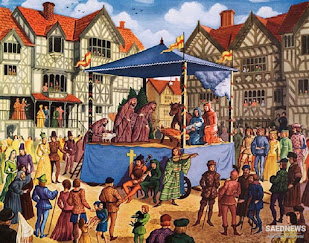
Other things, however, haven't survived as long - and this lends them well to livening up game worlds. Consider the town crier. In order to communicate news to illiterate townfolk, many towns would designate an official to walk through the streets ringing a bell or beating a drum, calling out important announcements, such as upcoming events or the proclaimations of nobles, or reminding people of laws. When the adoption of the printing press made mass production of written works possible, people often got news from broadsheets that were printed and pasted on the walls of buildings, but when literacy was rare, they would have people tasked with standing by these broadsheets and reading them to people who stopped by. Having a town crier in your game could be a great way to inform your players of plot points and adventure hooks, as well as providing exposition on local laws or customs of the city.Furthermore, the fact that most people couldn't read books made plays a popular form of entertainment. These often took place at festivals or other public events, and were performed by traveling troupes or by local guilds. Religious stories or the commedia del'arte were both popular, and sometimes overlapped (The Second Shepherd's Play, while ostensibly about the shepherds present at the birth of Jesus, is largely a secular comedy until the angel shows up at the end). Having a play take place while the PCs are in town could be a fun bit of local color, and perhaps the party could even get involved in filling in for one or more of the actors.
In low-magic settings, illiteracy also provides a convenient answer to why magic isn't more widespread and influential in society. Even if magic is powerful, it traditionally requires long and careful study in order to harness that power, and much of that information is written down in books and scrolls. If we assume most people are illiterate, that restricts its availability to people who have the resources and time to pursue its study, like the wealthy or the clergy - which maps quite nicely to arcane and divine casters. For most people, learning magic simply wouldn't be worth it. This helps keep magic feeling rare and special without needing to change much about the magic system itself.
Lastly, if one wishes, it could even be possible for PCs themselves to be illiterate. Obviously, this would have a significant impact in what that character could and couldn't do, and this would have to be taken into account, but it could lend itself to some new, and interesting, challenges. It adds another step to any quest involving secret messages or arcane manuscripts - now, the party will have to find someone capable of reading any texts they find, and preferrably that should be someone they can trust!
Adventure Seeds
- Looking to spread discord, an enemy force feeds false information to a town crier so that the public will be misinformed - perhaps ahead of an attack, or to sew dissent. Can the PCs figure out the plan in time?
- A wealthy but illiterate patron has come into possession of a manuscript, and requests the PCs to decode it. When they find it contains arcane secrets or directions to hidden treasure that the patron would covet, will they do the job, or will they keep those secrets to themselves?
To a modern eye, it might seem ridiculous that such matters were, ultimately, dependent on the honor system - but the belief in the power and sanctity of oaths made it possible to enforce complex matters in an era where the infrastructure needed to directly impose the will of a government over wider territories simply didn't exist. The entire concept of feudalism was dependent on oaths - vassals swore fealty to their lords to provide for them, and in turn, those lords were bound by their obligation to protect those subject to them. An easy way to add historical character to a setting, and to make it feel otherworldly and exotic to modern eyes, would be to work oath-taking into the practices of everyday life. When people start making oaths and depending on them with their lives, even when there's no real legal authority to enforce them, the world certainly seems less familiar.
Fantasy settings offer some especially interesting means to handle oaths, which we can see when we look at the folklore surrounding these proclamations. Throughout the world, there are many legends that speak of oathbreakers being punished with curses for failing to abide by their agreements to the gods, or of oaths being supernaturally enforced in other means. For instance, the Norse god Baldur was only able to be killed by mistletoe because it was the only object that didn't swear an oath to never harm him, and oneGreek folk song speaks of a man rising from the dead in order to fulfill his obligations to his mother. Oaths, evidently, are powerful things that transcend even the laws of nature.
In a universe where magic and gods exist, it may make more sense for oaths to hold the power they do, and it provides an easy way to introduce conflict into your stories. There are many monsters that can be justified as being spawned to punish oathbreakers, or even as the transformed oathbreakers themselves, and it's easy to work an oath broken by some ancient ancestor into the backstory of a cursed village or a misfortunate family. Perhaps even the PCs would need to swear oaths, and attract ill omens should those oaths be broken...
Adventure Seeds
- Long ago, a noble's ancestors swore an oath that they would never bear arms in the neighboring fief. The family has upheld the oath for generations, but now the fief is under attack, and they're powerless to provide aid. Can the PCs help?
- Before a difficult voyage, the PCs must swear an oath to the gods that until they return, they will not eat the flesh of their sacred animals - which, as it so happens, are the primary food source in the region they'll be traveling. They'll have to manage their resources carefully if they don't want to attract the wrath of the gods.
Part of the stigma around slavery in games comes from the fact that when most people today think of slavery, they think of chattel slavery, as exemplified the colonial-era Atlantic slave trade - an especially brutal and dehumanizing system that was controversial even at the time. However, this is far from the only form slavery took. One prominent example is ancient Rome. Although Roman slaves did not have the rights of citizens and were subject to the whims of their masters, they were allowed to hold and use their own property (in Greece, slaves could even run their own businesses), could become citizens if they were freed by their masters (whether that be due to personal choice or the slave buying their own freedom), and in later periods were even allowed to bring up charges against their masters in court. There was no association with race; although many slaves were prisoners of war, others were enslaved as a sentence for a crime, and citizens could sell themselves or their family members into slavery to pay off debts. Often there was little to visually distinguish slaves from citizens - which was in part by design, as the Romans feared that if slaves could recognize other slaves it would be easier for them to organize a revolt.
In medieval times, slavery was generally practiced in the form of serfdom, in which the workers who inhabited a plot of land were seen as part of the property; if the land came under new hands, the serfs would too. There was immense variation in this practice alone over times and places, but largely, serfs owned their own property and worked their own fields, but were not allowed to leave and would be obligated to provide service for their master as well, in addition to paying tithes. This was a part of life that everyone expected, and played a part in the functioning of the feudal system. In fact, by some records, medieval serfs had more time off of work than modern laborers, as many lords knew that overworking or mistreating their serfs would make them less willing to provide the services they depended upon.
- With apologies to the Anglo-Saxons: A runaway slave has stolen treasure from a dragon's hoard in order to buy their freedom - and now the dragon is attacking!
- After a feudal lord has gained control of a new fief, its serfs are unhappy with the new management, and are planning to rise up. Will the PCs aid them, or will they quell the rebellion?


.jpg)