Showing posts with label Gods of the Ortegids. Show all posts

Thursday, December 4, 2025

The Isle of the Sun

Our gazetteer of the world(s) of The Saga of the Ortegids is pretty much complete. Over the last few months, I've summarized every major region in the first three Dragon Quest games and explored their potential for TRPG scenarios. However, just today I started thinking about one small area I didn't pay any heed to before, but one that just might be more interesting than I thought.

In Dragon Quest III, upon crossing through the Pit of Giaga, you come out on a small island in the western gulf of Alefgard, directly across from Tantegel. This is the only location in this part of the game that has no counterpart in Dragon Quest I, likely because there's no sea travel in that game. On it is a small, unnamed port - there are no shops or inns here, so it's likely a small fishing village rather than a regional trade center. It's really just there to give you access to a ship while in Torland, and for this reason I overlooked it in my discussion of Alefgard.

However, one of the NPCs there asks the party if they've come from "the upper world," which indicates that the people of Torland are familiar with the existence of Erdland. To recap the cosmology I'm using for The Saga of the Ortegids, I have chosen - in part because it provides for more interesting gaming opportunities - to interpret Torland as literally being inside of a hollow Erdland, with the Pit of Giaga being an actual, physical pit connecting the two surfaces. Interestingly, the Western fandom tends to interpret the Pit of Giaga as being a portal and the worlds as separate universes, but the Japanese fandom is more equivocal about it. In any case, for Saga, it's a physical pit - which ties into my next point.

Torland (unlike Erdland) has no consistent day-night cycle and is shown to be in a state of constant night before the Sphere of Light is used for the first time in DQ3. Furthermore, the Dragonlord stealing the Sphere in DQ1 is sometimes said to cause an unending night, depending on what source you're reading (this could be metaphorical, but for me it's not). Under my interpretation, this implies that Torland had no natural light source until the Sphere of Light created one, being the inside of a hollow planet and all. So far, everything is interally consistent.

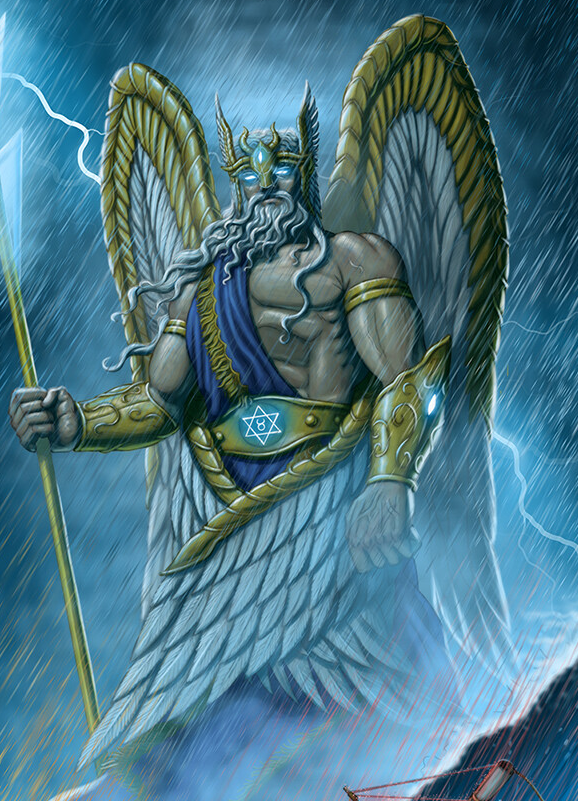
But then I realized that if the Pit of Giaga physically separates Erdland from Torland, if there's a big hole in the ground in Erdland, there must conversely be a big hole in the sky in Torland. And we do know that Erdland has a sun. Before the Sphere of Light was used, this island below the Pit of Giaga must have been the only place in Torland to receive natural light - that is, what was able to stream through the Pit when the sun was overhead.

Art by Vsevlod Ivanov
(Seriously, check his stuff out)
This likely wouldn't be enough light to illuminate all of Torland on a regular basis, but it would mean that this one island would receive direct sunlight for part of the day. In an otherwise lightless world, this would no doubt have a significant effect on the local culture. Perhaps the locals of this island, even if they know of the existence of an upper world, don't realize how a natural sun really works, and view this light as a divine phenomenon. This would transform the Isle of the Sun, as I've called it, into a natural choice for a holy site, with cults springing up around the light and adherents making pilgrimages to witness it.

With this in mind, perhaps the port we see in DQ3 isn't the only settlement on the island - perhaps there is another city that serves as the center of this sun cult, and we just don't see it in-game because there was nothing useful for gameplay or narrative purposes there. Given the Norse vibes of Torland in general and Alefgard in particular, let's call this city Sollenborg. While ostensibly a subject of the Alefgardic crown, it would be an autonomous power headed by a cult worshiping the sun, with the priesthood holding local positions of authority.

Art by Noah Bradley

In a campaign set in Torland before the events of DQ3, this city could be a curiosity for the party to investigate, or a regional power given its apparent blessed nature. It would also offer another religion to add to the worldbuilding of the setting. Also, one of the easiest ways to kill vampires in a pre-sun Torland. I also find it interesting to think about how even in a magical fantasy world, there would still be perfectly natural phenomena that are misinterpreted as miracles.

I also think it's interesting to consider what might happen to Sollenborg after the events of DQ3. Surely the sun cult would lose quite a bit of its authority with the Sphere of Light providing constant sunlight. This could lead to a crisis of faith for its adherents - and perhaps the more worldly of the cult's authorities, fearful of losing power, might be jealous of what the Sphere provides and covet it for themselves. You could also probably tell an interesting side-story about how the sun cult would handle the Dragonlord's theft of the Sphere. If Alefgard was suddenly deprived of its sunlight, the cult would have something unique to offer the people, who would surely grow desperate in such a time.

Wednesday, August 27, 2025

Zenithia

By this point, our investigation into the setting of The Saga of the Ortegids has covered every region present in the original NES Dragon Quest trilogy (and then some), across both the two worlds of Erdland and Torland, discussing the opportunities each one of them could offer a tabletop RPG campaign. However, we aren't done yet. There's still one more location I want to shine a spotlight on - the floating island of Zenithia.

Zenithia wasn't present in the NES release of Dragon Quest III. In terms of release order, it first appeared in Dragon Quest IV; that game, and its two sequels, all feature the island in some way or another, leading to those games being dubbed the "Zenithian Trilogy" by fans. Unlike the Erdrick Trilogy of through III, it's somewhat debatable whether or not those games take place in the same universe, and they definitely don't seem to take place in the same universe as the Erdrick Trilogy.

However, starting with the SNES release of DQ3, Zenithia was added as a post-game bonus dungeon, and it's stayed that way in all subsequent releases, even the ones that did away with most other changes added in the SNES version. Being optional post-game content, one could argue as to whether or not this material is supposed to be canon, and this project is specifically based on the NES releases and their Western marketing materials, but as a DM, I'm personally inclined to throw Zenithia into the mix anyway, purely because it's interesting, and would provide some neat implications on worldbuilding. Plus, it creates some nice symmetry if Erdland is connected to both a world below and a world above.


In all its appearances, Zenithia is a pretty small island. The one major feature is Castle Zenith, which is inhabited by a race of beings called the Zenithians. In DQ3 there's no real indication that the Zenithians are anything other than humans, but in the Zenithian Trilogy they have wings and increased magical aptitude, and I'd probably backport this for The Saga of the Ortegids. There, they are an aloof people, prefering (with some exceptions) to observe the lower realm from a distance but without any desire to interfere.

Art by Nottsuo
The nominal ruler of the Zenithians is King Zenith, but the most powerful resident of the island is surely the Divingon, a dragon god that dwells at the highest point of the castle. If the Divingon is bested in combat, he will grant a wish to whoever defeats him.

This is...a pretty obvious reference to Dragon Ball, sure. But I think there's a lot it could offer a campaign. The existence of the Divingon would offer a reliable high-risk, high-reward solution to any problem the PCs might face. If they need a powerful enemy defeated, or a curse lifted, or an ally brought back from the dead, they have a way to wish for it - they just need to be able to beat a god in order to do so, and getting to said god isn't exactly an easy task either. I'm always of the opinion that PCs should only have access to such powerful world-altering magic if they complete a suitably epic quest for it, and ascending to the heavens and convincing a divine dragon to fulfill their request certainly qualifies.

I also like the Divingon as a character - you can't actually kill him (he's a god, after all), but if you manage to impress him enough by dropping his HP to 0 within a time limit, he decides you're worthy of his favor. If you take too long, he gets bored and calls the fight off. He's a being operating on so high a level that the concerns of mortals are only worth his time if they amuse him, which is very much in keeping with popular conceptions of both dragons and gods (at least the kinds of gods I like.)

Art by Gustavo Cabral
And I do think the Divingon's divine status is literal. Lest we forget, Zenithia is accessed through a portal in Empress Castle, which is said to be the closest point to the heavens, and is home to the Dragon Queen, who calls herself a "messenger of the gods." For my take on the setting, I'd posit that the Divingon is none other than Gaius, the dragon-god of fire and the forge. The Dragon Queen must keep a portal to his realm in order to commune with him and guide the rightful interests of all dragonkind, as he is their patron and progenitor. A fun side effect of this: if we only see Gaius's personal domain, do the rest of the Nine Gods each have their own personal corner of the heavens? A DM could have fun with that concept.

There's two more bits I'd like to discuss when it comes to Zenithia. Many of the enemies encountered there are palette swapped versions of bosses from the main game - one of which is Baramos, the only time his sprite is used for a common random encounter. Given that I've chosen to interpret him as part of a magically created race of superbeings, this would suggest that Zenithia has access to an army of Drokkarim. I had previously described the Drokkarim as being a creation of the ancient Aliahanians, but I might instead have them as being bred by the Zenithians. Or perhaps the Old Aliahanians were in fact descended from Zenithians, or even that they were Zenithians. Given the comparisons to Tolkien's Numenoreans, having them be superhuman makes sense.

Lastly, I'd be remiss not to mention the adventure seeds implied by my cosmology for the setting. In the present day of the setting, I feel it would be useful to have a world tree allowing travel between Erdland and Torland to allow for both worlds to be accessible in a single campaign. But if the Worldtree has grown enough that those in Erdland can follow its roots down to Torland, surely they'd also be able to follow the branches up to Zenithia. And if mortals are suddenly able to travel to the lands of the gods, that would shake things up considerably...

Wednesday, June 25, 2025

The Spell of Embodiment

Art by Lindsey Crummet
Once again, we're discussing the nature of the divine in the Dragon Quest series. There are two separate occasions in the Erdrick Trilogy where we see a ritual performed to summon a divine entity into the physical plane. The first of these occurs at the climax of Dragon Quest II, in which the high priest Hargon performs a ritual to summon Malroth, the god of destruction, and ends up offering his own life in a ritual suicide to complete the ceremony when the party attempts to cut it short. Going next by release order but not chronological order, in Dragon Quest III we see a similar ritual being performed by gathering six magical orbs at the temple of Leiamland to summon the god-bird Ramia.

I don't think that the developers intended for a connection to be drawn between these two rituals. Summoning rituals have always been a trope in fantasy literature, and they make good climactic setpieces, offering both spectacle and a chance to race against time to stop a villain from unleashing a greater threat. But my pattern recognition can't help but find it rather curious that both these rituals are used to summon gods, not demons or other lesser spirits. As such, for The Saga of the Ortegids, I've chosen to interpret these two instances as examples of the same sort of magic, something I'm calling the Spell of Embodiment. This spell is a very powerful one, and may even be the most powerful in existence - through it, a god can be summoned into the mortal plane, and incarnated in physical form.

There's a few implications this has on worldbuilding. I'd like to point out that the existence of spells like these confirm that ritual magic does exist in the world of the original Dragon Quest trilogy. None of the games have ever let the players use similar spells - unlike in Final Fantasy, "summon magic" isn't really something that factors into the Dragon Quest games' mechanics - but we still see them being used in the backstory and by NPCs. We can assume, then, that the spells that exist in this world are not limited to those that can be used by playable characters. This fits with my goal in this project to investigate what setting the Erdrick Trilogy implies when game mechanics are taken out of the equation - we can assume that the spells available to the player are merely a representation of the in-universe magic system, and not what it's limited to. That's how I prefer my magic systems anyway - nothing kills the vibe of magic and mysticism more than locking it to a prescribed list of consistent fixed effects. There are clearly more spells in this world than those an adventurer might cast on the fly, and they may have different effects or means of being cast.

Secondly, the Spell of Embodiment is clearly more demanding than other spells in the setting - which one would hope would be the case if you're summoning something as powerful as a god. Malroth needs a long ritual in order to summon, and is ultimately invoked via human sacrifice, while Ramia is summoned using a set of powerful artifacts. If we are to interpret these rituals as different expressions of the same power, it seems that summoning a god requires a great expenditure of power. Sacrifice might be one way to harness that power, but the orbs might provide an alternative source of the same mystic energy in the right quantities. It does raise the question of where the orbs came from, and why they possess this much power. Given that they're only found in Erdland, I'd like to assume that they were created by the ancient Aliahanian Empire to harness its advanced magics.

Third, as I've discussed before, there seems to be a difference between lesser gods like Aurhea and the priestesses of Leiamland, who can exist on the mortal realm without issue but seem to have much more localized spheres of influence, and greater gods like Malroth and Ramia that must be summoned through complex rituals. Rubiss is a bit of an outlier - in DQ3, you encounter her imprisoned in a tower in Alefgard, apparently fully corporeal - but she was imprisoned there by Zoma, who appears to be a deity of equal power to her. In fact, I'd argue that, under this theory, Zoma was likely summoned through a similar Spell of Embodiment. We know that he isn't originally from Alefgard because one of the dungeons there is said to be where he clawed his way into the physical realm. This could be the result of the Spell, or it could be something that occurred in an earlier war between gods that led to him overcoming and imprisoning Rubiss. If we assume an event like this took place in the setting's past, it might explain why powerful gods are more limited in their ability to directly interface with the mortal plane of existence. They were more liberal with it in the past, but the results were catastrophic.

Having the Spell of Embodiment in a setting could provide some compelling adventure hooks. Perhaps the most obvious is to have a villain who wants to use the Spell to summon their dark master, or maybe a god that they foolishly believe they can control to further their aims. But it could be just as interesting if the PCs have to perform the Spell in order to combat a threat so great that only a god could possibly deal with it. Either way, gathering items powerful enough for the ritual - either so they don't fall into the wrong hands, or to use them onesself - could provide a good structure for a campaign, giving the party a good reason to scour the world and collect treasure. And if you're looking for a tense encounter, you can't go wrong with the party having to defeat the villain before they can unleash a terrible force of destruction on the world.

Monday, June 9, 2025

Leiamland

The middle third of Dragon Quest III is centered around collecting a series of six orbs found throughout the world, some of which require more elaborate quests to obtain than others. Once all six orbs are found, they can be used for a ritual to summon Ramia the God-Bird, who can then be ridden to previously inaccessible areas. And this ritual takes place in Leiamland, a frozen island in the far southwest corner of the map.

Leiamland doesn't give us a lot to work with, but I think there's definitely something there for The Saga of the Ortegids. Most of the island is covered by ice, with the one feature being a temple taking the form of a giant tower, at the top of which is kept the God-Bird's egg. The only inhabitants of Leiamland seem to be two priestesses who stand as guardians and tend to the egg, and the island seems too inhospitable to support any major settlements.

Art by Alayna Danner
There's definitely an otherworldly character to the two priestesses. They speak in unison, and they're living alone in a frozen wasteland. The question of "what do they eat?" obviously comes into play here. This video, incidentally, is one of my favorites on all of YouTube, and encapsulates my philosophy as a DM - I want my settings to feel like living, breathing, Shandified worlds, and a goal with this project is to reinterpret the setting of the Erdrick Trilogy as something recognizable to its source material, but with a minimum of video game conceits. It's possible that a more realistic Leiamland would be more arable, and the priestesses would grow crops to sustain themselves. But I don't think I'd go with that approach.

I think it's more likely that the priestesses are themselves immortal god-like beings - handmaidens of the God-Bird, and tasked with safeguarding her cycle of death and rebirth in the mortal world. We do see earthbound but divine beings elsewhere in the same game, like Aurhea, who appears to be the spirit of a particular lake. It would explain why the priestesses can survive in such an isolated, inhospitable environment, and why they would have such a close connection to a god incarnate, something that goes even beyond what we see at other temples, where the gods are more distant and metaphysical.

The orb ritual is not the only time we see gods being summoned into the physical world in the Erdrick Trilogy, and I think that's quite relevant. It seems that this is a setting that has particular rules about how gods work - even if they do not ordinarily exist on the same plane as mortals, there are rituals that can give them physical bodies that can be directly interacted with. This is pretty consistent throughout the first three games of the series, and for my purposes with the project, the similarities between the numerous instances we see will not be treated as a coincidence.

The existence of Leiamland presents some interesting implications for worldbuilding - through it, we can posit that there is a class of lesser gods native to the mortal realm, and another class of divine beings that must be summoned. But I think there's other things such a location could add to a campaign, too. Certainly one could lift the questline from DQ3 wholesale and have the PCs collect artifacts needed for the ritual because they need to ride the God-Bird to an otherwise inaccessible destination.

But it could be just as compelling to have the party tasked with stealing Ramia's egg. It'd make for an interesting heist scenario - they'd have to prepare for a journey to the remote island, braving the elements just to reach the temple in the first place, and then find a way to get past the immortal guardians tirelessly watching over the egg. It's entirely possible that the temple is located in Leiamland because the icy wastes would deter anyone seeking to claim the sacred egg for their own purposes. 

Going off this idea, you could expand the temple into a dungeon if you wanted to. There's precedent for this - the Game Boy version of DQ3 added a post-game dungeon underneath Leiamland, inhabited by a sleeping golden dragon guarding a holy sword that can call lightning. The first floor of this dungeon is even shaped like the phoenix icon used to represent Ramia, so it seems like the place is connected to her cult. It's one of the largest in the game (and features some of the best spritework on the Game Boy Color), and could well be used as the basis for a megadungeon.

Monday, April 14, 2025

Saga of the Ortegids: Other Pantheons

The Nine Gods comprise the main pantheon of The Saga of the Ortegids. These are the gods you can expect to be worshiped in any temple in respectable society, no matter where in the world(s) you go. However, these are not the only gods that exist in this universe. Other cults to other powers might not be as large, widespread, powerful, or accepted, but they do exist. Here are some other gods worshiped in the world of the Ortegids, and the roles they play in the setting.

The Beast Gods

A number of gods exist that are always depicted in animal form. These are believed to be older, primeval spirits, their cults predating the formation of those of the Nine Gods - according to some theologists, the Beast Gods existed long before the Nine Gods ever came to this world. In most of the world, worship of the Beast Gods has been supplanted by that of the Nine Gods, though they still have a following, especially among so-called barbarian societies such as Aliahan, Suland, and the hill tribes scattered throughout wild areas of the world. They are also commonly worshiped by beastmen, and some elven kingdoms. Worship of the Beast Gods is tolerated, as their followers can comfortably coexist with civilized society, but tends to be considered backward and the domain of heathens in the countryside among more advanced realms.

Ramia
, the God-Bird, is celebrated as the great phoenix, and a bringer of hope and life to the world. Her shrine sits on the frozen island of Liamland, where it is said that once an Age she emerges from a pit of fire tirelessly watched over by two sacred virgins, then flies around the world, chooses one who is destined to be a great leader of men, and then burns herself upon her own pyre so the cycle can continue again. She is also associated with the ideals of freedom and exploration, owing to her power of flight, which makes her popular among adventurers. Although one of the Beast Gods, Ramia is invoked in the courts of many kings due to her powers of prophecy and association with divine right, and her holy symbol can be found on many coats of arms, including that of the Ortegid Dynasty - Erdrick the Aliahanian was a follower of Ramia, and was said to have ridden her into battle.
  • Ramia appears as a massive bird with iridescent plumage. Her holy symbol is a stylized depiction of a phoenix in flight.
  • Alignment: Chaotic Good
  • Domains: Life, Light, Nature, Tempest
  • Oaths: Conquest, Glory, Vengeance
Nim-Tso
, the Serpent God, is the god of poisons, thieves, murderers, and other criminals. He is associated with trickery and betrayal, and for this reason, cults devoted to him are not openly tolerated. However, there are many guilds of thieves and assassins that pay homage to him. For some, this is treated as more of a metaphorical bond, associating their clandestine operations with that of the sinister serpent god, but other, darker organizations conduct their grim business in Nim-Tso's name, and some are rumored to offer dark rituals, offering human sacrifices to their dark god. No matter how many times the authorities try to stamp out these illicit snake cults, it seems that a new one always springs up not long after. Aside from his patronage over criminals, Nim-Tso is also revered by the lizardmen, who consider him their honored forefather.
  • Nim-Tso takes the form of a massive serpent. His holy symbol is two snakes coming together, facing each other, but they're one.
  • Alignment: Neutral Evil
  • Domains: Nature, Trickery
  • Oaths: Treachery

The Forbidden Gods

These are the gods toward whom worship is not tolerated by most societies, as their portfolios are considered incapable with civil life - the gods that govern such things as death, destruction, and cruelty. Worshiping them usually entails partaking in overtly destructive behavior, and thus their cults are forced to operate in the shadows - there are some exceptions, however, when these cults grow powerful enough to challenge civilized rule, as happened with the Children of Hargon, a Malrothite cult that managed to usurp the rulership of Rhone during the War of the Three Kingdoms. Although these gods are not counted among the Nine Gods due to matters of good taste, they are nonetheless agreed to be beings of the same order, and just as powerful and immortal. They are not to be confused with demons, which do not as a rule seek followers, and even the most powerful demons are less powerful than gods. Generally, however, demons do worship the Forbidden Gods, as their interests tend to overlap, and cultists of the Forbidden Gods often summon demons to do their bidding. To shamelessly rip off Knight at the Opera, demons of the Lunar Lands are classical; demons in Saga of the Ortegids are heavy metal. The Forbidden Gods are also worshiped by the more savage tribes of beastmen.

Art by noba
Zoma
, the Three-Eyed God of the Winter Wind, is the god of death, decay, and stagnation - he who sees to the end of all things. He is associated with ice, cold, snow, and winter, due to how frost kills crops and brings an end to the harvest season. Traditionally, he is held as the twin brother of Rubiss, and her equal and opposite in all respects. Long before the first humans drew breath, Zoma rebelled against his brethren in the God-War, feeling spurned for his macabre character, and attempted to get revenge on the other gods by bringing death to their creations, but was exiled to the Black Pits of Hades. To this day, however, he plots his vengeance, and seeks mortals to further his goals. He taught necromancy to mortals through the manipulation of life and death - unlike Melisine, he's just tasked with making things die, not what happens to them afterward, and he can't really care less about that.
  • Zoma's preferred form is that of a horned three-eyed giant with sickly blue skin, and he may manifest in this form if the proper ritual is performed, but most of the time can only project enough power over the mortal realm to appear as a gigantic eye spanning the sky. His holy symbol, likewise, is that of an eye.
  • Alignment: Neutral Evil
  • Domains: Death, or use a School of Necromancy Wizard to represent a pilgrim of Zoma.
  • Oaths: Oathbreaker
Malroth
, the Many-Fanged God of the Black Pits, is the god of chaos and destruction. If Zoma represents the silent, slow deterioration of entropy, then Malroth is the loud, fiery, violent cataclysm that destroys indiscriminately; the beast that will one day devour the universe and brings about natural disasters to sate his lust for wanton ruin. He is perhaps the oldest of the gods, ruling over the Black Pits since the dawn of existence, and will bring about the end of all things when the apocalypse comes. While most mortals view him with horror and disgust, for obvious reasons, he is considered the father of all demons, and many monstrous beings are said to have spawned from his flesh. His cults, however scarce, are some of the most terrifying. Some fear him, offering sacrifices to placate his hunger so that the end times might be delayed...others, worse yet, seek to summon him in order to accelerate the end of the world.
  • Malroth appears as a hideous creature with six clawed arms, bat-like wings, and a grinning mouth full of fangs. His symbol is a fanged maw flanked by wings.
  • Alignment: Chaotic Evil
  • Domains: Death, War
  • Oaths: Conquest, Oathbreaker

Thursday, April 3, 2025

Saga of the Ortegids: The Nine Gods, Part 2

Here's the other half of the main pantheon of The Saga of the Ortegids. See here for part 1.

Gaius
, the Forgemaster, is the god of the sun, fire, and the forge. He is the patron god of the dragons (and Dragovians), who - as beasts of fire - regard him as their forefather, but he is also a patron to the dwarves thanks to his association with the forge. Legend has it that he taught the secrets of fire and metalworking to mortals. His temples tend to be placed in areas of volcanic activity, as volcanoes are revered as the chimneys of his workshop buried deep within the earth; when a volcano erupts, it is because he is drawing on its heat to forge fantastic treasures. Gaius has created many magical artifacts, but the most celebrated of all is the Sphere of Light, a ball of congealed radiance and the most sacred treasure known to dragonkind. He originally created it as a gift to the dragons of Erdland, but it has since passed into the hands of the Kingdom of Alefgard, who use it to control the Inner Sun of Torland.
  • Gaius's appearance varies depending on who he appears to. He tends to appear as a stout bearded man or a dwarf when dealing with humanoids, and as a dragon with scales that flicker in the colors of fire when dealing with dragons and their kin. Depictions of the god in artwork likewise reflect the culture of their origin.
  • Alignment: Lawful Neutral
  • Domains: Forge, Light, Nature
  • Oaths: Crown
Astrella
, the Eternal Muse, is the goddess of love, beauty, music, and the arts. She taught mortals the secrets of music, and delights in striking them with the inspiration to compose great works. Her temples often exhibit paintings, sculptures, and tapestries donated by the faithful, and her prayers are always sung, some of them incorporating instruments. She also has power over romantic attraction, and presides over all marriages and oaths of love - though legends say that she is not afraid to compel people to fall madly in love with animals or inanimate objects simply because the act amused her. As befitting of a goddess of such passion, she is not afraid to encourage roguish tendencies in her worshipers, and her creed urges that one must follow their heart's true desire, regardless of ethics or the law of the land. This has made her cult popular among thieves and criminals, and a controversial one among many authorities.
  • Astrella appears as a striking woman - it is said that everyone who beholds her sees their ideal of beauty. Other legends say that this is only a guise, as beholding her in her true radiance would cause a mortal to go blind.
  • Alignment: Chaotic Neutral
  • Domains: Trickery, Unity, Zeal
  • Oaths: Devotion, Treachery
Wyrdpater
, the Father of Fate, is the god of fate, prophecy, and magic. He alone knows the ultimate fate of all beings, and sees to it that they play their part in the grand scheme of reality. He keeps the secrets of fate closely guarded from mortals, fearing that if they know of their destiny they will seek to work against it; to that end, he is known to place curses upon those who know too much, and sends his agents to bring them into line. He has, however, entrusted certain mortals with the ability to see into the future, or even manipulate reality itself - this is in itself a means to further the plan in mysterious ways that only he truly understands. Through this he imparted mortals with the secrets of magic, though his teachings have spread far beyond his original selection, and magicians conducting their own research have discovered further secrets independent of his guidance. Some say there are some spells even Wyrdpater refused to teach to mortal man, such as the pursuit of eternal life. To pursue these forbidden magics is a dangerous pursuit, but one considered the ultimate goal of sorcery among some circles.
  • Wyrdpater is depicted as a wizened old man with a long beard, dressed in the garb of a wizard. He is usually shown carrying a scroll, upon which is written the fates of all mortals.
  • Alignment: True Neutral
  • Domains: Arcana, Fate, Knowledge, or use a Diviner to represent a pilgrim of Wyrdpater.
  • Oaths: Ancients, Watchers
Verina
, the Beastmatron, is the goddess of animals and nature. She is the mother and mistress of all beasts, and her priests are gifted with the ability to commune with them. The forest is her domain, and her ceremonies are often held in the open air at sacred springs or groves, many of which are said to be the dwellings of her nymph daughters. In part, this is because she opposes any intrusions on the balance of nature, considering artificiality and construction to defile the sanctity of the natural world. Her worshipers will fiercely guard her sacred places from outsiders, and she will rally wild beasts to fight alongside them in their defense. According to legend, she does not dwell with her divine brethren; instead, she prefers to wander the world to witness the beauty of nature up close, though only select mortals can see her. Unexplained breezes are attributed to her running by.
  • Verina is often shown as a young woman barefoot and dressed in simple animal hides, with branches tangled in her hair, or a crown of leaves. She is sometimes depicted as a beastman (especially among beastmen).
  • Alignment: True Neutral
  • Domains: Nature
  • Oaths: Ancients, Watchers
Hesper,
 the Hearth Mother, is the goddess of hearth and home. She does not have any major temples - instead, she commands the faithful to worship her over the fire, during everyday tasks, and before going to sleep at night, thanking her for their good fortune during the day. Keeping the home orderly and providing for one's family is considered a worshipful act. She commands her followers to respect the sanctity of hospitality, and commands them not to take up arms unless attacked first. Despite her homebody nature, her cult has many pilgrims, as she inspires them to go forth performing acts of charity to the poor and downtrodden who have no home or family to call their own, standing in the defense of those who have no one else to care for them. Other priests run hostels for weary travelers and the poor to rest.
  • Hesper appears as a stout, matronly woman in an apron. Despite her divine nature, she does not favor the grandiose pageantry of other gods, and prefers to present herself modestly and humbly. As such, depictions of her are difficult to distinguish from those of ordinary people.
  • Alignment: Neutral Good
  • Domains: Life, Peace, Protection
  • Oaths: Redemption

Monday, March 31, 2025

Saga of the Ortegids: The Nine Gods, Part 1

Following up from last post, it's high time we began to lay out the pantheon we're working with for The Saga of the Ortegids. For the primary religion of the setting, I've arbitrarily decided on a set of nine gods, all of whom are traditionally regarded as siblings. These gods are worshipped more or less universally throughout Erdland and Torland, and any holy man will likely know a few prayers to each of them, even if they may focus on a single patron (though some are generalists). There are other gods that coexist with the Nine Gods, and may even be worshiped alongside them in some temples, but are not considered a part of the same group; these will be discussed in a later post.

The Dragon Quest games do give us some gods to work with, but most of this is me filling in the space between the broad strokes with my own creations, and striving to create something with a suitably sword-and-sorcery feel. There will inevitably be some overlap with the gods of the Lunar Lands, but I've done my best to make this pantheon feel distinct.

Rubiss,
 the Allmother, is the goddess of life, creation, and fertility. One of the most popular of the Nine Gods, idols dedicated to her can be found throughout the two worlds, and there is at least one temple devoted to her in just about every major city. Fittingly, her portfolio is broad, and she is favored by farmers, craftsmen, midwives, and healers - just about anyone who creates things or preserves life. It is said that she created all living things in the worlds, and treats them as a mother does her children - with nurturing respect, and with discipline for those who misuse the gift of life. She is one of the patrons of the legendary Ortegid Dynasty, who carry a sacred crest gifted to Erdrick the Aliahanian by Rubiss herself as a family heirloom.
  • Rubiss appears as a beautiful woman with red hair - people with red hair are regarded as having the blessings of Rubiss. Her symbol is a set of three rubies laid in an upside-down triangle, typically worked into an amulet.
  • Alignment: Neutral Good
  • Domains: Life, Peace, Protection
  • Oaths: Devotion, Redemption
Estark,
 the Eternal Swordsman, is the god of war and battle. According to legend, he dwells atop a mountain (where exactly this mountain is varies from region to region) on a throne of iron awaiting a worthy challenger, and the souls of all warriors who die in battle must face him in a duel. Though no mortal can beat him, if he is impressed with their strength, he will let them into Valhalla; if he is not, he throws them down the mountain, where they must fight their way back up against all other hopefuls to earn another chance against him. Estark is not usually called upon in battle, as it is considered a sign of weakness to rely on him; nonetheless, he does bless weapons and sword-arms, and his clerics often study martial magic.
  • Estark takes the form of a giant clad in armor, wielding a weapon in each hand and bearing two horns on his head, along with a third eye that beholds all battles in the world. His symbol is a set of brazen horns hung from a pendant, either worn or dangling from the hilt of a weapon.
  • Alignment: Chaotic Neutral
  • Domains: Strength, War
  • Oaths: Conquest, Glory, Vengeance
Melisine
, the Queen of the Night, is the goddess of night, the moon, the dead, and the underworld. She rules over all the sun does not touch, including both the night (and nocturnal creatures) and the underground (and any creatures that dwell there). She also rules over the souls of all those who do not die in battle. Note that while she is the goddess of the dead, she is not the goddess of death; she only has sway over those who have died, not the means of their death. Though her portfolio is a macabre one, and she is often worshiped by subterranean clans of beastmen, she is not regarded as one of the Forbidden Gods, and offerings made to the ancestors pass through her. She is also a patron of dwarves, hobbits, and gemcutters, as gems come from the earth.
  • Melisine is depicted as a pallid woman in dark robes and the veil of a mourner. Her symbol is a skull with gems set in the eye sockets.
  • Alignment: True Neutral
  • Domains: Grave, Twilight
  • Oaths: Ancients, Watchers
Art by Juan del Pino
Boros
, the Tidefather, is the god of the sky, the sea, and the storms. He dwells beneath the waves, and the merfolk are of his blood, but he is also a god of thunder and lightning, calling down storms and winds for his amusement. As he is of a tempestuous and unpredictable nature, his clerics are sought out by merchants and sailors to protect their vessels, and he has a large temple in Ashalam, as well as in the Torlandic port city-state of Lianport. It is held that anything that falls into the sea belongs to him, and retrieving treasure from shipwrecks may garner his wrath. For that matter, there are many unique beasts of the sea and air that are Boros's favored children, such as the Condors of Hades, which are capable of summoning a great gust of wind from the beating of their wings that can divert the course of ships. Those these beasts are great and deadly, he will not take kindly to any of them being harmed.
  • Boros appears as a weather-beaten man with a long beard, often with either the tail of the fish or the lower legs of a bird. He always has bird-like feathers along his arms, or wings on his back. His symbol is a set of wings.
  • Alignment: Chaotic Neutral
  • Domains: Nature, Tempest
  • Oaths: Ancients, Open Sea

Tuesday, March 25, 2025

Saga of the Ortegids: Thoughts on Religion

Art by chuckcg
Religion does not play a very big part in the Erdrick Trilogy. Remember, these games belong to an era where the difference between a JRPG and a western RPG had more to do with presentation than anything else. The trope of the corrupt church hiding a sinister conspiracy had not yet been established, and temples in the Trilogy play pretty much the same role they do in old-school D&D - they're a service you go to to resurrect dead party members and remove curses for a fee. However, there are still some implications we can overanalyze in the name of worldbuilding, and I feel it's possible to make some assumptions about the role of religion and the divine in The Saga of the Ortegids.

The predominant religion, in both Erdland and Torland, is that of the aforementioned temples. Its trappings appear to be grounded in your traditional fantasy Catholicism - priests wear miters; temples have stained glass windows. There's some ambiguity as to how many gods are actually worshiped here. The only deity mentioned by name is the goddess Rubiss, who plays an important role in the plot of Dragon Quest III.

Most discussion I see on the subject seems to assume that the temples belong to a monotheistic cult worshiping Rubiss alone, but I feel like this has more to do with people projecting the trope of JRPGs depicting a Catholic-like organization worshiping a goddess instead of a male god onto Dragon Quest. The Erdrick Trilogy never actually makes this explicit, and it's something that probably owes just as much, if not more, to The Legend of Zelda. Modern localizations lean into this, having priests invoke "the Goddess" in NPC dialogue. As I have previously stated, I am very much not a fan of the modern localizations. They make so many changes to the game script and terminology that I don't think this says anything about the canonical intent. Besides, we're basing this on the NES-era localizations.

Art by darksouls1
As a matter of fact, the Dragon Quest novels (yes, there are novels - I told you that no matter how big you think this series is in Japan, it's bigger than that) do depict multiple gods existing in the world of the Erdrick Trilogy, most notably Gaia, a Hephaestus-like forge god (just go with it). I'll only be taking light inspiration from this lore, because not only were these novels not available in English at the time the NES games were released in the West, they aren't available in English now. Still, the Japanese Dragon Quest wiki is fascinating to poke around in, and takes Google Translate reasonably well.

Anyway, the version of DQ3 I played as a kid has the priests very specifically mention "gods," plural, and as such, I'm inclined to make the people of The Saga of the Ortegids worship a polytheistic religion. This does, however, mean I'm going to have to make up most of the pantheon out of whole cloth. Some gods I can get away with borrowing from later entries in the series, but that's still not enough for a realistic pantheon. More on that in a future post. I'd also probably use more pagan imagery to add to the sword-and-sorcery atmosphere, so temples would have more sacrificial pyres and strange rituals of dancing and chanting. The miters and stained glass can stay, though.

On the subject of localization, the NES version of DQ3 actually - unintentionally - solves the issue of the discrepancy between adventuring clerics and the priests that play a role in society. At the time, Nintendo was so afraid of offending anyone that religious references in games were usually removed in translation, and the class later translated as "Cleric" or "Priest" was called "Pilgrim" in the first English release. However, considering the term already carries connotations of travel, I think this presents a great opportunity. In The Saga of the Ortegids, "clerics" are divided into two traditions, perhaps indicating a schism in thought - priests stay in temples and conduct rituals for the benefit of the community, while pilgrims walk the roads in the pursuit of spiritual enlightenment and to aid the weak so that they may become closer to godliness. They likely have similar abilities if the services temples provide is any indication, but this would explain why a cleric would ever go dungeon-delving.

An interesting point of the setting is how universal many things seem to be. Although Erdland's geography superficially resembles Earth's, all continents are available for exploration, and all of them seem to be on equal footing in terms of development and power dynamics. There are no places that are presented as unexplored frontiers or colonized subjects, even if their real-world counterparts would have been in the Middle Ages. The same temples, with the same services and aesthetics, are present whether you're in Romaly or Baharata, and even between the overworld of 3 and the hollow earth of Torland. Part of this is surely due to game limitations - it lets you reuse the same assets in each town, after all - but I think it has some interesting implications. After all, the same game also features a class of martial artists who are always drawn in Chinese clothing and who use katars and other such exotic weapons, yet can be found in a medieval European setting with no one batting an eye. I think it's interesting if we assume that traditions have disseminated far further and contacts have been more thoroughly established than they had in the real world by medieval times, and perhaps it means that Erdland is much smaller than Earth, even if the continents have recognizably similar shapes.

Art by Biel Bahi Pla

In the case of religion, though, it is quite interesting that the traditions in Erdland and Torland are seemingly identical, despite the two realms being on opposite sides of the planet's crust and having no way to contact one another. I'd personally interpret this to mean that the qualities of this religion are a fundamental part of how deities are worshiped, and that the same deities are worshiped universally (accounting, of course, for the possibility of sinister cults worshiping evil, forbidden gods - that's still pantheonism, just worshiping certain parts of the pantheon mainstream pantheonists don't want you to). Other religions exist, but they seem to worship different forces entirely.

Satorism, given its obvious comparisons to Buddhism, is likely a religion that focuses on internal spiritual growth, meditation, and the pursuit of knowledge over external divinities (and, with regards to the universality of religions, likely has adherents all over the world). Thus, it doesn't share much in common with Pantheonism, as it rejects the pantheon entirely. The only other hint we see at another religion is in Zipangu, the equivalent of Japan; as an isolationist culture, it does not worship the same gods as other lands, as noted by a foreign priest stationed there. They might instead worship animistic nature spirits, or they might be Satorists. If we look at real world precedent, it's probably both.