Showing posts with label meaningless kvetching. Show all posts

Monday, May 12, 2025

Zipangu

The various regions and kingdoms of Dragon Quest III's overworld take varying degrees of inspiration from their real-world counterparts. Lancel, for instance, might look like Australia on the map, but has absolutely no allusions to Australian history or culture. On the flip side, the Kingdom of Zipangu is particularly blatant about wearing its inspiration on its sleeve.

Zipangu is quite clearly based on Japan - if you didn't guess that from the name, or the fact that it's located on a chain of islands off the coast of the Asian-equivalent land mass, it's one of the few areas that has its own graphical assets not found anywhere else in the game, complete with a prominent torii gate in the center of the capital. Furthermore, it's an isolationist power with little contact with the outside world, as Japan famously was during the medieval era. There are no inns in town, and a foreign priest mentions trying to introduce his faith to the populace, indicating that they practice a different religion from that of the rest of Erdland. We don't get many specifics about this, but the kingdom does practice one particular ritual that the quest here centers around.

Zipangu's queen, Himiko, has ordered that one the kingdom's women be periodically sacrificed to appease a dragon known as the Orochi that dwells nearby. The twist, of course, is that Himiko is the Orochi in human form, using her status as queen to manipulate the people into following her orders, and the threat of devastation from the Orochi to bring them into line.

If you're as into history and mythology as I am, you've probably caught a couple of references immediately. Himiko was, of course, an early queen of what is now Japan, and the Orochi is an eight-headed dragon that plays into one of Japan's most celebrated myths - complete with demanding tribute in the form of maidens to devour. DQ3 is far from the only game to reference either of these figures. But they do raise some interesting worldbuilding questions for chronic overanalyzers like me.

Art by Maukamauka

Most people, upon seeing a region in a fantasy setting taking cues from Japanese history, will immediately envision something like Legend of the Five Rings - the first thing that comes to mind is the feudal era of Japan's Warring States period. I can admit that there are a number of factors that make this era well-suited for gaming. I've spoken on the storytelling potential of feudal politics before, and the number of competing factions of the era would create plenty of opportunities for players to get involved with one or the other, making allegiances and enemies, and potentially carving out their own domains. That's all fair and good, and if you like it, I can't fault you.

But I am going to be honest. I am utterly sick of samurai.

When was the last time you saw an Asian-inspired fantasy setting that wasn't specifically based on Japan? Well, I guess Yoon-Suin kicked off a trend of Southeast Asian fantasy settings, but aside from that. If you're lucky, you might get something based on China, but even then it tends to have samurai, ninjas, and yokai in it anyway. If Korean, or Mongolian, or Tibetan, or Siberian, or Indian, or Persian, or Turkic, or what have you history is more your thing, well, you're just out of luck. The fact is, Asia is a tremendously vast continent, with hundreds of fascinating cultures, some of which have rich histories going back literal millennia, and that stuff is woefully unexplored when it comes to inspiration. Sure, I like Kurosawa movies as much as anyone, but when every setting plays on the same old tropes, it starts to get tiresome.

Even looking at Japan itself, the country has plenty of interesting history outside of the Sengoku era. And that's particularly notable here, because the Orochi myth was first recorded in the eighth century, while Himiko reigned during the third century AD - both long before the time of samurai. Centering Zipangu somewhere in these eras would create a setting with a very different look and feel from what most people are used to.


If you lean on the earlier side of things, you could have something like the Yayoi Period, with shaman-kings asserting divine right, nobles decorating themselves with intricate tattoos, and the use of bronze bells and mirrors in rituals. If you expand the time frame a little further, you could even get Kofun-era burial mounds, which give you a ready excuse to have dungeons to loot - and angry spirits to invoke curses on you for disturbing their tombs. You don't even have to leave behind powerful regional rulers with a weak central government, as much of society was structured around localized clans at this time, just without a corresponding tradition of an honor-bound warrior caste.

Alternatively, you could look at what Japan looked like just before the feudal era was in full swing, with the Heian Period. Here, the country enjoyed more peace and stability than it would for centuries afterward, with the arts and culture flourishing, but you still had nobles accruing more and more power for themselves in the background, growing increasingly dissatisfied with the hands-off approach of a government with little interest in stopping the ever-present threat of banditry. There might not be any outright civil wars just yet, but it's still an environment conducive to independent adventurers unfettered by the light grasp of the law. Plus, with the authorities having little control over the economy, much commerce was done through barter and gifts - which could provide ways to get magic items into PCs' hands as a reward for completing quests.

Despite all me saying this, if you did want to put samurai and shoguns into Zipangu, I do think there's a place for that. Erdland is, after all, very much a History's Greatest Hits setting that favors the rule of cool over any internal consistency when it comes to historical accuracy. If you wanted to have a setting with giant burial mounds, shaman-kings, roving bandits, and ninjas all at the same time, it would not at all be out of place with some of the other things I've discussed for The Saga of the Ortegids.

There's also the fact that we don't really find out what happens to Zipangu after the events of DQ3, once the Orochi is vanquished. Sure, the dragon demanding tribute from the innocent people is gone...but when you consider that dragon was also a queen with enough power to hold the people in her sway, there's likely a power vacuum left in her place. And surely with any power vacuum comes opportunities for ambitious nobles with big enough armies to try and assert control - and without a doubt there are more of them than the islands have room for...

Monday, January 13, 2025

In Defense of Gor, Part 1: Addressing Misconceptions

Also, no one feels the need to hesitate
about defending Forgotten Realms -
and I could tell you some things.
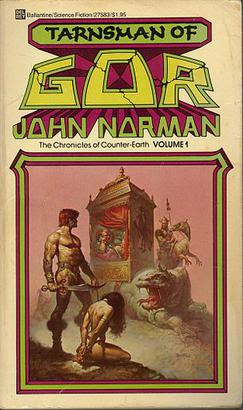
A while back, as a Christmas present, I got a set of Attillan Rough Riders for Warhammer 40,000. As-is, they don't really fit with any of the projects I'm working on at the moment, but they do look pretty cool, and I've been able to incorporate some of the parts into a few kitbashes. But in doing so, an idea sprung into my head - the parts, or at the very least some of the heads, would be a decent base for kitbashing an army of Wagon People from one of my biggest guilty pleasures in fantasy literature - John Norman's Chronicles of Gor.

Yes, that Gor.

I'm willing to bet that most people reading this have never heard of Gor, or have only heard it as the most profane and reprehensible hate literature in existence. Anyone who brings it up these days is either a fan of the books or doing so disparagingly, and the former category have essentially cordoned themselves off from the rest of society so as to be impenetrable to outsiders. Even 1d4chan/1d6chan, normally the South Park of the TRPG community when it comes to shock humor, has an article on the series that's one of their most vitriolic.

What might surprise you is that things weren't always this way. In fact, Gor was surprisingly influential in the early science fiction and fantasy communities - and, yes, that includes the early tabletop gaming community. It was never exactly mainstream, but it did have its influence, and there was a time where you could say you were a fan of Gor and people wouldn't recoil from you making the sign of the cross. It even got a few (very bad) film adaptations, one of which made it onto Mystery Science Theater 3000 (Outlaw, S05 E19 - it has absolutely nothing to do with the source material, but Jack Palance is in it, with predictable results).

And you know what? I know where those early names in the community were coming from - because Gor might well be one of the most gameable settings out there.

Let me back up a little, though. And put down those torches and pitchforks. Let me answer a few questions, and hopefully we can come away with a little more understanding.

What's a Gor?

A Beastman warrior, forming the majority of the Brayherds of Chaos, which have threatened the Empire for generations.

Okay, but all jokes aside. Chronicles of Gor is a long-running series of pulp sword-and-planet novels (a la John Carter of Mars) written by John Norman, starting with Tarnsman of Gor in 1966, and still being published to this day. Not all the stories feature the same characters or narrative, but they largely concern a university professor who is abducted by aliens and taken to a planet called Gor, orbiting the Earth on the other side of the sun and inhabited by the descendants of various human civilizations from throughout history coexisting at a roughly Iron Age technology level, where he becomes a powerful warlord.

Okay. What's so bad about that?

So to understand why Gor developed the reputation that it did, you need to understand the context surrounding it.

See, the books themselves are not really very good. The writing is dry, and the stories are largely an excuse to get the characters from place to place. But what really sets it apart is the worldbuilding. The world of Gor is incredibly intricate and detailed, and large swathes of the books are devoted to detailing different parts of the setting, its various cultures, and their practices.

It just so happens that these practices involve slavery, including sexual slavery. John Norman was writing in the time of the Sexual Revolution, and he has a few nonfiction publications exploring the rising fetish culture of the era. That context shaped the books, too. As such, the books detail various practices the Goreans use to keep, train, and use sex slaves. And when the BDSM community was rising in prominence at the time, many latched onto the descriptions in the books and used the information to shape how they handled things in the bedroom.

It's important to realize that the earlier Gor novels don't focus on this all that much. It's always there, but it's not really given much more focus than, say, Gorean honor culture, or weaponry, or the caste structure. The novels themselves aren't much different than what you would find in, say, a Conan the Barbarian story.

But due to the timing, some of the most prominent and most vocal members of the fandom were those people in the early BDSM community. And for better or worse, John Norman knew his audience. He realized that his books were selling because people read them for the smut, and he started writing more and more for those people specifically, with later books focusing much more on sexual slavery and including more focus on erotica. As such, the perception of Gor shifted to being "a sex thing" more than anything else, and that fact made it harder for outsiders, who might have liked pulp sword-and-planet adventure but had no interest in BDSM, to get involved. This in turn led to the community becoming increasingly tied to fetish culture.

That does not take away from the fact that, if you look past the sex stuff, it's still a wonderfully detailed, evocative, and elaborate setting that's just asking to be played in.

But Gor is about how all women should be sex slaves and how the ones that don't want that should be raped until they do!

This gets into the other side of the coin with the changing perceptions of Gor - the books started out as a part of the science fiction and fantasy fandom, but switched focus over time to instead be targeted at the BDSM community. These later books contained material that was characteristic of erotica, particularly BDSM erotica, including depictions of sexual slavery and sexual violence that were intended to titillate readers. But the books were still viewed through the lens, and judged by the standards, of people in the speculative fiction community, where this material was not commonplace. Naturally, this led to people believing that the BDSM content was in some way a reflection of the themes of the stories, or the personal beliefs of their author.

This isn't exactly true, on either aspect. Gor as a setting is not really about sex slavery or misogyny. It is stated on numerous occasions in the books that 98% of Gorean women are free. We don't have a figure for the entire planet, but it is mentioned that about 10% of the population of the city of Ar is made up of slaves - which is proportionate to some estimates of the Roman Empire, if not lower. Most slaves are female, but of these, many of these are used for labor, not sex. It's just that much of the writing focuses on female sex slaves, but this is not stated nor intended to be a representative sample of the norm. Norman focused on it because it sold. And the themes of the stories themselves are not unusual for BDSM erotica - if anything, they're tame by those standards; the books do not go into graphic detail on abusive or degrading practices, and a surprising amount of the sexual content is told through implication and occurs "off-screen." This is more than what can be said about some of the novels your bookstore probably has on the erotica shelf. The Gor novels, then, only seem offensive by the standards of "serious" science fiction.

As for John Norman himself, we have no reason to believe that the content of the later Gor novels is reflective of his personal philosophy. If you look into his nonfiction writings on sex, his outlook is not dissimilar to that of accepted voices in the modern BDSM community. His 1974 book Imaginative Sex focuses on the practice of erotic roleplay, and there he specifically lists consent and trust of one's partner as paramount in such a sexual relationship, as well as the fact that there are boundaries in one's sex life and personal life that must be respected.

In fact, some of his advice is hilariously quaint by modern standards. When discussing BDSM practices, he goes as far as to insist that using an actual whip on your partner is unacceptable; one should instead pretend to whip their partner because the fantasy of being whipped is erotic, but actually evoking physical pain is an inherently abusive act. I've never been to one, but I can say with confidence that if you said that in most BDSM clubs you would be laughed out of the room.

Also fun fact: Imaginative Sex presents several femdom scenarios. Just in case you thought he actually believed the stuff about men being naturally dominant. Sorry, try again.

But isn't there a culture based on Native Americans that are literally called "Red Savages?"

Yeah, I'll give you that one, that's pretty bad. That's why I'd call them Plainsmen if they came up in a game instead. There. Done.

It's important to realize that the Gor novels are products of their time. They were written in the 60s by a man who was born in 1931 - for reference, that's not a baby boomer; boomers are younger than that. Of course they're going to have things that won't fly by modern standards. So do plenty of stories that are beloved by the TRPG community. Kuo-Toa remain a staple of the Monster Manual, and they are based on a story about how mixed race people are disgusting and horrifying. We can accept that times were different then and strive to be better.

But wasn't there a Gorean sex cult involved in human trafficking? And don't a lot of Gorean BDSM people think you shouldn't use safewords?

Yeah, and they're pieces of shit. As previously stated, those people do not represent John Norman's beliefs or vision. There are going to be people like that in any fandom; they shouldn't be allowed to tarnish the good parts of the community. Should we judge D&D players by the standards of that guy who died LARPing in a steam tunnel in the 80s? Oh, wait, people did, and we laugh at them to this day.

But the Gor novels are poorly written anyway!

Yeah, you're not wrong there. John Norman is not a particularly good writer. What he is is a good worldbuilder, and the quality (or lack thereof) of his prose shouldn't devalue the genuinely interesting and gameable ideas he puts forward.

I'm uncomfortable with RPing sex at the table. Especially with strangers.

So am I. But as stated, there is plenty of material in Gor, as a setting, that has nothing to do with sex. There is no reason a Gor campaign has to address the topic of sex at all, let alone BDSM. It's important to know the boundaries of your players and what they're comfortable with and what they aren't (hey, that sounds familiar...). Yes, the official Gor TRPG includes sexual skills. I get why they did that, but I still find that weird and uncomfortable and I wouldn't use them if I was running it.

If you think the entire setting is too closely associated with fetish culture to feel comfortable using it at the table, that's fine. You can always take inspiration from certain parts without using the whole thing. You can just change certain names, and hey, anyone who notices can't call you out on it without outing themselves. There's plenty of ways you can make use of the material and stay well within your comfort zone.

I was in the Gorean RP community and it's full of elitists who think people who don't follow the books exactly are subhuman!

I wouldn't want to play with those people either. Again, we shouldn't let bad actors color a given fandom or community. When I'm running an established setting, regardless of what it is, that is essentially our version of that setting at the table, and canon only matters as long as it's fun. Hell, there are aspects of Gor canon I would do differently (more on that in a future post). Anyone who doesn't like that isn't going to be fun to play around, and games are supposed to be fun, so there's no room for them at the table. You don't have to play with them if it's going to make for a miserable experience.

I'm in the Gorean RP community and I think people who don't follow the books exactly are subhuman! Gor isn't a game, it's a way of life!

If your only conceivable notion of using existing source material as fodder for creative thinking is directly reenacting scenes from it verbatim, you sound like a thoroughly uninteresting person. Next.

Something something Houseplants of Gor! Hahaha, look at how funny and original I am!

Please, for the love of god, get another joke. People who don't like Gor have fewer jokes than Imperial Guard players or transphobes. Seriously, that was kind of funny in like the 90s, but it doesn't need to get brought up every time someone mentions Gor. Give it a rest.

Well, that does it for the first post in a perhaps ill-advised series of essays. Now that we've got that out of the way, I'm going to devote my next posts in this series to exploring the influence Gor had on the fantasy gaming scene (you'd be surprised!), discussing the factors that make it lend well to RPGs, and highlighting some parts I personally find cool. Stay tuned!

Thursday, January 2, 2025

The Year of the Gazetteer: A Retrospective

Click here to enlargee
With the Year of the Gazetteer behind us, I'd like to think back on how much it has done for this blog in the last twelve months. We went from averaging about two and a half posts a month in 2022 and 2023 to having at least 10 a month, with 2024 having 149 posts - my most productive year by far. I created 13 hex maps (counting Ochsebad) of various regions in my long-running Lunar Lands setting, which has hosted almost every campaign I've run since middle school - altogether detailing 33,543 hexes and 229,233 square miles of setting. That's an area a little smaller than Madagascar if smushed together, although the areas are not contiguous. I also wrote several articles, including lore, adventure hooks, and homebrew game material, that detailed different parts of my setting, fulfilling the purpose I made this blog for in the first place but never knew where to start with. Keep your eyes out for a Lunar Lands index in the future, where I will catalogue this material.

I learned a couple things along the way. Originally, I intended to use three-mile hexes for every map - I'm inclined to agree with Mythlands' points about this scale - but as I expanded beyond Switzerland-sized Lescatie I realized that it would just be unfeasible to keep making maps in that scale on a regular basis. After the undertaking that was Togarmah, I realized that even doing six-mile-hex maps of many regions was too big to do in detail, and most of the maps are only partial segments of their respective regions. Nevertheless, I still think there's more than enough to last a good few campaigns. Maybe some day I'll go back and fill in the gaps with hex maps of the remaining areas, but for now, it's a project I'm quite satisfied with.

Out of all the maps, the one that's gotten the most attention has been that of the Freikantons, which has sat in my list of most popular posts for some time now. I suspect this comes from its links to Ochsebad, which I submitted for the Summer Lego RPG Setting Jam at DIY & Dragons, realizing how I could contribute to both projects (which was a lot of fun!). Or maybe bitches just love the Old Swiss Confederacy. Who knows.

From here, I want to go from a big success (at the time of this writing, my post on terrain rules for combat is still my biggest success) to what I consider my biggest failed experiment. This didn't happen last year but the year before, but back then, I wrote a post about how the setting of the anime Puella Magi Madoka Magica would work well for an OSR campaign. I still think that, but I'm sad to say I don't think that's a campaign that will ever see the light of day. Though the post brought a lot of attention to my blog - even making it onto the OSR subreddit, somehow - a lot of the discourse there made me realize that there is not a lot of overlap between why I enjoyed Madoka Magica and why everyone else did.

I should note that I got into the series very early on in its run, I believe the day it blew up online as soon as the third episode aired (if you know, you know), and at that time, there had not been much in the way of character development; what drew me in was the interesting and very gameable setting and magic system, which seemed like it was going somewhere. I thought that setting would lend itself well to OSR gameplay. However, most of the reception I got was about how OSR systems don't model interpersonal dynamics well, despite me stating this was the aspect of the series I found the weakest. What I realized was that it's been over ten years, and most people now know Madoka Magica for the character-driven show it ended up becoming. I found the setting interesting but the characters unlikeable, whereas the fandom generally finds the characters likeable but the setting uninteresting (or at least unimportant). Nowadays, anyone wanting to play a game in the Madoka Magica universe is probably going to expect a depressed lesbian psychodrama instead of the horror-infused dungeon-delving sandbox about grappling with the limits of your own humanity I wanted to run, and that isn't really the kind of campaign I would be interested in running.

Anyway, I bring all of this up because this experience has taught me absolutely nothing.

Art by Martin Rodriguez
2025: The Year of the Barbarian

Barbarism is the natural state of mankind. Civilization is unnatural. It is a whim of circumstance. And barbarism must always ultimately triumph.
- Robert E. Howard

Crush your enemies, see them driven before you, and hear the lamentations of their women.
- Arnold Schwarzenegger


Lately, I've gotten deeply into a specific kind of fantasy. Sword-and-sorcery blood-and-thunder barbarian hero pulp heroic fantasy. The likes of Conan, Kull, Red Sonja, Fafhrd, Thongor, we can offer an honorable mention to Dave. While barbarians in the Lunar Lands tend to look more like ancient Celts or Germanics, I can't deny that I don't love myself a good Frazetta or Vallejo mighty-thewed warrior, in its own context.

I've been getting into not only 30s barbarian pulp, but also 70s barbarian comics, a surprisingly deep genre that Trey at From the Sorcerer's Skull has written plenty about. He's even done some writings of a game meant to emulate that milieu. I have him to credit for introducing me to Arak, Son of Thunder, which would have gotten into the Lunar Lands Appendix N had I not discovered it so recently and had there not been other, longer-standing influences to include It got me thinking of how I could do something like that myself - and, in particular, there are a few settings I've looked at that I feel would lend themselves well to such an approach. Neither are my own creation, but both I feel tap into the well of sword and sorcery goodness in their own ways.

One is a setting from the second big wave of pulp fantasy that I find incredibly gameable, and which has had a much bigger influence on the tabletop RPG world than many people realize, most likely due to its (in my opinion undeserved) bad reputation. The other is a setting I have talked about here on the blog several times already, one which, despite its association with another popular comic artist (to the point where most people overestimate how much involvement he had in it), I think would shine with a reinterpretation in the Mighty Marvel Manner under the theoretical pen of Roy Thomas. I intend to explore each of these in a forthcoming series of posts.

I'll still be posting the occasional Lunar Lands lore, of course - but we'll take a detour that will ring in the Year of the Barbarian! Stay tuned for what's to come!

Wednesday, November 20, 2024

Lunar Lands Appendix N

Whether you want to call it "6e" or "5.5e" or "One D&D" or "D&D 2024" or "the spawn of Satan," the core books for the most recent iteration of D&D's ruleset have hit shelves. I've had a chance to look at them (and what people online are saying about them), and while I would overall call it a mixed bag I don't have much in the way of strong feelings on, there is one decision I find truly concerning. The venerable Appendix N, of inspirational reading and influences on the game, is gone from the Dungeon Masters' Guide, replaced by a "lore glossary" of terms and characters from existing D&D fiction.

I'm sure you already knew I was going to hate this. It's just another nail in the coffin of what I've been arguing since the very beginning of this blog - that in becoming a brand, D&D has become a corporatized, proprietary Human Centipede constantly consuming, excreting, and regurgitating its own lore, and that the rejection of outside influences will just lead to more homogenized cinematic-universe-friendly slop targeted more at investors than gamers.

But rather than focus on how the sky is falling, I would like to use this as an opportunity to do something positive - to discuss the sources that influenced my approach to DMing and worldbuilding, both in content and in philosophy. I've seen other blogs do something similar, and I suppose that with the death of the official Appendix N, it's time to keep that spirit alive through exploring what an Appendix N for the Lunar Lands might look like. So, in no particular order, here are ten things that shaped both myself as a DM and the Lunar Lands as a setting. I might return to these with more detail at a later date, but for now, here's what I have.

National Geographic
1. World culture and history

Ever since I was young, I've had a fascination with how people live and lived their lives, both around the world and in different eras. I'm of the opinion that no fictional universe can ever be quite as deep or as interesting as the real world - even today, there are thousands of societies with their own practices and cultural norms all around the globe, and I find delving into the subject to be just as rich and compelling as any fictional universe bible. I love learning about how people live or lived on the other side of the world, or in a different age. My approaches to worldbuilding take after that interest, both from a superficial perspective and a more in-depth one.

Obviously, the Lunar Lands is very much a History's Greatest Hits setting, with various regions based heavily on different cultures and eras. Even with the Year of the Gazetteer, I've drawn from subjects as diverse as colonial Mexico, the Saami people of Scandinavia, the Holy Roman Empire, and Lancaster County, Pennsylvania. In rejecting Flintstonism, I make an effort to portray these cultures as people raised in them would have thought and felt, rather than to use them as dressing for contemporary stories - I enjoy doing the research, and I strive to give the worlds I portray a greater level of immersion and verisimilitude through referencing real-world practices, social norms, systems of governance, and other phenomena.

But on a broader scale, I also take inspiration from the diversity of real-world society to make every part of my setting feel distinct from one another, with all the intricacies and idiosyncrasies of real cultures. The Lunar Lands has ethnic minorities, diasporas, and stateless peoples - real life isn't so clean that you'll get a society where everyone wears hats, and that's it. That's one thing I like so much about this planet, and I want the same for my setting.

2. Mythology and Folklore

Long before I was into anything we'd call "fantasy literature," I was enamored by the various myths and legends of the world from throughout history. As a child, my image of stories of magic, monsters, and the supernatural was more colored by fairy tales and ancient myths than pulp speculative fiction. The iconic fantasy heroes, to me, were Odysseus and Beowulf, not Gandalf and Conan. Of particular interest were the Usborne and Kingfisher books that presented a glossary of gods, heroes, and stories from around the world, with beautiful illustrations that brought these tales to life. When I began running campaigns, I didn't have ready access to modules or setting guides, so these were the sourcebooks I used instead to get inspiration for my next game.

One of my players has described the tone of the Lunar Lands as "more fairy tale than fantasy novel," and that's a description that's stuck with me. I draw inspiration from real-life folklore whenever possible. If a creature in the Monster Manual has abilities that are at odds with what ancient people believed about its namesake, nine times out of ten, the ancient people are going to win out. My gods take human form, meddle in mortal affairs, and are fond of cursing people for arbitrary reasons, rather than passively sitting around rewarding prayer with spells. Add in my Catholic upbringing introducing me to the various saints, miracles, and folk rituals of Europe and beyond, and you have a setting where the fantastic has a more grounded, mythical feel - even if there's room for beholders and displacer beasts too.

I'm pretty sure either
I had this cover,
or my teacher did.
3. The Hobbit

That isn't to say that modern fantasy literature hasn't influenced my setting. Far from it. When I was raised on a diet of myths and legends, it was only natural that I would move on to the works of Tolkien when I was older, and that I would be enamored with it from the beginning. My first exposure to Tolkien's work was The Hobbit, a book that one of my teachers decided to read to us over lunch period, and it didn't take long for me to be hooked.

I've always preferred The Hobbit to The Lord of the Rings - the first of the movie adaptations of which came out just after we had finished The Hobbit, in a stroke of good timing - and while I suspect nostalgia plays a part here, I also find the tone, scale, and scope of the story resonates more with me. The world of The Hobbit has a more folkloric character than what would come later. A big part of it, I feel, is that Tolkien is content to just let things happen, without needing to justify it through worldbuilding. Animals talk. Bags talk. People just have magic items lying around. Elves are bothersome tricksters, not wise mentors. There are encounters with strange creatures that Tolkien never attempts to fit into a greater and more cohesive world. I always hate when fans try to explain away the giants playing catch in the mountains as a metaphor, citing that giants aren't mentioned in any other Middle-Earth stories - maybe there are just giants in this world, and that's okay. My setting strives to work in much the same way.

The Hobbit, compared to its sequel, is more concerned with a singular adventure, making it feel more intimate and relatable than a grand sweeping epic where the fate of the world lies in the balance. That's a tone I try to capture with my setting, but I'm also influenced by the structure of The Hobbit. The story is an episodic one, told through a number of incidents along the journey that are largely self-contained. When my players are seeking out a destination, I always make sure to have plenty of interesting locations along the way - whether they be dangers or potential allies and resources. And, just as Bilbo and the dwarves rarely overcome their obstacles through force of arms, I like to encourage players to use clever tricks and exploit their environments to get out of a bind.

4. Swashbucklers and Historical Adventure Fiction

Think Ivanhoe, the various Robin Hood stories, The Three MusketeersPrince Valiant and similar comics, and their legions of adaptations and derivative works on the big screen. This genre is a bit of a lost art - the latest example I can think of is 1991's Prince of Thieves, unless Pirates of the Caribbean counts - and that's really a shame, because they provide a great font of material for interesting plot points and adventure sites.

The Lunar Lands is a low-magic setting, and I think that a big part of that comes from how stories like these have shown me that you can have compelling and dramatic stories in a pre-industrial setting without needing to throw a wizard in there. My games are full of corrupt nobles, daring escapes, and honorable duels; while there are plenty of conventional D&D dungeons, just as many are literal dungeons, where one will have to fight their way out of a scheming baron's castle, braving guards and traps and navigating passages hidden by clever stonework. Of course, doing all of that and throwing a wizard in anyway is fun too!

A lot of swashbucklers are comparable in tone and character to old-school sword and sorcery tales - something I think a lot of people don't realize, especially given Robert E. Howard considered himself a writer of historical fiction - but without the influence of turn-of-the-century weird fiction, they mesh more easily with a setting that's more grounded in myths than Lovecraftian themes. I suspect my lifelong interest in history made these historical adventures more appealing to me, but there's plenty of material there to be mined by any DM.

5. Wilderlands of High Fantasy

Is this one cheating? In the interests of slaying the self-referential ouroboros of modern-day pop culture, I've tried to avoid sources that came from D&D itself. But I'm going to list Wilderlands here. Not only is it a third-party product so I think I can get away with it, it was a profound influence on my approach to worldbuilding and running games. One of the most important moments of my development as a young DM was when I received the 3.5e Wilderlands boxed set as a birthday present. At the time, I had no idea it was a setting that was almost as old as D&D itself. What I was fascinated by was the nature of the product.

The Wilderlands boxed set - apparently something of a collector's item today - is essentially a big collection of hex maps, altogether covering an area about the size of the Mediterranean Sea, with two books detailing every region described therein, and the various points of interest contained within each hex. There's plot hooks, but no overarching narrative. It's meant to be a sandbox you can drop a party into and have them make their own fun. This was a game-changer, for me. It made me realize the virtues of sandbox campaigns, and how you could seed an area with enough interesting encounters to let a party explore it as they pleased. They might save the world. They might become wanted criminals. They might even carve out kingdoms - all of this was anticipated and expected.

That was the kind of campaign I decided I wanted to run. It also got me thinking of how I could design a setting that was just as open-ended, detailed, and diverse. The Wilderlands has a reputation as somewhat of a gonzo setting, with lost technology and alien races, but I never got that impression from the boxed set, and none of that really found its way into my work. What I saw was that I could do something similar in terms of presentation and game philosophy, and I've never looked back.

6. British old school gaming

I've spoken on this subject in the past. As far as I'm aware, I was one of the first people to posit the existence of a distinct tradition of British old school fantasy gaming on the OSR subreddit, and it got some discussion going in its day. I need to revisit that at some point. But I'm of the opinion that there is a distinct pantheon of British RPGs and related material - the tentpoles of Warhammer Fantasy Roleplay, the Fighting Fantasy gamebooks, and Dragon Warriors, plus related works and also-rans like Blood Sword, Maelstrom, and the material in old White Dwarf articles and TSR UK's books (yes, that includes the Fiend Folio, so the Flumph and the Space Marine are cladistical cousins!). These works have a distinct feel and their own tropes and conventions, and while I am both American and a 90s kid, they've always appealed to me in a way that American games of the era never did quite as well.

While American games took inspiration from pulp fiction, British games had more of a grounding in history and folklore. Flintstonism was downplayed in favor of accurately depicting medieval culture and society, and often there was a greater influence from fairy tales, Arthurian romance, and other more traditional sources. Things were more grounded in mundanity, providing a contrast to the overtly fantastic, and there was a slant toward low fantasy rather than high fantasy, with PCs being desperate rat-catchers and adventures entailing bogus haunted houses set up to scare locals away from smuggling operations. A lot of this paralleled and overlapped with other areas of interest to me, so I consider the Lunar Lands a British old school fantasy setting, in spirit if not by birth. Since discovering Fighting Fantasy, I've also incorporated much of the series' philosophy into my approach to game design. In those books, a clever player can get out of danger or evade a tough fight by taking an alternate route around or using the right item, and I strive to do the same with my campaigns.

7. Dragon Quest

I've spoken on the subject before, but as a child, I played the Game Boy port of Dragon Quest III extensively, and read the strategy guide even more extensively. The game dates back to an era where Japanese RPGs were only starting to meaningfully diverge from their western counterparts, and III wears its D&D influence on its sleeve, with a party of customizable characters, thieves with utility abilities to be used outside of battle, clerics who can wear armor and use weapons (have you ever seen a white mage do that?), and cursed items that can only be removed by seeking a blessing at a temple. Discovering the game at the same time I was discovering D&D was well-timed. Even if I did recognize the box art was done by the guy I knew from watching Dragon Ball Z on Toonami, I could also recognize the two games as being part of the same canon, and they seemed to complement each other. I always just assumed DQ3 was of the same genre as Might and Magic VII on my family's computer, just designed differently due to technical limitations. In my early days of gaming, I tried to remake my D&D characters in DQ3 (poorly), and I ran several dungeons out of the DQ3 Prima strategy guide at the table.

While the Lunar Lands doesn't have cutesy ooze mascots, I do draw inspiration from how DQ3 - and the greater series, now that I've gotten back into it - presents its world. A big aspect of the games that I think gets left out of the conversation is how open-ended they are. While there are some entries that are more story-driven, the stories tend to be simpler and the worlds more open to exploration than a typical Final Fantasy title. Often times, story arcs are self-contained to a single town or dungeon, hitting on the same episodic nature of a hexcrawl, of Bilbo's journey to the Lonely Mountain, or indeed, of the campaigns I run. Furthermore, the settings tend to play things more traditionally than most JRPGs, and despite Toriyama's art, they feel closer to classic fantasy or folklore than to modern-day anime.

I do, alas, regret to inform anyone who's interested in seeking Dragon Quest out nowadays that the series' English releases changed translators partway through its run, and more modern games have rejected faithful translations in favor of just adding in whatever dumb jokes the translators wanted to tell, regardless of if they fit the intended tone. If you want something with the tone my games aim for, avoid anything with Dragon Quest on the cover and look for Dragon Warrior instead. While I use the official title for clarity's sake, earlier English releases, including those of my youth, were released under Dragon Warrior because TSR owned the trademark to Dragon Quest at the time. Which is ironic, because...

8. Dragon Warriors

Yep, there actually was a TRPG out there called Dragon Warriors, and no one bothered to care. This one falls under the umbrella of British old-school gaming I talked about earlier, but I wanted to devote its own section because its influence is just that strong.

Dragon Warriors takes place in Dave Morris's Land of Legend, a setting based heavily on medieval folklore and culture. It's a setting where people invoke the names of saints so that the fair folk won't cause their milk to curdle and their grain to spoil so they'll be able to pay their tithes to the local lord. When I discovered Dragon Warriors for the first time, my immediate thought was somewhere between "Yes! This is exactly what I've always wanted!" and "Oh no, someone beat me to it." It hits the nail on the head perfectly for what I want out of fantasy grounded in history, myths, and legends, and a lot of Legend content would fit into the Lunar Lands with minimal changes. In fact, I've done exactly that.

Dave Morris is still putting out content today - he's working on a new edition of the rules, titled Jewelspider, and his blog Fabled Lands still releases material for the setting in the form of semi-regular zines and adventures, all of which have that deeply folkloric feel that I can't get enough of, and many of which have made it into the Lunar Lands practically unchanged. I'm only somewhat joking when I call the guy my spiritual liege.

9. The Elder Scrolls

You may have noticed that one of the bigger recurring themes in this list is that I like open-world games that encourage and reward player-driven exploration. It shouldn't come as any surprise that I'm a big fan of The Elder Scrolls, a series that makes this sort of thing its wheelhouse. In turn, it's influenced how I think about campaign design. Most of my campaigns have been set up similarly to a typical Elder Scrolls game, where I might have an overarching plotline, but also seed the world with plenty of locations, sidequests, factions, and NPCs that the players are free to explore as they wish, pursuing different leads and affiliating themselves with different parties. If they want to ignore the main quest entirely and just focus on doing missions for the local guild, or clearing out dungeons, or collecting roots, that's perfectly fine, and they can do that as long as I have interesting material to throw at them.

But more importantly, Elder Scrolls was a heavy influence on me for how it approached its world. Before I played Oblivion, my introduction to the series, I had never seen a video game that felt like a living, breathing world - one that I could see people actually living in, with lives and stories that unfold beyond what's necessary for gameplay. A big part of this is how Elder Scrolls handles its lore. There's much more canon information about the setting than is ever encountered in any of the games, with the world possessing hundreds of books you can read - everything from novels to encyclopedias to biographies, and all expanding on the world of Nirn and making it feel like something greater. That was a big inspiration for me to develop the world of my setting to match. The Lunar Lands doesn't have the weirder metaphysical qualities of Mundus - there's no room for a magical space station (yes, that's canon!) in a world of myths and legends - but the philosophy of creating a setting for a game that's rich and detailed enough to stand on its own drove me to the sorts of thinking that led me to make this blog. Even if some of this stuff never comes up in gameplay, I know it's there, and that's enough for me.

10. Touhou Project

Come on, it wouldn't be a Lunar Lands article without something completely out of left field. Out of all the things I've listed today, this is probably the one most unfamiliar to much of my readerbase, so allow me to explain.

Touhou Project is a long-running series of independently published video games, produced almost entirely by a single Japanese man who goes by the online handle of ZUN. They're arcade-style shooters about poorly-drawn anime girls in funny hats firing excessive amounts of lasers at each other. I haven't played a single one of them. My exposure to Touhou instead comes from its large and devoted fanbase. ZUN has encouraged players to produce fanart and fanfiction of his characters - there are over 100 poorly-drawn anime girls in funny hats that have appeared over the course of the series, each of whom has their own distinct personality and unique quirks, and the fans have been so compelled by them that the majority of Touhou-related content on the internet comes from fans. These range from memes to music videos to professionally-produced manga to an entire animated film. There are entire characters who have no dialogue at all, but the personalities and traits fan works have given them have been so influential they've set the model for how they're portrayed in other productions.

But what on earth, you might ask, does this have anything to do with the Lunar Lands? Well, Touhou is heavily inspired by Japanese folklore. The characters and their abilities are all based on mythical beings, Shinto and Buddhist traditions, and urban legends, and much of the series's appeal comes from seeing how these entities are reimagined and how they interact with one another. Very rarely is something created completely out of whole cloth. Though the cultural backgrounds I draw from are different, it's a philosophy I apply in my worldbuilding as well, creating cosmologies and magic systems out of real folkloric traditions and basing characters on precedents found in myths. Another one of my players compared my setting to a European Touhou, and while the anime influences are not nearly as overt, it is something I've leaned into.

Also, tying back to my first point, I do have to credit Touhou with introducing me to the principles of Shinto, and I find the religion's animist traditions fascinating. The concept of regional shrines, local deities, and items that can gain sentience with time have found them into my setting, and I don't think I would've used the term "shrine maiden" in my setting if not for Touhou. Plus, I almost called this blog "Lunar Land Story," so that should count for something.

With that retrospective on the material behind my setting, I would like to open the floor. Let's not mourn Appendix N. Let's celebrate the rich tapestries of influences behind our games and our settings! If you haven't written anything on the Appendices N for your games, I encourage you to do so. I'm not the first DM to blog about this subject, and I'm sure I won't be the last. I'm interested in hearing from you!

Saturday, September 23, 2023

And Now For Something Completely Different: Why Madoka Magica is OSR

I swear I haven't lost my mind! Come back!

I don't just post about learned and erudite things like history and medieval folklore on this blog, you know. Yes, I watch anime. Call me cringe all you want, but let's not deny that at the end of the day, the world of RPGs owes just as much to pop culture as it does to "serious" literary tradition. Anything can be a font of inspiration to make our games, and our lives, a little richer. And today, I'd like to explore one such example.

Besides, if you were really paying attention, you'd know I already dropped a few in-jokes to the subject of today's post back in one of my first posts on this blog. Purely because it referenced the same Germanic traditions I did. That's just what I do. Like some sort of enigmatic trickster god, my players never know if I'm referencing some obscure 13th century epic poem or some internet meme. You might not know either.

Anyway, today I'm going to talk about the anime series Puella Magi Madoka Magica. What makes the series notable for me is that it was the first anime - really, one of the first TV series in general - that I actively followed as it was being released (as it was being released in Japan, no less). It debuted in early 2011, while I was in high school, and I happened to become aware of it when it was freshly three episodes in (if you were there, you know). I proceeded to follow new episodes as they released week to week, and that was a kind of experience I had never really had before. Or, really, since, given the changing landscape of streaming and whole series dropping at once.

Rewatching it a few years back, I don't think Madoka Magica is a perfect series. I wouldn't even call it a great series. It settles for being merely good, but not without its flaws, and they only grow more apparent with age. The pace vacillates between being agonizingly slow and breakneck fast, but rarely settles on a comfortable middle ground. So many characters are frustratingly underdeveloped, and I've come to see the effective protagonist - one of the few who isn't - as the kind of person I would probably punch in the face if we were locked in a room together for long enough. The Watsonian lore and the Doylist themes of the show both raise all kinds of fascinating ideas and implications that feel like something could be done with them, but they never are. The individualist philosophy the series takes on the question of self-sacrifice never sat well with my utilitarian socialist self, and in light of the sequel movie (which split the fanbase in two - I'm solidly on the "it sucked" side of that rift), there's an unpleasant undertone of Objectivism that I can't help but pick up on whether intentional or otherwise. But there's something that makes the series hold a place in my heart.

And I suspect that something may just be how the setting seems to resonate so well with the ideas of a tabletop RPG - particularly one of the Old School ethos.

In the rest of this post, I'm going to give a rundown of Madoka Magica lore with a focus as to what aspects of it are gameable, and summarize how they abide by OSR principles. If you're already familiar with the series, you can probably skip this next part (though I recommend you at least give it a look because there's some things that never actually happen in the series but are totally missed opportunities, and you may not even know about them). If you aren't, please be aware that this discussion will contain spoilers if that matters at all to you - but for what it's worth, I wouldn't have gotten into the series at all if I didn't have it spoiled for me back then.

More under the cut.

Saturday, June 10, 2023

Visions of Tolkien's World

If you're active in the geekosphere, you may know about the upcoming Magic: the Gathering set based on The Lord of the Rings. What I take away from this is that the way Wizards of the Coast handles the lore of its two flagship properties is almost diametrically opposed, with D&D so locked down with the lore of just one setting out of the infinite potential of the creativity of DMs the world over, while the folks over at MTG embrace the opportunity to cross over with everything they can get their hands on, no matter how fitting - but that's not the subject of this post.

It do be like this though.

You may have heard the controversy over the set depicting Aragorn (and a few other characters, but he's
the most visible) as a black man. You can weigh in on whether or not it's fitting of the lore, or whether or not it's representative of tokenism, all you want. Actually, don't, I don't want my comments section to turn into a minefield. But that isn't what I'm here to talk about either. I don't have any strong feelings one way or the other about Aragorn being black. But it does excite me. What I do care about is how this represents a rare exploration into the potential for more diverse depictions of Middle-Earth and of Tolkien's stories than what we're used to.

I, of course, refer to the fact that they're not making everything look like the movies.

...what? What did you think I was talking about?

All jokes aside, I welcome the fact that the artists over at Wizards are putting their own spin on Tolkien's world. If you take a look at Tolkien art, you'll notice a very noticeable shift around the early 2000s, right when the Peter Jackson movies hit theaters and became smash hits. After this, everyone uses the movies as their template of what Middle-Earth is "supposed" to look like. Color palettes are drab and mostly shades of brown. Elves wear gold armor with elaborate, leaf-like designs. The Uruk-Hai use equipment with an industrial, almost brutalist feel. Hobbits have curly hair and dreamy boy-band looks. There's lots of open plains. Aragorn looks like Viggo Mortensen.

Which of these is concept art from the movies?
Trick question: none of them are.

Before this, though? There was no established "look" for Middle-Earth. Every artist was free to intepret the world in their own way, and we saw some really creative interpretations. Take a look:

There's of course the famous art of the Hildebrandt Brothers, which defined Tolkien in the eyes of many before the movies thanks to their popular series of calendars.


The genesis of pig-faced orcs?

Give Gimli his hat back.

Or how about the work of Ted Nasmith, whose lush, detailed landscapes paint the sort of vistas I can only hope to portray as a DM?


Famed Conan illustrator Frank Frazetta did a lesser-known series of Tolkien artwork that brings a pulp feel to the story.


Not sure how effective Eowyn's disguise is, though

The Rankin-Bass adaptation of The Hobbit probably comes the closest to my childhood mental image of Gollum.

And their depiction of the elves of Mirkwood can't be farther from Jackson's.

Foreign editions bring their own interpretations to the table, like this Finnish version of Gollum.

And this Russian Gandalf has a folksy, almost medieval-tapestry feel.

Would anyone today portray Boromir as a Viking, as seen in the Ralph Bakshi film?


What about a flippin' samurai? Because that's what the Finnish television series Hobbits did.


Hell, even the art straight from Tolkien himself seems refreshingly different to modern eyes.


I'm glad that Wizards is willing to experiment and go against the grain, not because I'm any fan of identity politics, but because a world where we only have one flavor of Middle-Earth is boring. Or one flavor of anything, really. As popular as the Jackson movies are, they're just one of a handful of adaptations, and one of even more personal interpretations of what was described in the text. And artists shouldn't be afraid, consciously or unconsciously, to share their visions because they're not the definitive look - they shouldn't even believe there is a definitive look to begin with. There should always be room for creativity, and the popularity of adaptations that came before shouldn't stifle that.

It's the same reason why, when running published modules, I never show my players any illustrations. The world and the characters is theirs and theirs alone to imagine, and I don't want to color that with any other interpretation. The players' mental image probably doesn't look anything like what's in my head. And that's a good thing.