Showing posts with label Swordbrothers. Show all posts

Thursday, June 20, 2024

Karnoffel

Back when I was in college, one of my classmates of a similar persuasion regarding history introduced me to Karnoffel - Europe's oldest surviving card game, tracing back to 1426 and probably beyond. Those who have been with this blog for a while might remember the earlier post I made on Hazard, and much along the same vein, I've used Karnoffel as a minigame in my D&D sessions.

There have been attempts to make card games that might exist in a D&D world, like Three-Dragon Ante and Prophet's Gambit, but none of them have really hit the mark for me. They're clearly based off of modern principles of game design - too streamlined and too complicated at the same time, with mechanics more in keeping with Magic: the Gathering than a traditional card game. In a preindustrial society, card games shouldn't be so refined; they would usually have rules that can fit in a simple document (so rarely will single cards drastically change the rules of the game in a unique way), making them easy to transmit orally, and with enough inconsistency to make it clear that they were created by ordinary people as a diversion, not by professional game designers doing this sort of thing for a living. Karnoffel scratches that itch, and has the added benefit of being relatively simple to play - plus, you don't need any special equipment; just a standard playing card deck.

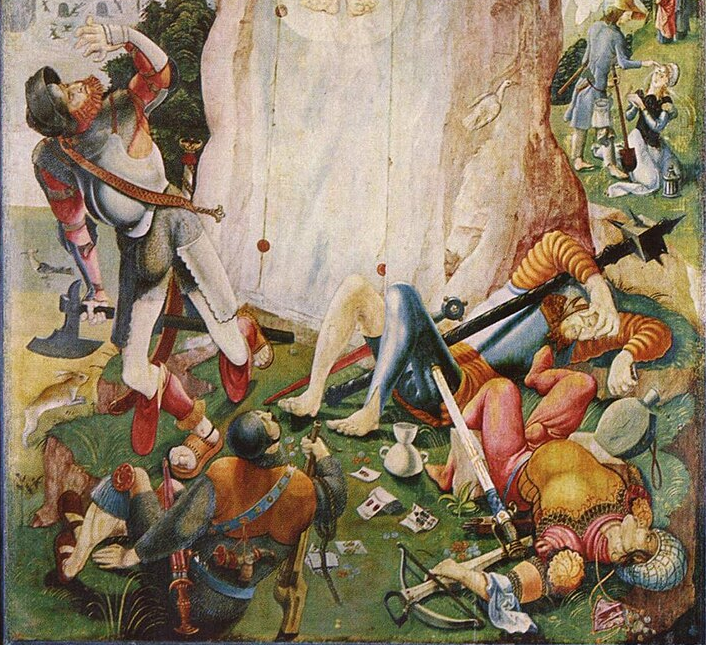
As an added bonus, Karnoffel has a long history of association with the Landsknechts, the model for the Swordbrothers of the Lunar Lands. Which means that it fits right into our ongoing tour of the Freikantons.

How to Play

You'll need a standard 52-card playing card deck, with the aces and jokers removed. For flavor purposes, cards in the Lunar Lands use the suits of the minor arcana (swords, staves, cups, and coins), but any deck will work.

Karnoffel is what's known as a trick-taking card game - that is, players take turns playing cards over a number of rounds, or tricks, with a winner for each trick. At the start of a game, a dealer deals five cards to each player, one of which is face up. Of the face-up cards, the suit of the one with the lowest number becomes the trump suit for that game; in the case of a tie, the card that was dealt first determines the trump suit. Certain cards of the trump suit have higher value than cards of other suits - see below.

Each player plays one card from their hand per trick, starting with the player to the left of the dealer and continuing clockwise. The value of the cards is as follows, in descending order:

Jack of Trump Suit: The Karnoffel.

7 of Trump Suit: The Devil. This one has some unique rules. It must be the first card played in the trick, and may not be played on the first trick of a game. In all other circumstances, it automatically loses the trick. 

6 of Trump Suit: The Matriarch (in real-life Karnoffel, the Pope).

2 of Trump Suit: The Emperor. 

King of Any Suit

3 of Trump Suit: The Oberstecher.

Queen of Any Suit

4 of Trump Suit: The Unterstecher or Duke.

Jack of Any Non-Trump Suit 

5 of Trump Suit: The Knight.

10 of Any Suit

9 of Any Suit

8 of Any Suit

7 of Any Non-Trump Suit

6 of Any Non-Trump Suit

5 of Any Non-Trump Suit

4 of Any Non-Trump Suit

3 of Any Non-Trump Suit

2 of Any Non-Trump Suit

7 of Trump Suit when not played as the first card of the trick or when played on the first trick of a game. 

From personal experience, I recommend having the list of card values on hand when playing Karnoffel, as players may struggle to keep track of them if unfamiliar with the game.

Once all players have played a card, the trick ends, and the player who played the highest-valued card wins the trick. The next trick begins with the player who won the last trick and continues clockwise. The first player (or team; see below) to win three tricks wins the game. Whoever was to the dealer's left becomes the dealer for the next game.

Note that Karnoffel was traditionally played with either two players, or with two teams of players. If teams are used, players on the same team are allowed to look at each others' cards and consult with one another on their moves. Theoretically, it could be played with more than two players or teams, but this might lead to running out of cards before a trick is won, so the number of cards in each players' hand might need to be adjusted accordingly.

An Example of Play

Two Swordbrothers - Marius and Hilmar - are playing a game of Karnoffel back at their camp. Marius is the dealer, and deals Hilmar the following cards:

6 of Cups (face-up), Jack of Cups, 4 of Coins, 8 of Cups, Jack of Swords

Whereas he deals himself the following cards:

8 of Swords (face-up), 5 of Cups, 9 of Coins, 4 of Swords, 7 of Coins

The numbers of the face-up cards are a 6 and an 8. Since 6 is lower, the trump suit for this game is Cups. Hilmar, feeling quite smug but wanting to hold onto his Karnoffel just in case, plays the 6 of Cups - the Matriarch. Marius knows none of his cards can beat it, and decides to play his 4 of Swords to get rid of it. Hilmar wins the trick.

For the next trick, Hilmar plays the Jack of Cups - the Karnoffel. No card in the deck can possibly beat it. Marius restrains the urge to gut Hilmar with his katzbalger and instead considers what card he wants to get rid of. His lowest-numbered card is the 5 of Cups, but that is the Knight, and still a trump card, so he decides to hang onto it just in case. Instead, he decides to relinquish his lowest-valued non-trump card, the 7 of Coins.

At the start of the third trick, Hilmar is in the lead by two, but is out of trump cards. He gets cocky and plays the 8 of Cups - but even though it's the trump suit, an 8 of the trump suit doesn't trump an 8 of any other suit. Marius decides to play his Knight here, and wins the trick. Even though the number is lower, the fact that it's a trump suit means it takes precedent.

For the fourth trick, each player has two cards left. Since Marius won the last trick, he goes first and plays the 9 of Coins. Hilmar, realizing that he needs to take things more seriously, plays the Jack of Swords. Even though it isn't of the trump suit, a Jack still beats a 9, so it wins. Hilmar wins the third trick, and the game.

Each player then returns their cards to the Marius, who shuffles them back into the deck and passes it to Hilmar. Now Hilmar is the dealer, as he was sitting to Marius's left, and he deals five cards to Marius and to himself.

Why "Karnoffel?"

As for why the game is called that? Well, the term "Karnoffel," in medieval German, meant either to beat someone, or an inguinal hernia. Both of these are weird things to name a card game, but apparently, the term was also used as a slang term for a Landsknecht. No clue as to which meaning was intended for the game.

Wednesday, June 5, 2024

Brothers of the Sword

Art by ThaneBobo
Though often described as an organization, it would be just as accurate to call the Swordbrothers a philosophy, a movement, or even a fashion sense. There are a number of different mercenary companies - most based in the Freikantons, but some have established operations beyond there, some even beyond Vardessy - who define themselves as Swordbrothers, but not all are aligned with one another, and not all practice the same codes or traditions. There are, however, a number of common traits that help to define these warriors, and which all such organizations exhibit.

The Swordbrother way of life can be traced back to Adelbrecht von Bergschafen, a mercenary captain active in what is now the Canton of Hagen many centuries ago. He was known for his eccentric behavior, which he imparted to the men in his employ, and many other mercenaries began to follow his example, modeling themselves after him - whether in the hope of attracting attention, winning the same success he did, or merely being impressed with his swager. These sellswords, and their armies, were the first of what would become the Swordbrothers. Though a number of disagreements and divergences have broken out among the ranks over the years, some of them with corresponding armed conflicts, all Swordbrother companies to this day honor Adelbrecht von Bergschafen as their spiritual liege.

The most noticeable quality of the Swordbrothers is their outrageous fashion sense - by all regards, they dress more gaudily than even the most ostentatious of nobles, favoring big hats (often with large feathers), puffed-and-slashed sleeves and pantaloons, and elaborate codpieces. They are fond of using as many colors and patterns in their ensemble as possible, often leading to dazzling asymmetrical designs - and they wear these outfits into battle. The purpose of this is multifold. As dyes are expensive, the ability to wear so many vivid colors at once is a sign of a Swordbrother's wealth, and thus an advertisement of their success. In much of Vardessy, dyes are taxed; Swordbrothers have historically been exempt from this as their way of life ensured their lives would be short, and officials thus deemed them as not worth bothering with shaking down (the fact they carry zweihanders didn't make things any better, of course) - in turn, the Swordbrothers latched onto this exemption as a point of distinction and an assertion of their independence. The outfits are also a way for the Swordbrother to express themselves; owing to the individualistic spirit of the Swordbrothers, each chooses their own colors and patterns, and they are not bound by uniform or heraldry, using only badges to identify themselves as belonging to a specific company. Finally, to wear such conspicuous costumes into battle is a statement in and of itself - it is the means by which the Swordbrothers declare that they have enough faith in their sword arms to have no need for stealth, and no need to hide.

Art by drunkonishuten

The Swordbrothers are also well known for their weaponry. While their ranks make use of crossbowmen, spearmen, and halberdiers, their most iconic weapon - used as a symbol of their movement, borne by their members as a badge of office, and lending the group its name - is the zweihander (stats of a greatsword), an exceptionally long two-handed sword, long enough that it may be used as a polearm and carried over the shoulder as it is too long to fit in any scabbard. There are accounts of Swordbrothers using their swords to cut the tips off of enemy spears before they could get into range. Some are made with wavy blades to grant the swords an even more imposing appearance. As a sidearm, Swordbrothers also carry a katzbalger (stats of a longsword), a shorter sword that is traditionally worn hung from the belt by a single loop of cat skin, and with an open, S-shaped guard designed to catch and parry opposing blows.

Finally, the various Swordbrother companies are united by their fierce independence and love of freedom. The Freikantons were, after all, shaped by the Swordbrothers' desire to govern themselves free of Imperial oversight, and that is a value that has not been forgotten. Swordbrothers are taught to only hold loyalty to their masters, rather than to any kings or feudal overseers. In times of peace, they are expected to be loyal to their fellow Swordbrothers and drink, eat, and socialize with one another at their guild halls, but when on the job, they are to defer to their employers - and, should members of the same company be hired by opposing sides in a war (it happens more often than you'd think), Swordbrothers are usually expected to take up arms against one another. They do, however, maintain the right to revolt if they are not being paid. In keeping with this free spirit, the only requirement to become a Swordbrother is to submit onesself to a company for training, and they do not discriminate by race, societal class, or nationality. The majority are Vardessian, but many foreign swords have found themselves joining the ranks of the Swordbrothers, and some companies have even been started in other lands following the Vardessian example.

Swordbrothers form the elite class of the Freikantons. With no nobility and no knights, they are what serves as the ruling powers of these lands, with each canton being effectively controlled by a different company. Though the Freikantons are ostensibly democratic and every citizen has a voice, the Swordbrothers exert considerable authority by being both wealthy and heavily armed as well as forming the backbone of the region's defenses, leading many to rely on them against invasion. The voices of the Swordbrothers have weight that few would wish to contest.

Background: Swordbrother

Skill Proficiencies: Athletics, Intimidation

Tool Proficiencies: Karnoffel cards

Weapon Proficiencies: Martial weapons

Languages: Vardessian, one other language of your choice

Equipment: A set of ostentatious clothes (Disadvantage on Stealth checks when worn), a deck of Karnoffel cards, a zweihander, a katzbalger, a badge of your company, and a pouch containing 100 GP.

Feature: Swordbrother Training. You have all the benefits of the Great Weapon Master feat. In addition, you have a badge that marks you as belonging to a particular Swordbrother company; it is considered dishonorable to hide this badge. As long as you wear the badge, Swordbrothers of your company will recognize you as a fellow and will allow you to eat and sleep in their guild halls free of charge.

Swordbrother Traditions (d20)

Each Swordbrother company has its own rules and traditions. Roll 1d4 times on this table for whatever rules apply to this company.

1. Members must distribute all wealth won in battle (either as loot or payment by an employer) equally among all members.

2. In order to join the company, prospective members must defeat an existing member in a duel.

3. Several members of the company are doppelsoldners - they are obligated to be paid twice as much as regular members in exchange for going on more dangerous missions or being placed on the front lines of combat. 

4. Members of the company are sworn to secrecy and may not discuss what happens at any meetings under the penalty of expulsion.

5. Members are obligated to never surrender in combat unless magically compelled to.

6. This company is made up of swordsisters; only women may join.

7. Each time the company holds a banquet, a different member is selected to hunt a suitable animal for the main course.

8. Members add a feather to their cap for every campaign won.

9. The company holds a regular tournament that all members must partake in.

10. The company silvers all their weapons.

11. Members are not allowed to take orders or assignments directly from nobles.

12. Members must give half the wealth won in battle (either as loot or payment by an employer) to the poor.

13. The company conducts its meetings dressed as monks to mock the clergy.

14. The company conducts its meetings dressed as cultists to cultivate the rumor that they have demonic powers. 

15. Members are forbidden from using magic or magic items other than enchanted weapons or armor.

16. The company maintains a trophy hall, where artifacts won in past campaigns around the world are displayed.

17. Members are forbidden from harming other members, even if on opposite sides of a battle.

18. Members of the company use exclusively flame-bladed swords.

19. Members may not refuse a duel if offered.

20. Members are not allowed to have homes of their own and must stay with fellow Swordbrothers.

Monday, June 3, 2024

Dominion of the Swordbrothers

Nominally, the Freikantons are a province of the Vardessian Empire, sitting astride the hills and valleys of the great Halvard Mountains that split the eastern reaches of that vast realm. But there are many corners of Vardessy that the hand of the Emperor does not reach - and it is here, perhaps, that his control is at its weakest.

Though treated as a single unit for official purposes, the Freikantons are really a confederation of a number of autonymous holdings, all of which largely govern themselves. Each individual canton would hold little power by itself - they are small, some of them consisting only of a single town or a valley of a few villages, and none boasting any great cities. The mountainous terrain limits transport and the flow of commerce, and arable land is a prized commodity, with farmsteads clinging to mountainside meadows. As such, the cantons produce little in the way of exports, and their people live an isolated existence tending to their fields and herds in the name of sustaining themselves.

The reason the Freikantons can sustain their independence in the face of imperial authority lies in the Swordbrothers, an organization of mercenary companies headquartered in the region. Through their distinctive - some might say eccentric - qualities, the Swordbrothers established a name for themselves that won fame throughout the known world, known for their flamboyant clothing, their massive swords, and their fierce belief in independence and self-governance. Establishing connections in multiple cities and kingdoms, the Swordbrothers were hired out to lend their services in many wars and expeditions, where they proved themselves to be great fighters - and their renown could only grow from there, as the stories of their great exploits and brave deeds spread. So too grew their wealth, bolstered by plunder from foreign ports and the pay of their masters - and their wealth would draw notice from Vardessian authorities.

Previously, the Empire paid little heed to the Swordbrothers. As mercenaries, they were viewed as disreputable rogues who were going to die anyway with their foolhardy and self-destructive ways, so it wouldn't matter if they started to grow opinions. However, when the nobles of Vardessy saw how successful the Swordbrothers were becoming and how much power their guilds commanded, they wished to bring them under their control. Envoys were sent to subject the Swordbrothers to heavy taxation on their winnings and to ensure their loyalty to the dukes and princes of the Empire, wishing to ensure that Vardessy could count on having such powerful warriors in their employ - and to keep them out of the hands of rivals.

In response, the Swordbrothers revolted. They were not so keen on having external authority tell them what to do.

It seemed unthinkable that the great armies of Vardessy could be quelled by mere sellswords, and yet, the Vardessians were unable to attain control over the valleys the Swordbrothers called their homes. Fiercely devoted to the cause, the mercenaries stood firm against domination by outsiders, and they were able to exploit the rugged terrain and harsh winters of the Halvards to isolate and pick off Imperial forces. Even if the Vardessians had superior numbers, they could still be ground into attrition. Although the Swordbrothers comprised multiple factions, sometimes with rivalries and competing agendas, they all pledged to stand in mutual defense against Vardessy. In the end, the Swordbrothers won the war, and the Vardessians suffered one of the most humiliating defeats in their history.

As a result of the Swordbrother Revolt, the Empire decided to raise their holdings to the level of a province, and the Freikantons were born. Though the Freikantons, governed by a collective council, pay tithes to the Emperor and accept their status as Vardessian vassals, they enjoy a high degree of autonomy and are scarcely curtailed by the machinations of noble courts. In fact, most decisions in the Freikantons are either the result of direct rule by the Swordbrothers, or decided by consensus of all the people of a given community. Each canton obeys its own laws and recognizes its own government, but by their charter, they are bound to mutual defense; if one is threatened or invaded, all cantons will pledge men to deal with it. For this reason, coupled with the impenetrable mountains and the wealth brought from foreign wars, the Freikantons have secured power in spite of their small size and scarce population, and they see no reason to believe that their freedoms will be curtailed.

To outsiders, the Freikantons are a land of greedy, foppish brutes who are only a step away from descending into barbarism without a noble hand to guide them. But to the Swordbrothers, the cantons are perhaps the only lands short of the battlefield that may truly be called free.