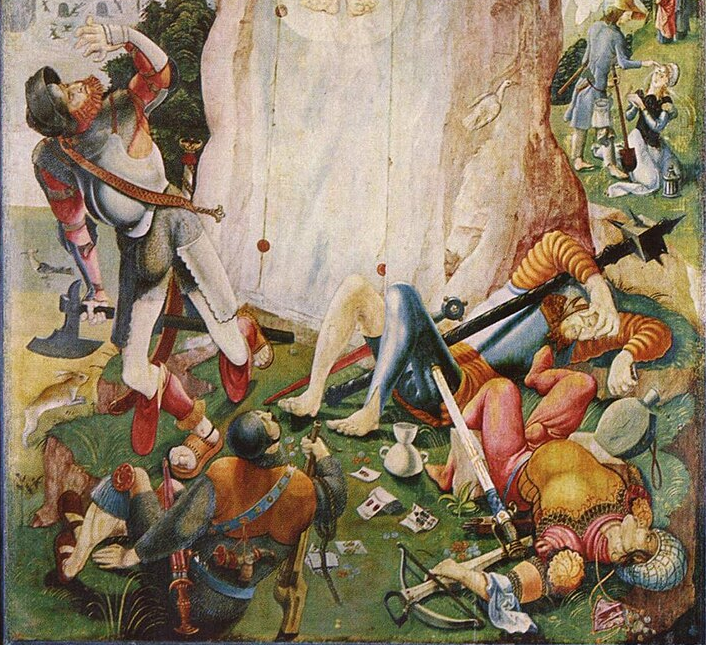
There have been attempts to make card games that might exist in a D&D world, like Three-Dragon Ante and Prophet's Gambit, but none of them have really hit the mark for me. They're clearly based off of modern principles of game design - too streamlined and too complicated at the same time, with mechanics more in keeping with Magic: the Gathering than a traditional card game. In a preindustrial society, card games shouldn't be so refined; they would usually have rules that can fit in a simple document (so rarely will single cards drastically change the rules of the game in a unique way), making them easy to transmit orally, and with enough inconsistency to make it clear that they were created by ordinary people as a diversion, not by professional game designers doing this sort of thing for a living. Karnoffel scratches that itch, and has the added benefit of being relatively simple to play - plus, you don't need any special equipment; just a standard playing card deck.
As an added bonus, Karnoffel has a long history of association with the Landsknechts, the model for the Swordbrothers of the Lunar Lands. Which means that it fits right into our ongoing tour of the Freikantons.
How to Play
You'll need a standard 52-card playing card deck, with the aces and jokers removed. For flavor purposes, cards in the Lunar Lands use the suits of the minor arcana (swords, staves, cups, and coins), but any deck will work.
Karnoffel is what's known as a trick-taking card game - that is, players take turns playing cards over a number of rounds, or tricks, with a winner for each trick. At the start of a game, a dealer deals five cards to each player, one of which is face up. Of the face-up cards, the suit of the one with the lowest number becomes the trump suit for that game; in the case of a tie, the card that was dealt first determines the trump suit. Certain cards of the trump suit have higher value than cards of other suits - see below.
Each player plays one card from their hand per trick, starting with the player to the left of the dealer and continuing clockwise. The value of the cards is as follows, in descending order:
Jack of Trump Suit: The Karnoffel.
7 of Trump Suit: The Devil. This one has some unique rules. It must be the first card played in the trick, and may not be played on the first trick of a game. In all other circumstances, it automatically loses the trick.
6 of Trump Suit: The Matriarch (in real-life Karnoffel, the Pope).
2 of Trump Suit: The Emperor.
King of Any Suit
3 of Trump Suit: The Oberstecher.
Queen of Any Suit
4 of Trump Suit: The Unterstecher or Duke.
Jack of Any Non-Trump Suit
5 of Trump Suit: The Knight.
10 of Any Suit
9 of Any Suit
8 of Any Suit
7 of Any Non-Trump Suit
6 of Any Non-Trump Suit
5 of Any Non-Trump Suit
4 of Any Non-Trump Suit
3 of Any Non-Trump Suit
2 of Any Non-Trump Suit
7 of Trump Suit when not played as the first card of the trick or when played on the first trick of a game.
From personal experience, I recommend having the list of card values on hand when playing Karnoffel, as players may struggle to keep track of them if unfamiliar with the game.
Once all players have played a card, the trick ends, and the player who played the highest-valued card wins the trick. The next trick begins with the player who won the last trick and continues clockwise. The first player (or team; see below) to win three tricks wins the game. Whoever was to the dealer's left becomes the dealer for the next game.
Note that Karnoffel was traditionally played with either two players, or with two teams of players. If teams are used, players on the same team are allowed to look at each others' cards and consult with one another on their moves. Theoretically, it could be played with more than two players or teams, but this might lead to running out of cards before a trick is won, so the number of cards in each players' hand might need to be adjusted accordingly.
An Example of Play
Two Swordbrothers - Marius and Hilmar - are playing a game of Karnoffel back at their camp. Marius is the dealer, and deals Hilmar the following cards:
6 of Cups (face-up), Jack of Cups, 4 of Coins, 8 of Cups, Jack of Swords
Whereas he deals himself the following cards:
8 of Swords (face-up), 5 of Cups, 9 of Coins, 4 of Swords, 7 of Coins
The numbers of the face-up cards are a 6 and an 8. Since 6 is lower, the trump suit for this game is Cups. Hilmar, feeling quite smug but wanting to hold onto his Karnoffel just in case, plays the 6 of Cups - the Matriarch. Marius knows none of his cards can beat it, and decides to play his 4 of Swords to get rid of it. Hilmar wins the trick.
For the next trick, Hilmar plays the Jack of Cups - the Karnoffel. No card in the deck can possibly beat it. Marius restrains the urge to gut Hilmar with his katzbalger and instead considers what card he wants to get rid of. His lowest-numbered card is the 5 of Cups, but that is the Knight, and still a trump card, so he decides to hang onto it just in case. Instead, he decides to relinquish his lowest-valued non-trump card, the 7 of Coins.
At the start of the third trick, Hilmar is in the lead by two, but is out of trump cards. He gets cocky and plays the 8 of Cups - but even though it's the trump suit, an 8 of the trump suit doesn't trump an 8 of any other suit. Marius decides to play his Knight here, and wins the trick. Even though the number is lower, the fact that it's a trump suit means it takes precedent.
For the fourth trick, each player has two cards left. Since Marius won the last trick, he goes first and plays the 9 of Coins. Hilmar, realizing that he needs to take things more seriously, plays the Jack of Swords. Even though it isn't of the trump suit, a Jack still beats a 9, so it wins. Hilmar wins the third trick, and the game.
Each player then returns their cards to the Marius, who shuffles them back into the deck and passes it to Hilmar. Now Hilmar is the dealer, as he was sitting to Marius's left, and he deals five cards to Marius and to himself.
Why "Karnoffel?"
As for why the game is called that? Well, the term "Karnoffel," in medieval German, meant either to beat someone, or an inguinal hernia. Both of these are weird things to name a card game, but apparently, the term was also used as a slang term for a Landsknecht. No clue as to which meaning was intended for the game.


