Showing posts with label video games. Show all posts

Monday, January 6, 2025

The Saga of the Ortegids

Know, O prince, that between the years of the fall of the Sons of Aliahan, and the years when the moonless sky drank the Great Pit of Giaga, there was an Age undreamed of, where shining kingdoms lay spread across the worlds above and below like blue mantles beneath the stars - Romalia, Samanao, Ashalam and Baharata, Zipangu with its dark-haired women and towers of dragon-haunted mystery, Edina with its chivalry, Isis that bordered on the rich lands of Portoga, Rhone with its shadow-guarded tombs, Moonbrooke whose riders wore steel and silk and gold. But the proudest kingdom of the world was Alefgard, reigning supreme in the dreaming heartland. Hither came Erdrick, the Aliahanian - black-haired, sullen-eyed, sword in hand, a thief, a reaver, a slayer, with gigantic melancholies and gigantic mirth, to tread the jeweled thrones of Torland under his sandalled feet.

- The Midenhall Chronicles

This is basically my vision,
summarized in one image.
I don't think I need to introduce that I'm a fan of the Dragon Quest games. I've posted about them many a time, and I maintain to this day that were it not for me playing the third game on the Game Boy Advance as a kid, I would never have become the DM I am now. Not only was that game my first real introduction to an interactive, open-ended game world with player-driven exploration, the excellent Prima strategy guide was a major source of inspiration for my campaigns and homebrew creations. I borrowed a lot of quests, dungeons, items, and locations from that game in my early days.

Now, I would like to explore taking things a step further - creating a full-fledged campaign setting out of the world of Dragon Quest.

I'm not the first person to suggest such a thing. On the subreddit for the series, I've seen a number of players ask for advice on how to take the Dragon Quest games and adapt them to the tabletop. Usually, the advice I see focuses on making D&D play more like a console JRPG, or using a system specifically designed to mimic one.

I get where this line of thinking comes from. In Japan, Dragon Quest is a much bigger phenomenon than it is here, and defined the popular perception of the fantasy genre in the way The Lord of the Rings did in the west. As such, a lot of Japanese fantasy pastiches heavily ape the games, not only in aesthetics but also in its tropes and mechanics. I'd like to do a post on this phenomenon somewhere down the line, but you'll notice, for example, that in a lot of modern fantasy anime like Konosuba, you'll see such things as "heroes" and "monsters" being defined and recognized metaphysical classes of beings ontologically different than regular people or animals, and sometimes even people having recognized "levels." That can all be traced to Dragon Quest - for much of Japan, part of the fantasy genre, at least a very popular subgenre thereof, is things acting like they're in a video game.

I, instead, would like to go in the opposite direction.

Lately, I've been constructing a setting I'm calling The Saga of the Ortegids around this conceit - what happens to the setting of Dragon Quest when anything "video gamey" about it is treated as indeed a construct of game mechanics, rather than a diegetic in-universe truth? Take the maps, the characters, the plots, but strip back the video game artifacts to bring the setting back in line with its roots in classical Western fantasy and TRPGs.

There's more precedent here than you might think. Let's take a trip back in time. Today, in the west, the series is known primarily for its designs courtesy of the famed manga artist Akira Toriyama, better known as the creator of Dragon Ball. In fact, it's so associated with Toriyama that most people don't even know about its other two co-creators, Yuji Horii and Koichi Sugiyama (and if they know the latter, it's mostly as "that guy who said some homophobic things"), despite the fact that in Japan, all three were established as big names by the time the first game came out. Since the original Dragon Quest came out shortly after Dragon Ball started its run, Toriyama was already a household name, and his involvement was a major boost for sales, coupled with advertisements in Shonen Jump, the magazine that Dragon Ball ran in.

However, when the first game was released in the West in 1989 as Dragon Warrior (due to trademark issues with TSR), no one knew who Toriyama was. The game's main selling point in Japan was useless. Instead, the marketing heavily stressed the game's inspiration in tabletop RPGs and classical fantasy, with art inspired by the likes of Larry Elmore. I've seen some people blame the series never catching on stateside on this, but that overlooks the historical context involved. And I do think that the western art is beautiful and evocative in its own right. Consider that these games started coming out on the NES, with limited resources and often highly abstracted 8-bit graphics. For many, art like this was required for players to visualize what was going on. I don't doubt that what American gamers had in their heads back in the late 80s looked much more like Elmore than Toriyama.

My intent, with The Saga of the Ortegids, is to reverse-engineer the world that western players imagined all those years ago in the original Dragon Quest games, and to explore it as a setting for tabletop campaigns. If we prod a bit at the implications underpinning it, it's actually quite a compelling setting, with strong undertones of Norse mythology mixed with Robert E. Howard's Hyborian Age and the occasional dash of gonzo pulp, as I'll be elaborating on over the next few posts.

I'd like to set myself some ground rules here:

  1. The primary focus here will be on the original three NES titles - the so-called Erdrick Trilogy. This is for a number of reasons. For one, they all take place in the same continuity, whereas the later games are mostly stand-alone affairs. The overarching narrative of the trilogy is also surprisingly akin to a Norse saga, which is something I want to play up. They also were all released for the NES under the Dragon Warrior name (IV was as well, but that one won't fit as nicely), while later titles were not released in the west until much later, and under Toriyama's original art. While I may reference elements from later in the series, they will be used sparingly, with a strong preference toward cosmic entities like gods or demons that could conceivably cross universes. I recognize this disqualifies Dragon Quest V, easily the most sword-and-sorcery-flavored entry in the series (I am of the opinion that 1982's Conan the Barbarian is a better DQ5 movie than the actual DQ5 movie, Your Story), but that's a sacrifice I'm willing to make.
  2. The conceit here is that the events of the games are mostly canon, but not necessarily in the way they are portrayed in games. As stated above, game mechanics will be treated as just that, game mechanics; it will be assumed that the way the story actually played out in-universe was more realistic. For instance, "monsters" are not a discrete class of beings as portrayed in later games, but instead refers to a variety of unrelated creatures that might be encountered, as is the case in D&D.
  3. Maybe not like a poorly-drawn
    Keanu Reeves, though.
    Similar to the above, in-game graphics are taken to be a representation, not a literal image of how the world looks. Western art, from manuals, box art, posters, and the like, will be treated as being closer to a literal depiction of the setting. Ergo, Erdrick existed, but he did not resemble Gohan (and probably looked quite a bit like John Buscema's Conan, as a matter of fact - there's more to this than the ramblings of a madman, as you'll see).
  4. The official English releases of the Dragon Quest series were handled by a different studio from Dragon Quest VIII onward. In my personal opinion, this marked a major decline in quality of the translations, as the studio decided to heavily play up the comedic aspects of the franchise over translating the Japanese script faithfully, adding in jokes in previously dramatic scenes, and renamed most characters and locations. I will be using the English terminology used in the NES and GBC releases wherever possible, both out of personal preference and because these were the versions western audiences would have had access to when the series was marketed using Elmore-style art. You may have noticed that my riff on Howard at the start of this article used a few of the newer names - this is because I feel like some of them work better as names for countries as opposed to cities, but I will still be using the original English names for capitals.
  5. On the same lines, there will be a strong preference for using material present in the original NES releases of the original trilogy over that added in later remakes. Only NES content will be treated as guaranteed canon; material from later releases may or may not be used as I see fit.
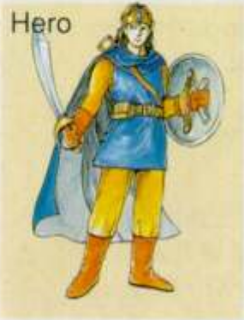
To close, a visual guide to the project. The world of The Saga of the Ortegids is a world where the heroes look like this:
And battle villains who look like this:

With items that look like this:

In places that look like this:
In scenes that look like this!

Join me in the Year of the Barbarian, as we explore an age undreamed of since 1992!

Saturday, March 9, 2024

20 Encounters from Dragon Quest III

Akira Toriyama, one of Japan's most prolific and influential manga artists, passed away last week. Even if you don't follow anime or manga, chances are you recognize his name. Toriyama is most famous as the creator of Dragon Ball, and it's hard to overstate the impact he and his work had on the landscape of popular culture. Not only was Dragon Ball a smash hit in Japan, revolutionizing action and martial arts manga, setting many of the tropes that characterize it today, and inspiring many of today's artists to get into the industry, it was also immensely popular around the world, and kicked off the surge in interest in Japanese popular culture among Westerners that continues to this day.

I've been a huge fan of Dragon Ball ever since I was watching it on Toonami as a kid, and I wasn't alone. All my classmates were pretending to throw Kamehamehas at each other on the playground, and everyone I know who watched the series in their childhood is still a fan of it to this day, myself included. Many people credit the series with inspiring a love of storytelling, and others cite it as what influenced them to take up martial arts. In one series alone, Toriyama left a legacy that will never be forgotten.

At least over here in the States, it's easy to forget that Dragon Ball wasn't the only thing Toriyama did. But his contributions to pop culture go even deeper than that. He was one of the co-creators of the Dragon Quest video game series, doing all the concept art for the franchise ever since its inception. And around the same time as I was tuning into Cartoon Network after school every day to keep up with the Cell Saga, I was also experiencing Toriyama's work through my Game Boy Advance port of Dragon Quest III, a game I've already spoken about here.

I have many fond memories of the game's expansive open world, and the amount of content it managed to pack into what was originally an NES cartridge still blows my mind. It's filled with interesting and unique locations and sidequests, with no two areas being quite alike, and every major corner of the map offering something to explore. I don't think it's any coincidence that I began to explore running tabletop RPGs as a DM around the same time, and in my early days I lifted a lot of locations, quests, and encounters from DQ3. Sometimes I still do. With fans around the globe gathering to remember Toriyama, it's worth turning to this part of his legacy.

Here are twenty things from Dragon Quest III that have stuck with me through the years, and that have found their way into my games. You could use it as a random encounter table if you wanted to, though it'd probably lead to some strange results. You could roll on it ahead of time for an idea you could try to work into your next session. Or you could look over the list and think about the possibilities it could offer for your games - just as I did with the strategy guide many years ago.

1. A talking horse who knows the location of a powerful artifact.

2. A halfling hermit who guards a pass through the mountains and will only grant entrance on order of his liege.

3. A king willing to trade a ship for a bag of black pepper from a far-off land (as the kind of weird kid who read history books for fun, this was a bit of Vikings in Clown Trousers I appreciated even then). 

4. A tower on an island accessible only through a series of underwater caves.

5. A town under a sleeping spell cast by an elven queen after her daughter stole a priceless treasure to run off with her human lover.

6. A cursed suit of armor made from the hide of a demon.

7. A vase that can suck in enough water to drain a passage hidden beneath the sea.

8. A magic spring inhabited by a spirit who will exchange items dropped into it for better ones - so long as one doesn't get greedy with it.

9. A pit where treasure is set on ledges only accessible by climbing to tightropes strung high above and taking a leap of faith.

10. A dragon disguised as the queen of a town, deceiving the villagers into sacrificing their women in exchange for "protection." She talks in her sleep, revealing her true nature.

11. Carved stone heads that guard a treasure by speaking to those who pass, trying to tempt them into giving into cowardice and turning away.

12. The ghost of a woman who drowned herself after her husband was lost at sea, now haunting a narrow cape and refusing to let any ships pass through until her spirit is placated.

13. A gaping pit leading to a continent on the inside of the hollow earth.

14. A market selling magical herbs that can bestow the power of invisbility.

15. A dungeon warded by a curse that prevents those inside from using magic.

16. A king who, upon being helped with his problems, will abdicate the throne at the first opportunity and pass his title off to those who helped him so he can go off gambling.

17. A flute that causes treasure to vibrate in response to its music.

18. A volcano that must have an artifact dropped into it so that its lava can form a bridge.

19. A town renowned for its blacksmith, who has brought the secret of working orichalum from a far-off land.

20. A dragon in a castle high above the clouds, who can grant a wish to any who defeat him in combat (nice try, Toriyama).

Monday, November 6, 2023

Playing With Power

In my earliest days as a DM, the sourcebook I got the most out of wasn't published by Wizards of the Coast. Or even by TSR. It wasn't made for the current edition of D&D at the time, or any edition for that matter. Nor was it made for any TRPG at all.

The sourcebook I got the most out of as a DM was the Prima strategy guide for Dragon Quest III.

I had the game - technically, it was Dragon Warrior III; the trademark for "Dragon Quest" in the West was taken at the time (by a TRPG, funnily enough) - on my Game Boy Advance back then. I was probably 10, at the oldest. I never finished the game, but when I look back, I'm still honestly amazed at the technical achievement that it took to create it.

With Dragon Quest being a considerably more obscure series here than it is in Japan (where so many people skipped work to wait in line for new releases that the government had to issue a law that new entries in the series had to be released on weekends - yes, really!), I'm not sure how many of my readers have played it or even heard of it. I've seen some people online call III the foundational JRPG that defined the subgenre, but really, it plays much closer to a western RPG, with a party of fully customizable characters, a plot mostly consisting of "your father was killed by an evil wizard, go get revenge" and a vast open world full of unique locations, dungeons, and sidequests that can be explored in any order the player wishes (though some areas require quests to open up). It's basically a top-down Elder Scrolls game with turn-based combat, and yet its world is more detailed and full of things to do than any Bethesda title in recent memory. And my GBA copy was a port. All of this fit on an NES cartridge.

There's a lot I could say about Dragon Quest III. It'll probably get its own post at some point. But this post is not about Dragon Quest III. This post is about the Dragon Quest III strategy guide.

Remember how I said I never beat the game as a kid? Well, this was around the time that video game strategy guides were big, and every book store carried racks upon racks of them. Hoping to figure out how to progress, I picked up the Prima guide from the same Borders my parents got me the D&D 3E starter set from. Maybe that was a stroke of fate, because I used that book for TRPGs much more than I did for a computer RPG.

The strategy guide for DQ3 is one I have fond memories of. It has a full walkthrough of every town, dungeon, and quest in the game, with detailed maps, and I ran my players through plenty of those dungeons and even lifted a few NPCs and quests that stuck with me. It has a list of every single item in the game, from your basic consumables to legendary artifacts and quest items - each of them illustrated! - which gave me plenty of fodder for some of my first homebrew magic items. It has every encounterable monster statted out, summarizing the attacks and strategies of each, and I copied the radar chart format they used to represent the stats of each enemy for many of the crude RPG bestiaries - yes, plural - I made with pens and notebook paper in my youth.

Anyway, as I discovered when looking for images, it turns out the whole thing is on the Internet Archive. Take a look if you want some game material.


If you're looking for inspirational material for TRPG campaigns, I highly recommend getting your hands on video game strategy guides. Even if you have no interest in playing the actual games. I don't know if they're still making them now that GameFAQs took over the internet, but if you can find some at a reasonable price, definitely pick them up. You'll find plenty of dungeon maps you can adapt to your campaigns, and plenty of quests laid out with in-depth information on what paths you can take and where they lead, which are ripe to be adapted into a tabletop adventure. Even if you just want to flip through and look at the concept art they used for filler illustrations - something I'm not ashamed to admit I did plenty of times - you just might find something to inspire you.

Dave Hargrave, creator of the Arduin Grimoire, was a firm believer that his work would benefit DMs even if they didn't use the same system he did, because "the numbers don't matter; only the ideas." Even before I knew anything about Arduin or heard that quote, I agreed wholeheartedly with the sentiment. I've used plenty of books for RPG systems I wasn't running just because I liked the ideas they had. And some of those RPGs weren't even made for the tabletop.