Showing posts with label Nuwapians. Show all posts

Monday, September 23, 2024

The Metal Men of Golnir

Art by DoctorChevlong
There are many artifacts of the old, bygone Fedreline Empire that speak to the mark they had on the world in their day. Fragments of mosaics in crumbling floors, black-figure vases with elaborate scenes, and the corroded bronze helmets of their soldiers, to name a few. Some artifacts are of value beyond being mere historical curiosities - the Fedrelines, it is known, were workers of magic, and many enchanted treasures still sit beneath the earth today, waiting to be discovered, preserved through the ages by the spells woven into their craft.

But other discoveries are harder to explain. Largely in Golnir, but occasionally in surrounding areas, there have been found peculiar constructs dating to the Fedreline era - figures of men, forged of bronze, iron, and orichalcum, bearing arms and armor. Though they may appear to be suits of armor, the pieces are almost always found riveted to articulated frames with gears and joints, and all of them possess a hollow chest, in which is stored a clay jar or a box of some kind, inlaid with runic inscriptions.

These metal men, as they are called, have not been explained, despite many inquiries by the sages of all the lands. In their construction, they most resemble, if anything, the automatons of the learned Quel'Ahman engineers, but no mechanisms have been found to power them, nor have been recovered any manuals or blueprints that would describe their function. Furthermore, the automatons of the modern era spray water and play music for the amusement of noble guests, but all of the metal men that have been found are equipped as warriors. Some have proposed they may have performed mock battle scenes, but if that was the case, this must surely have been a popular pastime, due to the sheer number of such creations that have been found.

The most curious part of the metal men is surely the vessels contained in their chests. In light of the Fedreline conflicts with the Nuwapians, with their knowledge of necromancy, a connection to the lich's phylactery is inevitable. So too, a number of metal men have been discovered in Quel'Ahma, often amidst the ruins of Nuwapian cities, many of them bearing the scars of battle. Some have posited, then, that to combat the lich-lords, the Fedrelines may have pursued similar arts, using bound souls to animate suits of armor as a new kind of soldier - one that would never tire, nor have to eat or drink, and would not be affected by disease or the desert heat.

If such magics gave life to the metal men, the rituals involved in their creation have long since been lost. No one has seen one of these beings move, let alone fight. At least, no scholars have documented such a thing - but rumors will always abound, and there have been occasional sightings of silent figures dressed in archaic armor lurking around the ruins. Some, it is said, have even slain those who came too close.

Sunday, May 26, 2024

The Sea of Uam

By strict definition, the Sea of Uam, in northern Al-Riyah, is not really a sea at all, but a large freshwater lake. Nevertheless, for many in the dry Quel'Ahman lands, it may as well be a sea. It stands as an oasis at the edge of the great deserts, and its fertile shores have been well settled, producing bountiful crop yields that sustain Quel'Ahma's people.

Fed by the Shamat River and by a system of underground springs, the Sea of Uam supplies a ring of marshy wetlands, which have been largely settled and given over to agriculture on its south shores. The waters are a hub of activity, with ferries going back and forth across the water to transfer supplies from one village to another, and the lake is well-known for its great bounties of fish, with many inhabitants of the region relying on fishing to sustain themselves.

Despite boasting a relatively large population for a place this far inland in Quel'Ahma, however, the Sea of Uam has no great cities; its people are spread out along a number of small villages along the shore that get by on fishing and farming, largely regarded as country bumpkins by the wealthier elite of the coast. In days long past, the Sea was much more important as a center of commerce, but with trade on the Great South Sea eclipsing the more limited routes through the desert, it began to decline, and many of the region's former cities now sit abandoned, their crumbling walls harvested to build new homes.

The largest settlements on the Sea are both found to its south. On the west shore is the town of Katsir (hex 012.021), which boasts a major market drawing in farmers who travel from miles away to sell their produce every week. As one of the Sea's major population centers, it is managed by an office of Genasi nobles who collect taxes and oversee trade for the Emir - which causes some friction with the largely human populace who are unused to such direct oversight. A nearby cave opens into a large subterranean spring - and a few shepherds who have sheltered their flocks there report seeing winding tunnels, dug by massive crabs and scorpions.

On the east shore is Salamah (hex 014.021), a town that grew around a trading post that stood as a center of exchange between the settlers on the lake and the Caravan People of the desert beyond. To this day, it has many inns and bathhouses, some of them centuries old, and the visiting caravans bring an influx of trade goods from across Quel'Ahma. One caravan has drawn plenty of attention, for one of its merchants, Aberkan Nersesian, has displayed a large carved scarab of blue stone, found in a Nuwapian ruin far to the east. He claims that it has given him great fortune and healed his family's illness, but he refuses to part with it - some have whispered he has even stabbed those who got too close to it, which seems uncharacteristic of the normally patient man...

To the north, the village of Al-Negba (hex 012.014) marks the end of a system of trade routes linking the Sea to the coastal cities, and thus sees its fair share of visitors. Despite this, the village has a reputation as a swampy backwater, and most travelers only seek its service for a ferry to the wealthier settlements on the south shore. Currently, the village is home to an Amidi mystic named Hayim al-Din, who is renowned for his ability to heal the sick and repel evil. He is, however, getting tired of all the attention this brings him, finding it disrupts his meditation, and he intends to leave soon - but how will the people who have become dependent on him to solve their problems cope?

The village of Rumanah (hex 011.017) sits in a fertile valley, but is largely isolated from the outside world, scarcely receiving any trade. It is built amidst the ruins of an older, and much larger, abandoned city, but its inhabitants are reluctant to explore the ruins further - they have everything they need where they are, and local lore tells of the lingering spirits and ancient curses that cling to the ancient graves. The ruins have not been fully charted, and perhaps there may be something of value there yet...

The village of Ahkbera (hex 012.020) isn't far from Katsir, but the people there have little interest in dealing with the town - they are suspicious of the Genasi and have little interest in being ruled by wealthy dilettantes who don't understand their hardships and ways of life. However, this has proven an issue when the village has of late seen a number of mysterious disappearances, with villagers going missing and their mangled bodies turning up days later bearing strange teeth marks. The elders blame these attacks on a ghul - a man-eating spirit that can take the form of whatever it eats. But can they deal with such a problem when they refuse to go to Katsir for help? And what if the ghul is closer than they think?

The village of Ibtan (hex 015.019) is one of the Sea's wealthier farming communties, owing to its location along the river. It is a center of trade, with many farmers from steadings in the area traveling here to sell their wares - and, as a result, a hotbed of rumor, where news from many nearby settlements can be heard and passed on, often growing in the telling. It is an open secret that many deals on the black market happen here too, with farmers and Caravaneers covertly smuggling goods without having to pay the taxes they might be subject to in larger markets - or that might attract inspection from those who might disapprove of what is sold.

Other points of interest that might be found on the shores of the Sea of Uam include the ruined city of Al-Abeytas (hex 010.016). The city has had a long history, first being built by the Nuwapians, briefly conquered by their Fedreline rivals, and later settled by Quel'Ahmans, before declining into ruin over the ages. As a result, the site consists of many ruins layered on top of one another, with older sites buried in the swamp. The Royal Archaeological Society has sent expeditions here to catalogue and examine artifacts - and many of these expeditions, for one reason or another, have been stricken by misfortune.

Also in the swamp is a long-abandoned and overgrown maqam found at hex 016.015. The old shrine has served as a landmark for travelers, but few are aware of its true significance as the burial place of the Amidi master Abdullah en-Nur. If a faithful devotee of the Covered Path spends the night here in meditation, his ghost may pay a vist and impart knowledge.

Thursday, May 23, 2024

The Abbiyad Mountains

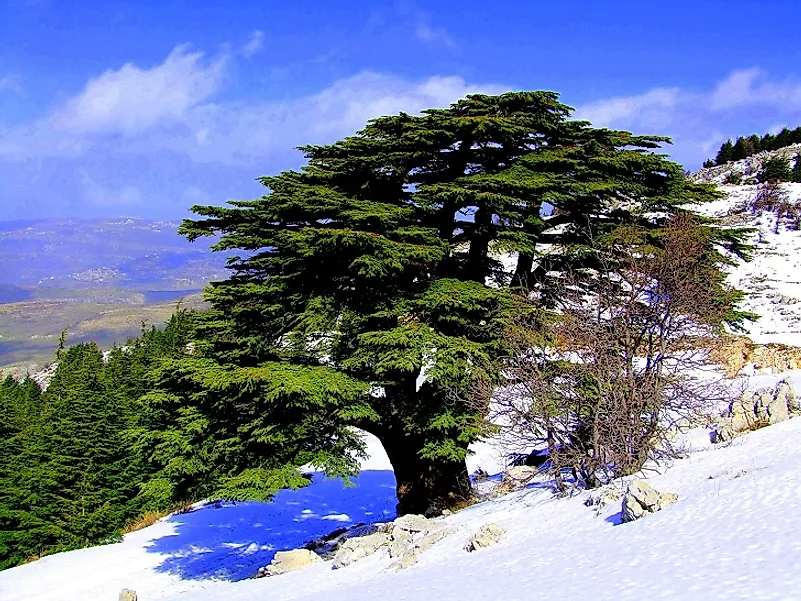
Though Quel'Ahma is known as a desert land, its terrain is more varied than many travelers would expect, particularly in the relatively fertile Al-Riyah. The Emirate of the Winds is home to the Abbiyad Mountains - the name of this great range is derived from a Quel'Ahman word for "white," for they are so tall that on their upper slopes they are covered in snow year-round. Shielded from the hotter climate of the lowlands, these mountains are home to a robust forest of cedar trees, and the sight of the Abbiyad Mountains breaking over the horizon has brought relief for many travelers lost in the desert - not only for being an easily recognizable landmark for navigation, but also because they hold the promise of cooler and more hospitable lands within sight.
The Abbiyad region is known for its cedars, and many of the communities that hug the slopes of the mountains rely on the export of timber - in Quel'Ahma, where trees are scarce, the Abbiyads have provided essential materials for Al-Riyah's robust fleet of merchant vessels, which both rely on the wood for construction and export it to other parts of the realm. Though the mountains are a rugged hill country, with little in the way of major cities, a number of villages have grown up around them.
Perhaps the largest of these is Misri (hex 013.034), located on the trade route that goes north to the great city of Hajar, a major stopping point for caravans. Although the people there largely live an independent life and have little want for the attention of outsiders, they nevertheless see much traffic from merchants, traders, and nomads, and they have found their own ways to take advantage of this. The village is built along a number of multi-leveled terraces in the hills, with the main road winding through a narrow valley, and the people there hold a great market along this street, with vividly colored banners flapping in the breeze as merchants hawk all sorts of goods from their stalls. During business hours, the amount of traffic can slow passage through the mountains - which is just as the people like it, since it means merchants have no choice but to stop and peruse the town's wares. Many merchants spin elaborate tales about what they have for sale in order to make it seem more exotic and appealing, and to fetch a higher price than what it is by all means worth. They have no regrets for their dishonesty - after all, it doesn't affect them if they con some gullible outsider who won't come that way again out of a few coins.

Further off the beaten path is Ain-Kinan (hex 013.036). A more rustic community of foresters, it - like any village in Al-Riyah - has its own maqam; that is, a small domed shrine, built on a high place and often associated with a long-dead master of the Covered Path, sometimes (but not always) marking the site of their burial. In rural Al-Riyah, many people, though ostensibly Elementalists, care little for the grand pagentry of official cults and temples and devote their prayers to saints and spirits; in fact, not all masters honored by maqams can be historically verified, and some may be vestiges of cults to forgotten gods. Ain-Kinan's patron saint is Aziz S'himi bin Amnon al-Qadir, said to have been a Genasi official who renounced his life of luxury to pursue the Covered Path. It is said that those who leave food inside the shrine overnight will find it miraculously multiplied the next day.

Finally, in the southern foothills of the Abbiyads is the village of Al-Mazrah, which stands at the foot of the Lahksa River. Its people largely subsist as farmers from the flooding of the river, though they do harvest some lumber as well. Located not far from the village is a strange inscription cut into the stone of the mountainside, in what appears to be Nuwapian script. Those who can decode it will find it promising to honor one who has proven themselves stronger than the king of all beasts of the land and air - a DC 15 History check will reveal this must be referring to a gryphon, many of which dwell on the slopes of the mountains. If one anoits the wall with the blood of a gryphon, it will open into a hidden chamber containing 4,500 GP in gold and jewels and a scroll of etherealness.

Despite the scarcity of trees in Quel'Ahma, much of the cedar forests of the Abbiyads remain untapped. This is for good reason - the deepest reaches of the forest are known as a land of monsters, and few have emerged from them alive. Perhaps the most infamous of them all is the gorgon Kombaba, a monstrous ogress with iron claws for hands and snakes for hair, whose flesh is like steel and whose gaze can petrify (stats of a medusa, but with 159 HP and Large size, with Resistance to slashing, piercing, and bludgeoning attacks from nonmagical sources); she dwells in a cave located at hex 014.037, but has been sighted roaming the mountains by those lucky enough to escape to tell the tale.

Other dwellers of the deep woods may be more helpful. At hex 015.034 is the tower of Khadul al-Ghazzawi, a noted scholar and astronomer who has made his home in the mountains to better study the motions of the stars, and chart the course of fate. He is a bitter recluse and will not tolerate those who waste his time, but he may be able to impart advice on what the future may bear. At hex 015.036, meanwhile, is a shrine where the Amidi mystic Jamilah ibnat Karim dwells atop a snowy mountain peak, living her life in meditation. She is a wise old woman who can guide those who seek her to the path of perfection, but her mountain may only be found by those who actively search for it, and to ascend it is a challenge in and of itself, fraught with dangerous conditions and powerful guardians. Jamilah will only instruct one who shows enough dedication to the cause to brave the threats its pursuit entails.

Lastly, beyond the mountains, in the desert, is a ruined Nuwapian tomb (hex 016.038), in which is buried an ancient priest, Pahemnetjer, who pursued the path of lichdom. Though this lich still remains dormant in his coffin, buried far below the earth, his undead servants still stand guard against would-be tomb robbers, and so do many traps and enchantments placed to safeguard the priest's phylactery. A band of Caravan People are camped in the ruins above ground; they know of the dangers within and will provide rumors and trade with those who wish to brave its depths, but will not think of setting foot inside themselves.

Wednesday, May 15, 2024

The Ruins of the Nuwapians

The genies were not the first civilization to rule over the deserts of Quel'Ahma. Long before the rise of Vardessy, before the Way of the Four Elements held sway, Quel'Ahma was ruled by a great empire of a bygone age, one remembered only by the eldest of the genies of Tasshen. This was the age of the Nuwapian Empire - one of the greatest of its day, and one that saw rise to great advances in the mystic arts - and one that lives on, in its own ways.

There is much that remains still unknown about the Nuwapians. There are many ruins and artifacts yet to be unearthed, and many inscriptions that have yet to be decoded. The Royal Archaeological Society of Quel'Ahma has made it its mission to retrieve as many Nuwapian artifacts as they can to better understand these mysterious people. What is known is that the Nuwapians came from a land far over the sea, settling Quel'Ahma, and there they established a great empire that stretched across the desert sands and as far as into Golnir, ruled by an emperor who was perceived by the people to be a living god, and they held power over the lands for more than three milennia.

The emperors of the Nuwapians were esteemed sorcerers, always seeking to further their power and rise above the common men they governed. It was through their magical aptitude that they cemented the legitimacy of their reigns, and earned fear and admiration from the lower classes. Through magic, the Nuwapians sought to surpass the limits of mortal men; to become stronger and more enlightened. Their ultimate goal was to conquer death itself - and of the ruins that remain among the deserts, there are many great mausoleums where the bones of ancient kings are buried amidst their wealth and the bodies of their retainers, in the hopes that they may one day rise from the dead and make use of such riches.

But perhaps the greatest achievement of the Nuwapians came when finally they managed to unlock the secrets of immortality.

By all recorded accounts, it was the Nuwapians who were the first to discover the secrets of lichdom - the process by which the mortal soul could be separated from the body while still keeping the life force that sustained consciousness, allowing one to live forever. At the height of the empire, the Nuwapians' greatest emperors and nobles were liches, who underwent this process to transcend the very boundaries of mortality, and to become as gods, whose reigns could go untested by time or the sword. With this power, the Nuwapians sought to extend their reach even further, and realize their destiny as the masters of reality.

Ultimately, though, this would not come to pass. Over time, the once-great empire dwindled to a collection of warring city-states and petty kingdoms, before those too vanished. The downfall of the Nuwapian Empire is steeped in as much mystery as its rise. Some say that the emperors, in their pursuit of eternal life, overstretched themselves and lost sight of more earthly concerns, allowing their empires to fall into ruin right under their noses. Some say it was the people who rose up against their masters, tired of being at the whims of such powerful beings. Some even say that the fall of the Nuwapian Empire was an act of Morthanos himself, who sought to punish mortals for their hubris in evading his reach. In the end, the great cities and temples of the Nuwapians fell silent, and were buried beneath the desert sands.

Still, the influence of the Nuwapians was not lost. Their discoveries became a part of the canon of magic and mysticism, and many of their spells and rituals have been passed down and perfected over the ages. So too, the spirits of many great sorcerers of the Nuwapians live on, still standing guard over the ruins of the palaces they ruled from in life. Many Nuwapian ruins mark the burial places of ancient liches, resting in their sarcophaguses until the day comes that the Quel'Ahmans fall and they may once again reclaim their birthright. The traps, guardians, and mystic wards these magicians prepared to safeguard their phylacteries still stand against intruders to this day. And if any of these bygone emperors are released from their slumber, they are not likely to react well to the strange new worlds they discover...