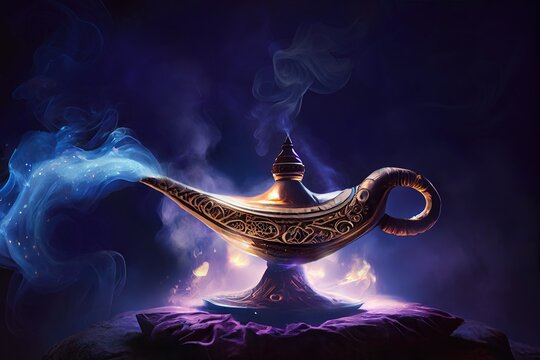
Social stratification in Quel'Ahma is set up according to a caste system that reflects how closely one can trace their lineage to the great genies - the more genie blood one has in their veins, the more power they hold in society.
Since time immemorial, the genies have held sway over the Quel'Ahman desert. These magical beings command great power, and they embody the four elements that shaped Quel'Ahma and all other lands, which caused them to come to be seen as emissaries of the cosmic forces and being in some way closer to perfection. But in ancient times, the genies grew content in the power and respect they were afforded - and they saw fit to exert it. They amassed vast harems of humans in an attempt to spread their noble lineage, or merely to slake their baser desires (for even if the genies were more perfect beings, they were just as vulnerable to mortal temptations). Their children were the genasi - those of mixed genie and mortal blood.
As time went on, the population of genasi increased more and more, and the genies began to fear that they were diluting their issue too thoroughly with mortal stock - that the genasi had tarnished the perfection of the genies by mixing it with the follies of mankind. To that end, the genies issued an edict that has been law in Quel'Ahma ever since - the formation of the three castes.
Humans make up the lowest caste of Quel'Ahman society, and are the most numerous in number. They are the common people - the laborers, farmers, soldiers, and slaves. Under the philosophy of Elementalism, it is believed that all earthly creatures, including humans, are composed of all four elements in equal parts - but for this reason, each individual element is impure, making it harder for that being to attain true perfection (humans are believed, under Elementalism, to still be capable of perfecting their beings, but it is harder for them to do so compared to genasi or genies. They are encouraged to strive toward being as perfect as they can be). As the genies care not to risk their magnificent immortal existences in the toils and trifles of everyday life, it is the humans who are tasked with all the dirty work they wish not to sully their hands with. One does not see an almighty djinn engaging in hard labor, after all.
This does not mean that humans in Quel'Ahma are doomed to a life of squalor and poverty. It is, in fact, quite possible for humans to attain wealth and influence, and some of the finest scholars and the most well-traveled merchants have been of human stock. But their lives are fleeting and their powers diminished compared to their masters, giving them less opportunity for advancement, and they are not often trusted with more important positions.
Sample NPC: Mahmoud ibn Yusha is a trader in Hajar, a nexus of several important caravan routes that pass through Al-Riyah. As the city is a cosmopolitan one, with many travelers from foreign ports passing through, he has made great business buying and selling goods from many lands, and he is keen to flaunt his wealth in treasures from foreign lands, trimming his turban with furs from the north and his robes in silks from the City-States, among other things. He is regarded as somewhat of an eccentric; some of his peers argue that he has grown too much like the Northerners he deals with, and has taken to a love of gambling and strong drink. However, he uses his connections well, and has befriended several merchants and their entourages, making him privy to all sorts of information that passes through the city and beyond.
The
Genasi - those who can trace their heritage back to mixed mortal and genie parentage - make up the middle caste of Quel'Ahman society. Though they were descended from the mingling of great and lesser beings, their population grew so great as to earn them recognition as a separate caste, and now it is expected that genasi marry and associate with other genasi to avoid diluting their genie blood any further with that of mere mortals. If mortals are composed of the four elements in equal parts, then the genasi have a greater percentage of one element compared to the others, granting them longer lives and greater attunement to magic - they are thus seen as being closer to the pure, unrefined form of their respective element, but not attaining the purity of a true genie. They can still grow old and die, and their powers are diminished compared to their forefathers, but humans still treat them with awe and respect - if not fear. Generally, genasi of a given type are more commonly found in the emirate corresponding to their element, but exceptions occur, be they well-traveled merchants or simply well-connected officials.
Genasi are the executive class of Quel'Ahma. They are clerks, government officials, and merchant-princes, often overseeing particular towns or businesses for the benefit of their genie masters. Often born into wealth and privilege, the average genasi can expect to not have to deal with the back-breaking manual labor of humans, but they cannot afford the idle luxuries of a true genie either - rather, it is they who must manage the humans on behalf of the genies, to ensure that everything proceeds under the auspices of order. Still, their long lives and relative freedom warrants them plenty of time to themselves, and many are philosophers and scholars, turning their attention to decoding the mysteries of the universe while their underlings take care of the hard labor.
Sample NPC: Zakariah al-Diklah bin Eli al-Su'ud is the administrator of the town of Mesenshah, and an envoy to the Emir who ensures that his word is carried out. He is a loyal servant to the Emir and respects his judgments, but is not without ambition - he has led an initiative to open up relations with the outside world, in particular sending more envoys to Wulin in the hopes of strengthening trade with the far-off land. However, he will not hesitate to back off if convinced that doing so is in the Emir's wishes. When dealing with others, he is strict and businesslike - he finds it unbecoming of a noble genasi like him to be tied up with mistakes and unprofessionalism.
The
Genies - djinn, efreet, marids, and dao - are the ruling class of Quel'Ahma. They are immortal beings of the elements, composed of their respective element in its purest and unmixed form, and are thus seen as models of elemental perfection that mortals must strive toward in all regards possible. As beings of great magic, they command power over even the wisest of genasi, and they have lived long enough to master untold knowledge. It is no surprise, then, that genies are treated with awe and reverence, in a matter some foreigners have compared to living gods.
Quel'Ahma is divided into four emirates, and the Emir who rules over each one is a genie with power over the corresponding element. Those these spirits keep the company of genasi courtiers and whatever human envoys are lucky enough to be granted access to their marvelous palaces, they socialize with their own kind, usually comprised of their extended families, which can grow quite large and house many generations beneath one roof. As can be expected, this puts aspirants for the throne (though genies are immortal, they often grow bored of ruling for too long and choose a successor before abdicating) in close contact with one another - and this can cause palaces to turn into hotbeds of intrigue as competing factions jostle with one another for their place in line. The homeland of the genies is the holy city of Tasshen - the dwelling place of the Sultan of all Quel'Ahma, and a flying city that soars above the clouds. No mortal has ever laid eyes upon it, and any who set foot in it would be summarily disintegrated.
Despite the importance of their positions, the genies of Quel'Ahma tend not to be active rulers. They are content to live in splendor and opulence, spending their immortal existences in the pursuit of decadence. After all, they have genasi to worry about the complicated business for them. This hands-off approach to ruling does, however, mean they can easily be swayed by ambitious viziers who tell them what they want to hear while furthering their own schemes, and there have been many times where the disgruntled populace rose up against their genie masters who spent their taxes on their own dalliances - though the power that the genies wield is an effective deterrant to unrest.
Ironically, as creatures of magic, genies may possess great power, but power can be worked on them as well. With the right spells and rituals, it is possible for a genie to be bound into a physical object, such as a lamp or ring, and forced to work its powers for the benefit of its captor - even if that captor is a mere mortal. Much like fairies or demons, they are creatures of their word, and if outwitted they have no choice but to serve those who gained power over them. Of course, binding a genie in such a way is a grave offense and a symbol of insubordination in Quel'Ahma, but it is one way in which mortals have fought back against their masters. If a genie is freed from such imprisonment, it is customary for them to reward their gracious rescuers with three wishes.
Sample NPC: Najii Rafiq Itamar al-Gefen ibn Mahir Amjad is the Emir of Al-Riyah. A powerful djinn known for his skill in magic and his ability to see into the future, he is well respected by his people, who view him as the embodiment of the wind itself. As such, no one dares offend him, lest he call storms against them and strand their ships. Despite such a fearsome reputation, though, the Emir is a jolly soul who spends much of his time drinking, feasting, and laughing in the company of his court. He's quite laid-back and takes little seriously; compared to other genies, he is unusually lenient with letting strangers into his court, and has been known to entertain noted guests with grand spectacles if they are present in the area, merely to enjoy their company. He leaves much of the heavy lifting to his courtiers and officials, allowing himself to enjoy such luxuries, but he is as mercurial as the wind, and it would be unwise to believe that he would not pose a threat if offended.
Note that foreigners - be they those from outside Quel'Ahma, Caravan People, or citizens of the independent cities not under the sway of the Sultan - are not considered to be part of any castes, not even that of humans. This allows them to enjoy more mobility and opportunity than may be limited to human Quel'Ahmans, but also means they cannot depend on the genasi or genies to protect them if they fall back to their authority.